New research could be key to stopping spread of killer diseases
March 4, 2013 in Medical research
(Medical Xpress)—New research from the University of Reading could be crucial in the fight to stop the spread of killer viruses such as HIV and avian flu.
Dr Ben Neuman has discovered a key step that some of the world's most dangerous viruses take when they attempt to leave cells in our bodies. Understanding how these viruses transfer from cell to cell is vital for scientists looking for ways in which to combat the spread of deadly diseases.
The spreading of viruses is a major global health concern. According to the World Health Organisation 1.8 million people died in 2010 from AIDS, which is caused by contracting the virus HIV, while recent outbreaks of SARS and avian flu have caused many deaths around the world.
Scientists know that different viruses all exit cells via the same route but did not know how they broke through the cell membrane, until now.
Dr Neuman, from the University of Reading's School of Biological Sciences, said: "Our research looked at SARS virus, which is closely related to the new coronavirus, haemorrhagic fever viruses and close relatives of avian flu and HIV. We know that these viruses use totally different-looking 'tools' (called matrix proteins) to unlock a cell 'door' but we made the exciting discovery that they all use the same method."
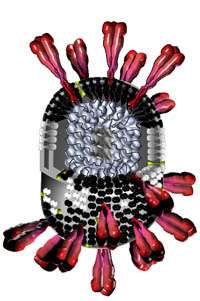
The researchers discovered that all of these viruses exit the cell by overloading one side of its membrane with their proteins. The matrix proteins all nestle into the membrane like little wedges, prying apart the molecules that make up the membrane and opening the cell 'door'.
Membranes are rich in phosphorous atoms, which stand out in pictures taken with an electron microscope. Comparing membranes with and without matrix proteins showed that a considerable amount of phosphorous was missing where it had been pushed aside by matrix proteins.
Dr Neuman added: "We don't know precisely what happens next but this is a big step toward understanding how particularly nasty viruses spread from one cell to another cell. Once you understand how something happens you have the potential to stop it."
Dr Neuman's paper, "Direct observation of membrane insertion by enveloped virus matrix proteins by phosphate displacement," was published in PLoS ONE on 1 March.
Journal reference:
PLoS ONE
Provided by
University of Reading
-
New drug could combat killer diseases
Sep 30, 2011 |
not rated yet |
0
-
Matrix protein key to fighting viruses
Apr 29, 2009 |
not rated yet |
0
-
Virus discovery helps scientists predict emerging diseases
Sep 22, 2011 |
not rated yet |
0
-
Seeing through HIV's disguises: Researchers identify 25 human proteins that may be crucial for HIV-1 infection
Feb 27, 2013 |
not rated yet |
0
-
How sneaky HIV escapes cells
Jun 05, 2007 |
not rated yet |
0
-
Motion perception revisited: High Phi effect challenges established motion perception assumptions
Apr 23, 2013 |
3 / 5 (2) |
2
-
Anything you can do I can do better: Neuromolecular foundations of the superiority illusion (Update)
Apr 02, 2013 |
4.5 / 5 (11) |
5
-
The visual system as economist: Neural resource allocation in visual adaptation
Mar 30, 2013 |
5 / 5 (2) |
9
-
Separate lives: Neuronal and organismal lifespans decoupled
Mar 27, 2013 |
4.9 / 5 (8) |
0
-
Sizing things up: The evolutionary neurobiology of scale invariance
Feb 28, 2013 |
4.8 / 5 (10) |
14
-
Pressure-volume curve: Elastic Recoil Pressure don't make sense
May 18, 2013
-
If you became brain-dead, would you want them to pull the plug?
May 17, 2013
-
MRI bill question
May 15, 2013
-
Ratio of Hydrogen of Oxygen in Dessicated Animal Protein
May 13, 2013
-
Alcohol and acetaminophen
May 13, 2013
-
Marie Curie's leukemia
May 13, 2013
- More from Physics Forums - Medical Sciences
More news stories
Now we know why old scizophrenia medicine works on antibiotics-resistant bacteria
In 2008 researchers from the University of Southern Denmark showed that the drug thioridazine, which has previously been used to treat schizophrenia, is also a powerful weapon against antibiotic-resistant bacteria such as ...
Medical research
May 17, 2013 |
3.7 / 5 (3) |
0
|
SUMO wrestling cells reveal new protective mechanism target for stroke
Scientists investigating the interaction of a group of proteins in the brain responsible for protecting nerve cells from damage have identified a new target that could increase cell survival.
Medical research
May 17, 2013 |
5 / 5 (1) |
0
How serotonin receptors can shape drug effects, from LSD to migraine medication
New findings by researchers carrying out experiments at the U.S. Department of Energy Office of Science's Advanced Photon Source (APS) help explain why some drugs that interact with two kinds of human serotonin ...
Medical research
May 17, 2013 |
4 / 5 (1) |
0
|
Preventing blood poisoning
Peptide molecules derived from the body's natural immune system can help boost the body's defence against life-threatening blood poisoning, joint University research has uncovered.
Medical research
May 17, 2013 |
4 / 5 (1) |
0
|
New mechanism to prevent type 2 diabetes in obese individuals
A new Montréal study conducted by Dr. May Faraj, associate research professor at the Université de Montréal and invited scientist at the IRCM, along with her research team and medical collaborators, shows ...
Medical research
May 17, 2013 |
not rated yet |
0
|
Consuming coffee linked to lower risk of detrimental liver disease, study finds
Regular consumption of coffee is associated with a reduced risk of primary sclerosing cholangitis (PSC), an autoimmune liver disease, Mayo Clinic research shows. The findings were being presented at the Digestive Disease ...
Ketamine shows significant therapeutic benefit in people with treatment-resistant depression
Patients with treatment-resistant major depression saw dramatic improvement in their illness after treatment with ketamine, an anesthetic, according to the largest ketamine clinical trial to-date led by researchers from the ...
Research examines new methods for managing digestive health
Research presented at Digestive Disease Week (DDW) explores new methods for managing digestive health through diet and lifestyle.
New smartphone application improves colonoscopy preparation
The use of a smartphone application significantly improves patients' preparation for a colonoscopy, according to new research presented today at Digestive Disease Week (DDW). The preparation process, which begins days in ...
New research identifies practice changes to improve value and quality of GI procedures
There are significant cost and risk factors associated with two procedures commonly used to diagnose or treat gastrointestinal problems, according to research presented at Digestive Disease Week (DDW).
New research identifies risks, interventions for children's GI health
An increasing number of U.S. children are experiencing gastrointestinal issues that require interventions to resolve, according to research presented at Digestive Disease Week (DDW).