Modest changes in military dining facilities promoted healthier eating
March 22, 2013 in Overweight and Obesity
The prevalence of obesity within the military is currently 13 percent. This rising epidemic, also rampant throughout the general population, could result in military career setbacks, negatively impact operational readiness, and jeopardize Department of Defense operations. To combat the epidemic, a team of researchers chose the military cafeteria as the venue to observe and evaluate eating behavior and the positive impact of modest changes to promote healthy eating and food selection. The results are captured in a new report published by the Journal of the Academy of Nutrition and Dietetics.
"Many studies have tested the effect of dietary, informational, and environmental interventions on the eating behaviors of customers in civilian worksite and university cafeterias," says lead investigator Major Aaron Crombie, PhD, RD, Military Nutrition Division, US Army Research Institute of Environmental Medicine, Natick, MA. "However, studies to date testing such interventions in military dining facilities (DFACs) have been very limited and inconclusive. Our study aimed to address that information gap." Nearly three-quarters of military personnel eat at least one meal a day in garrison dining facilities.

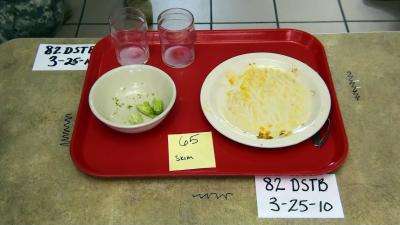
This is digital photography of a study participant's tray before consuming the test meal. Digital photography was used as a tool for visual estimation of diner intakes. Credit: Pennington Biomedical Research Center

This is a photo of a study participant's tray after consuming the test meal. Photo stills were compared to both before meal photos and photos of reference portions to determine nutritional intake. Credit: Pennington Biomedical Research Center
The study team from the US Army Research Institute of Environmental Medicine and the Pennington Biomedical Research Center staged an intervention within five dining facilities on Fort Bragg, NC, that included the following actions consistent with 2005 Dietary Guidelines for Americans:- Increased availability of fresh fruit
- Increased availability and variety of vegetables
- Increased availability of whole-grain foods
- Reduced availability of foods with high dietary fat and sugar
- Offering one main lean meat or vegetarian entrée at lunch and dinner with no added fat
- Placement of color-coded "Go for Green" nutritional information cards at the point of service
Five other dining facilities served as a control during the first half of this year-long study. Researchers collected data using a combination of survey questionnaires and digital photography of the diners' plates before and after meals were consumed.
Over time, investigators observed that minimal changes in food service practices and menus in DFACs produced significant improvement in soldiers' nutritional intake, including decreases in fat. Customer satisfaction increased on four criteria – flavor and taste, available choices, low-fat food availability, and appropriate portion sizes. More favorable results were observed the longer the intervention lasted, indicating that the positive changes are sustainable over time.
Says Major Crombie, "The results of this study give credence to the idea that DFAC food service interventions can promote a healthy lifestyle and, in turn, optimize the health profile of warfighters. Although intakes of fruit, vegetables, and whole grains continue to be problematic, reductions in energy and fat intake may prove effective over the long term in combating the obesity problem."
While the study was performed in army dining facilities, it has implications for the entire military family, since many meals are not taken in the DFAC, but at home. Further, the study team advocates that results can be easily applied to civilian settings.
More information: Journal of the Academy of Nutrition and Dietetics, DOI: 10.1016/j.jand.2013.01.005
Journal reference:
Journal of the Academy of Nutrition and Dietetics
Provided by
Elsevier
-
Eating out can hurt heart health, expert warns
Mar 01, 2013 |
not rated yet |
0
-
Whole grain consumption by teens and young adults falls short of guidelines
Feb 01, 2010 |
not rated yet |
0
-
Young adults need to make more time for healthy meals
Jan 06, 2009 |
not rated yet |
0
-
Parents' work influences how often family meals are eaten outside of home
May 06, 2011 |
not rated yet |
0
-
E-Learning programs may do little to change eating habits
Oct 26, 2011 |
not rated yet |
0
-
Motion perception revisited: High Phi effect challenges established motion perception assumptions
Apr 23, 2013 |
3 / 5 (2) |
2
-
Anything you can do I can do better: Neuromolecular foundations of the superiority illusion (Update)
Apr 02, 2013 |
4.5 / 5 (11) |
5
-
The visual system as economist: Neural resource allocation in visual adaptation
Mar 30, 2013 |
5 / 5 (2) |
9
-
Separate lives: Neuronal and organismal lifespans decoupled
Mar 27, 2013 |
4.9 / 5 (8) |
0
-
Sizing things up: The evolutionary neurobiology of scale invariance
Feb 28, 2013 |
4.8 / 5 (10) |
14
-
Change in momentum when a body is thrown up and falls back down.
3 hours ago
-
change in speed and wavelength of light while travelling from one med
3 hours ago
-
Calculus of Variation - Classical Mechanics
6 hours ago
-
Frictional Force Equation Doesn't Make Sense
6 hours ago
-
Calculating Steam Pressure in Closed Container
11 hours ago
-
Learning curve of Electromagnetism?
16 hours ago
- More from Physics Forums - Classical Physics
More news stories
Young children appear to reject story characters who are obese
(Medical Xpress)—Research by the University of Leeds has shown that very young children appear to reject story book characters who are overweight, but not those who are disabled.
Overweight and Obesity
May 16, 2013 |
3 / 5 (1) |
2
Gene variations may explain weight gain among men, women
(HealthDay)—Weight gain in men and women is predicted by two different genetic variations—so-called polymorphisms, according to a new study from the Netherlands.
Overweight and Obesity
May 15, 2013 |
5 / 5 (1) |
0
|
ECO: Distilled water doesn't up resting energy expenditure
(HealthDay)—Drinking 500 ml of purified water is not associated with increases in resting energy expenditure (REE), according to a study presented at the annual meeting of the European Congress on Obesity, ...
Overweight and Obesity
May 14, 2013 |
2 / 5 (2) |
1
ECO: Industry-funded reviews query sweet drink, obesity tie
(HealthDay)—Reviews that are funded by industry tend to find the evidence weak for a causal link between sugar-sweetened beverages (SSBs) and the increasing prevalence of obesity, while other reviews consider ...
Overweight and Obesity
May 14, 2013 |
not rated yet |
0
The smart phone app that helps weight loss
Researchers at the University of Liverpool have developed a smart phone app that helps users lose weight by carefully recording their food consumption.
Overweight and Obesity
May 13, 2013 |
5 / 5 (1) |
0
Consuming coffee linked to lower risk of detrimental liver disease, study finds
Regular consumption of coffee is associated with a reduced risk of primary sclerosing cholangitis (PSC), an autoimmune liver disease, Mayo Clinic research shows. The findings were being presented at the Digestive Disease ...
Ketamine shows significant therapeutic benefit in people with treatment-resistant depression
Patients with treatment-resistant major depression saw dramatic improvement in their illness after treatment with ketamine, an anesthetic, according to the largest ketamine clinical trial to-date led by researchers from the ...
Research examines new methods for managing digestive health
Research presented at Digestive Disease Week (DDW) explores new methods for managing digestive health through diet and lifestyle.
New smartphone application improves colonoscopy preparation
The use of a smartphone application significantly improves patients' preparation for a colonoscopy, according to new research presented today at Digestive Disease Week (DDW). The preparation process, which begins days in ...
New research identifies practice changes to improve value and quality of GI procedures
There are significant cost and risk factors associated with two procedures commonly used to diagnose or treat gastrointestinal problems, according to research presented at Digestive Disease Week (DDW).
New research identifies risks, interventions for children's GI health
An increasing number of U.S. children are experiencing gastrointestinal issues that require interventions to resolve, according to research presented at Digestive Disease Week (DDW).