Mouth device in clinical trials as possible treatment for TBI
March 1, 2013 by J. Ellen Crown in Medical research
The tongue is an amazing organ. Thousands of nerve fibers in it help us eat, drink and swallow. Without them, we would not taste. The tongue helps us speak. Quietly, its surface defends our bodies from germs.
Yet for everything the tongue can do, perhaps one of its most exciting roles is to serve as a direct "gateway" to the brain through thousands of nerve endings.
Now researchers at the U.S. Army Medical Research and Materiel Command in collaboration with the University of Wisconsin-Madison and NeuroHabilitation Corporation are leveraging the power of those tiny nerves. They are aiming to restore lost physical and mental function for service members and civilians who suffered traumatic brain injury or stroke, or who have Parkinson's or multiple sclerosis.
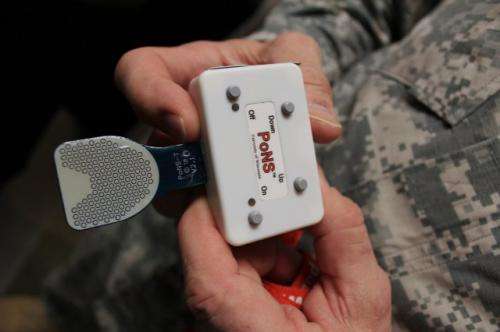
The treatment involves sending specially-patterned nerve impulses to a patient's brain through an electrode-covered oral device called a "PoNS," a battery-operated appliance placed on the tongue. The 20-30 minute stimulation therapy, called cranial nerve non-invasive neuromodulation, or CN-NiNM, is accompanied with a custom set of physical, occupational, and cognitive exercises, based on the patient's deficits. The idea is to improve the brain's organizational ability and allow the patient to regain neural control.
NeuroHabilitation Corporation is funding the commercial development of the device, and has more than just financial investments in PoNS. The company was created with support by Montel Williams, a celebrity and military veteran who was diagnosed with multiple sclerosis in 1999.
Williams was originally introduced to the research through an American Way magazine an attendant gave to him while he was on an American Airlines flight. The magazine included an article about work being done at the University of Wisconsin-Madison. Shortly after reading the article, Williams joined a study at the University of Wisconsin-Madison's Tactile Communication & Neurorehabilitation Lab, which is in the Department of Biomedical Engineering.
"The third day there I said we need this in the mouths of our Soldiers," recalled Williams, stating that he has always kept his ties with the military after serving in the Marine Corps and graduating from the U.S. Naval Academy.
The PoNS prototype and associated therapeutic use were developed by University of Wisconsin-Madison scientists Yuri Danilov, Ph.D., Mitchell Tyler, M.S., P.E., and Kurt Kaczmarek, Ph.D. Their research is driven by the principle that brain function is not hardwired or fixed, but can be reorganized in response to new experiences, sensory input and functional demands. This area of research is called neuroplasticity and is a promising and rapidly growing area of brain research.
Preliminary data from University of Wisconsin showed CN-NiNM to have great potential for a wide variety of neurological issues. Remarkably, the therapy doesn't only slow functional loss, but also has the potential to restore lost function. That's why researchers are saying that it "breaks the rules."
"When we talk about a brain changing itself, this is what we mean," said Danilov.
Because of its possible application for service members, especially those returning from combat with blast-related traumatic brain injuries, the USAMRMC signed a Cooperative Research and Development Agreement with NeuroHabilitation Corporation (founded by Williams and his colleagues, including the University of Wisconsin scientists), Feb. 8, that allows the Army to further evaluate the device.
"This exciting agreement leverages a unique private-public partnership," said Col. Dallas Hack, director of the USAMRMC Combat Casualty Care Research Program. "By collaborating with University of Wisconsin-Madison and NeuroHabilitation Corporation, we maximize our resources to explore a potential real-world treatment for injured service members and civilians with a variety of health conditions."
Testing will include a collaborative study with researchers and clinicians at the Blanchfield Army Community Hospital in Fort Campbell, Ky., due to start this month as the result of a year-long coordination effort led by Capt. Ian Dews, deputy director of CCCRP. The hospital is home to the Warrior Resiliency and Recovery Center, which is dedicated to the treatment of Soldiers with physical and neuropsychological problems due to service-related trauma.
Provided by US Army
-
Researchers use brain interface to post to Twitter (w/Video)
Apr 20, 2009 |
not rated yet |
0
-
Scientists cultivate human brain's most ubiquitous cell in lab dish
May 22, 2011 |
not rated yet |
0
-
Improved recovery of motor function after stroke
Apr 19, 2011 |
not rated yet |
0
-
Rutgers center sparks 'liquid bandage,' a new frontline wound treatment
Feb 07, 2008 |
not rated yet |
0
-
More research needed on blast induced traumatic brain injury and vestibular pathology
Oct 16, 2009 |
not rated yet |
0
-
Motion perception revisited: High Phi effect challenges established motion perception assumptions
Apr 23, 2013 |
3 / 5 (2) |
2
-
Anything you can do I can do better: Neuromolecular foundations of the superiority illusion (Update)
Apr 02, 2013 |
4.5 / 5 (11) |
5
-
The visual system as economist: Neural resource allocation in visual adaptation
Mar 30, 2013 |
5 / 5 (2) |
9
-
Separate lives: Neuronal and organismal lifespans decoupled
Mar 27, 2013 |
4.9 / 5 (8) |
0
-
Sizing things up: The evolutionary neurobiology of scale invariance
Feb 28, 2013 |
4.8 / 5 (10) |
14
-
Pressure-volume curve: Elastic Recoil Pressure don't make sense
May 18, 2013
-
If you became brain-dead, would you want them to pull the plug?
May 17, 2013
-
MRI bill question
May 15, 2013
-
Ratio of Hydrogen of Oxygen in Dessicated Animal Protein
May 13, 2013
-
Alcohol and acetaminophen
May 13, 2013
-
Marie Curie's leukemia
May 13, 2013
- More from Physics Forums - Medical Sciences
More news stories
Study suggests new source of kidneys for transplant
Nearly 20 percent of kidneys that are recovered from deceased donors in the U.S. are refused for transplant due to factors ranging from scarring in small blood vessels of the kidney's filtering units to the organ going too ...
Medical research
15 hours ago |
5 / 5 (2) |
0
|
Discovery of circadian clock in mice hair reveals period of time when damage from radiotherapy can be quickly repaired
Discovering that mouse hair has a circadian clock - a 24-hour cycle of growth followed by restorative repair - researchers suspect that hair loss in humans from toxic cancer radiotherapy and chemotherapy ...
Medical research
15 hours ago |
5 / 5 (2) |
1
|
Do salamanders hold the solution to regeneration?
Salamanders' immune systems are key to their remarkable ability to regrow limbs, and could also underpin their ability to regenerate spinal cords, brain tissue and even parts of their hearts, scientists have ...
Medical research
16 hours ago |
4.9 / 5 (7) |
2
|
New study finds blind people have the potential to use their 'inner bat' to locate objects
New research from the University of Southampton has shown that blind and visually impaired people have the potential to use echolocation, similar to that used by bats and dolphins, to determine the location of an object.
Medical research
19 hours ago |
not rated yet |
1
|
Germ-fighting vaccine system makes great strides in delivery
A novel vaccine study from South Dakota State University (SDSU) will headline the groundbreaking research that will be unveiled at the American Association of Pharmaceutical Scientists' (AAPS) National Biotechnology Conference ...
Medical research
19 hours ago |
not rated yet |
0
Anti-CD47 antibody may offer new route to successful cancer vaccination
(Medical Xpress)—Scientists at the School of Medicine have shown that their previously identified therapeutic approach to fight cancer via immune cells called macrophages also prompts the disease-fighting killer T cells ...
Biomarker trio predicts near-term heart risk
(Medical Xpress)—Cardiologists have identified a trio of biomarkers that may predict which patients with heart disease have a high risk of heart attack or death in the next two years.
Primary care docs should play role in kids' dental health, experts say
(HealthDay)—When it comes to the care of your children's teeth, dentists aren't the only experts who can help.
New theory offers clues to vital 'repair and maintenance' role of sleep
(Medical Xpress)—We spend about a third of our life asleep, but why we need to do so remains a mystery. In a recent publication, researchers at University of Surrey and University College London suggest a new hypothesis, ...
Salt consumption in India: The need for data to initiate population-based prevention efforts
(Medical Xpress)—International researchers are studying the salt intake of Indian adults to provide vital new data to aid the development of a national salt reduction strategy.
Eyes on the sun: Child sunshine exposure and eye development
(Medical Xpress)—Exposure to sunshine as a small child is crucial to the development of a healthy eye according to results of long-term myopia study conducted by University of Sydney researchers.