The nose's unheralded neighbor
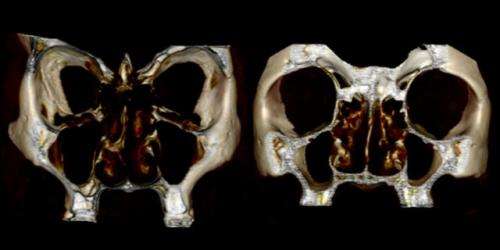
Pity the poor maxillary sinuses. Those bulbous pouches on either side of the human nose are known more for trapping mucus and causing sinus infections than anything else. They were thought to be an evolutionary relic of our distant past, with little known present value.
Yet researchers led by the University of Iowa believe the unheralded maxillary sinuses play a fortuitous, integral role in the shape and function of the human nose, even today. After studying faces of African and European origin, the team has concluded that the maxillary sinuses act as a cushion of sorts, changing their size to make room for the nose and to maximize its primary function, which is to make air as breathable as possible. The researchers explain the interconnectedness of the maxillary sinuses and the shape of the nasal cavity for the first time in a paper published in the journal The Anatomical Record.
The maxillary sinuses "allow the nose to change shape without affecting other areas of the face," explains Nathan Holton, a biological anthropologist at the University of Iowa and lead author on the paper. "When something is under selective pressure like the nose, that's a good thing."
The maxillary sinuses and the nose share the same wall, like neighbors in a duplex. Whether they are on good terms or at odds is important, because the nose needs to be able to assume different shapes—and change that shape without shifting everything else in the face and cranium—to maximize its function depending on the climate. Put more simply, the human nose has evolved over time depending on the type of climate where humans have lived. In colder places, the nose has evolved to be narrower and longer, the better to trap air in the nasal passage and warm and moisten it, which is exactly how the lungs like it. In warmer climates, the nose is broader and shorter, because the air generally already is warm and moist and so the goal is to transport it quickly to the lungs, rather than let it reside in the nasal passages. That explains, broadly speaking, the long, patrician shape of the typical northern European nose and the flatter, broader shape of the African nose. The maxillary sinuses have been around as long as the nose, but it's been unclear why.
The team sought to better understand the relationship by taking computed tomography scans of 40 living people, divided evenly between African and European ancestry. The researchers first wanted to find out whether a larger nose would mean smaller maxillary sinuses, and vice versa. To their surprise, that was not the case.
"What we found is that a bigger nasal volume was associated with a bigger sinus volume in both African and European samples," Holton explains. "This is best explained as an overall size dynamic. Individuals with a bigger face also have a bigger nasal cavity and bigger maxillary sinuses."
The team figured then that nose shape must play a more pronounced role than previously thought. The researchers mapped the shape of the nasal cavity in the participants by plotting points at different spots in a grid. The team found that maxillary sinuses in the European-derived participants were, on average, 36 percent larger than those in African-origin participants, in faces of roughly the same size. The reason: Europeans, with their narrower noses, have more room for maxillary sinuses.
"Essentially, by having these sinuses, that's what allows the nose to change its shape, at least in terms of width and independently from other parts of the face," says Holton, who will be named an assistant professor in the orthodontics department at the College of Dentistry in June.
That's important when considering that the nose needs to change according to where our ancestors lived, with the maxillary sinuses graciously acting as "zones of accommodation," as the researchers put it.
"Our results suggest that while the sinuses are unlikely to play a direct role in nasorespiratory function, they are important with regard to accommodation of climatically relevant changes in internal nasal shape," the authors write.


