Older adults benefit from home-based DVD exercise program
March 11, 2013 in Health

Older adults benefit from home-based DVD exercise program

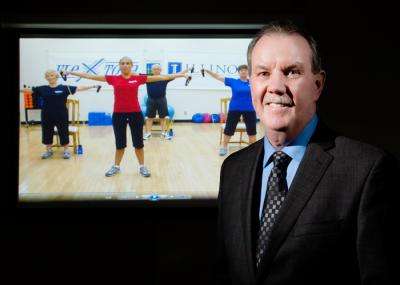
Kinesiology and community health professor Edward McAuley led a new study testing the efficacy of a home-based DVD exercise program for people 65 and older. Credit: L. Brian Stauffer

Fitness DVDs are a multimillion-dollar business, and those targeting adults over the age of 55 are a major part of the market. With names like "Boomers on the Move," "Stronger Seniors" and "Ageless Yoga," the programs promise much, but few have ever been rigorously tested.

"There are tons of DVDs out there, 20 percent of them are purchased by , and with few exceptions there is no evidence that they work," said University of Illinois and professor Edward McAuley, who led a new study testing the efficacy of a home-based DVD for people 65 and older.

The study appears in the Journals of Gerontology Series A: and Medical Sciences.

The researchers recruited 307 older adults from 83 towns and cities in Central Illinois. Half of the participants used a special fitness video at home. The others, a control group, watched a different video about healthy aging.

The fitness video was an outgrowth of years of research on interventions to enhance the health of older adults. The program, called "FlexToBa" (flex-toe-bah), was designed to improve flexibility, toning and balance, three components of function associated with the maintenance of independent living and avoidance of disability in older adults.

The FlexToBa video included several hours of instruction presented over six sessions meant to encourage progressive exercise three times a week over six months. New challenges each month helped keep participants engaged and encouraged them to build on their achievements.

In each session of the FlexToBa video, a presenter demonstrated a series of exercises, with age-appropriate models offering alternate approaches for those who found the exercises too challenging or too easy.

"We were very conscious of the fact that we wanted to make something that would reach a broad array of performance levels and physical capabilities," McAuley said.

Participants were asked to complete daily exercise logs and received short support telephone calls with exercise tips every other week for the first two months, and then every month. The control group also received the telephone calls.

The researchers were interested in whether a home-based exercise program could be as effective as classes offered in a central location, McAuley said.

"When we run these trials here (at the university) it's a lot of time, a lot of effort and can be an inconvenience for participants," he said. "Physical activity is one of those behaviors that people find very easy to see as inconvenient and they will come up with any excuse not to do it."

A home-based program could reach many more people than a center-based intervention, and at a much lower cost, he said.

At the end of the six months, those who stayed with the FlexToBa program saw "clinically important" improvements in scores on a battery of tests of physical function as compared with the control group. These tests assess strength, balance and gait, and have proven to be useful indicators of future performance, disability and independence in older adults. Unlike those in the , FlexToBa participants saw increases in their upper body strength and balance, and were able to maintain their previous level of lower body flexibility.

"This has important implications for an increasingly elderly population who are at risk for subsequent declines in function and increased disability," McAuley said. "We now know that this type of program can help to prevent that decline, and possibly reverse it."

More information: The paper, "Effects of a DVD-Delivered Exercise Intervention on Physical Function in Older Adults," is available online: biomedgerontology.… 014.full.pdf

Provided by University of Illinois at Urbana-Champaign search and more info website

not rated yet  

Rank not rated yet
Relevant PhysicsForums posts

More news stories

Bed sharing with parents increases risk of cot death fivefold

Bed sharing with parents is linked to a fivefold increased risk of sudden infant death syndrome (SIDS), even when the parents are non-smokers and the mother has not been drinking alcohol and does not use illegal drugs, according ...

Health created 4 hours ago | popularity 1.5 / 5 (2) | comments 0

Sports seem OK for many with heart-zapping device

Doctors tell people with a heart-zapping device in their chests to give up intense sports like basketball and soccer in favor of golf or bowling. But lots of patients ignore that advice—and now new research is challenging ...

Health created 4 hours ago | popularity not rated yet | comments 0

Gym class reduces probability of obesity, study finds for first time

Little is known about the effect of physical education (PE) on child weight, but a new study from Cornell University finds that increasing the amount of time that elementary schoolchildren spent in gym class reduces the probability ...

Health created 6 hours ago | popularity not rated yet | comments 0

Prenatal exposure to traffic is associated with respiratory infection in young children

Living near a major roadway during the prenatal period is associated with an increased risk of respiratory infection developing in children by the age of 3, according to a new study from researchers in Boston.

Health created 8 hours ago | popularity not rated yet | comments 0

Combined wood and tobacco smoke exposure increases risk and symptoms of COPD

People who are consistently exposed to both wood smoke and tobacco smoke are at a greater risk for developing chronic obstructive pulmonary disease (COPD) and for experiencing more frequent and severe symptoms of the disease, ...

Health created 8 hours ago | popularity not rated yet | comments 0


The compound in the Mediterranean diet that makes cancer cells 'mortal'

New research suggests that a compound abundant in the Mediterranean diet takes away cancer cells' "superpower" to escape death. By altering a very specific step in gene regulation, this compound essentially re-educates cancer ...

Do salamanders hold the solution to regeneration?

Salamanders' immune systems are key to their remarkable ability to regrow limbs, and could also underpin their ability to regenerate spinal cords, brain tissue and even parts of their hearts, scientists have ...

Scientists identify molecular trigger for Alzheimer's disease

Researchers have pinpointed a catalytic trigger for the onset of Alzheimer's disease – when the fundamental structure of a protein molecule changes to cause a chain reaction that leads to the death of neurons ...

Practice makes perfect? Not so much

Turns out, that old "practice makes perfect" adage may be overblown. New research led by Michigan State University's Zach Hambrick finds that a copious amount of practice is not enough to explain why people ...

Older prostate cancer patients should think twice before undergoing treatment

Older prostate cancer patients with other underlying health conditions should think twice before committing to surgery or radiation therapy for their cancer, according to a multicenter study led by researchers in the UCLA ...

New test better detects elephantiasis worm infection

A new diagnostic test for a worm infection that can lead to severe enlargement and deformities of the legs and genitals is far more sensitive than the currently used test, according to results of a field ...