Scientists find promising new target for aggressive breast cancer
March 20, 2013 in Cancer

Scientists find promising new target for aggressive breast cancer

Women with triple-negative breast cancer are more likely to have high levels of the MET biomarker in their tumours, making it a good new target for cancer drugs according to research published in the British Journal of Cancer, today (Wednesday).

Scientists from Austria and Greece examined 170 tumour samples from patients with triple negative breast cancer – a less common but aggressive type of the disease.

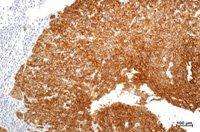
They found that over half of these women had high levels of the MET biomarker. The MET protein plays an important role in cell development but is often faulty in .

The study also showed that women with high levels of this biomarker were three times more likely to have a within five years of diagnosis than those with low levels (33 per cent compared to 11 per cent).

And nearly 90 per cent of tumours – called G3 – that are known to be more likely to spread, had high levels of the biomarker.

Over 7,500 women develop triple negative breast cancer each year. But the disease is often hard to treat as it does not contain any of the receptors such as oestrogen, progesterone or that are targeted by common treatments such as hormone therapy or Herceptin.

Professor Martin Filipits, study author from the Medical University of Vienna, said: "Our findings suggest that levels of the MET biomarker in a patient's breast tumour could be an important way of predicting the best type of treatment for women with triple negative breast cancer.

"This aggressive type of breast cancer is harder to treat as the tumours don't have the receptors that the common drugs can target – blocking the growth of the tumour.

"But knowing which women have high levels of this molecule in their could help doctors to adapt the type of treatment they're given.
"Levels of this could also give an idea of how likely the cancer is to come back."

Dr Julie Sharp, senior science information manager at Cancer Research UK, said: "Triple negative breast cancer can be very difficult to treat but this interesting research could open up the possibility of new approaches to monitor and treat this aggressive disease.

"Last year a Cancer Research UK study found that even among patients with the same type of breast cancer, such as triple negative, no two women's tumours will be exactly the same. What we call 'breast cancer' is in fact at least ten different diseases, each with its own molecular fingerprint, and each with different weak spots.

"This is a challenge and we continue to support research that aims to identify these weak spots and develop better treatments for all types of ."

More information: Zagouri, F et al, High MET expression is an adverse prognostic factor in patients with triple-negative breast cancer (2013) BJC, DOI:10.1038/bjc.2013.31

Journal reference: British Journal of Cancer search and more info website

Provided by Cancer Research UK search and more info website

not rated yet  

Rank not rated yet
Relevant PhysicsForums posts

More news stories

Older prostate cancer patients should think twice before undergoing treatment

Older prostate cancer patients with other underlying health conditions should think twice before committing to surgery or radiation therapy for their cancer, according to a multicenter study led by researchers in the UCLA ...

Cancer created 5 hours ago | popularity not rated yet | comments 0 | with audio podcast

Two radiotherapy treatments show similar morbidity, cancer control after prostatectomy

Intensity-modulated radiation therapy has become the most commonly used type of radiation in prostate cancer, but research from the University of North Carolina suggests that the therapy may not be more effective than older, ...

Cancer created 7 hours ago | popularity not rated yet | comments 0

The compound in the Mediterranean diet that makes cancer cells 'mortal'

New research suggests that a compound abundant in the Mediterranean diet takes away cancer cells' "superpower" to escape death. By altering a very specific step in gene regulation, this compound essentially re-educates cancer ...

Cancer created 8 hours ago | popularity 4.8 / 5 (8) | comments 1 | with audio podcast

CT radiation risk less than risk of examination indicator

(HealthDay)—For young adults needing either a chest or abdominopelvic computed tomography (CT), the short-term risk of death from underlying morbidity is greater than the long-term risk of radiation-induced ...

Cancer created 9 hours ago | popularity not rated yet | comments 0

Team finds mechanism linking key inflammatory marker to cancer

In a new study described in the journal Oncogene, researchers reveal how a key player in cell growth, immunity and the inflammatory response can be transformed into a primary contributor to tumor growth.

Cancer created 14 hours ago | popularity not rated yet | comments 0 | with audio podcast


Do salamanders hold the solution to regeneration?

Salamanders' immune systems are key to their remarkable ability to regrow limbs, and could also underpin their ability to regenerate spinal cords, brain tissue and even parts of their hearts, scientists have ...

Scientists identify molecular trigger for Alzheimer's disease

Researchers have pinpointed a catalytic trigger for the onset of Alzheimer's disease – when the fundamental structure of a protein molecule changes to cause a chain reaction that leads to the death of neurons ...

Practice makes perfect? Not so much

Turns out, that old "practice makes perfect" adage may be overblown. New research led by Michigan State University's Zach Hambrick finds that a copious amount of practice is not enough to explain why people ...

New test better detects elephantiasis worm infection

A new diagnostic test for a worm infection that can lead to severe enlargement and deformities of the legs and genitals is far more sensitive than the currently used test, according to results of a field ...

Researchers develop model for better testing, targeting of malignant peripheral nerve sheath tumors

University of Minnesota Medical School researchers from the Masonic Cancer Center, University of Minnesota, in partnership with the University's Brain Tumor Program, have developed a new mouse model of malignant peripheral ...

Study shows how bilinguals switch between languages

(Medical Xpress)—Individuals who learn two languages at an early age seem to switch back and forth between separate "sound systems" for each language, according to new research conducted at the University of Arizona.