Star-shaped glial cells act as the brain's 'motherboard'
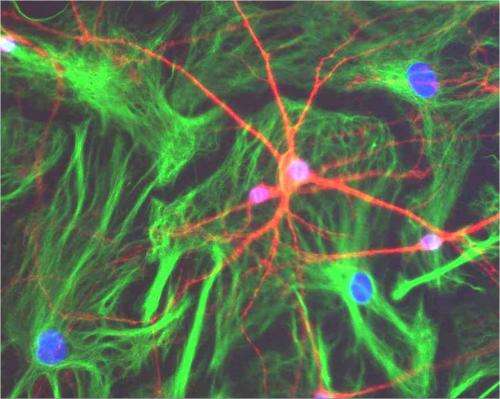
Neural networks (red) grow interspersed in the brain's glial networks (green). Credit: Pablo Blinder and Prof. Eshel Ben-Jacob of Tel Aviv University.
The transistors and wires that power our electronic devices need to be mounted on a base material known as a "motherboard." Our human brain is not so different—neurons, the cells that transmit electrical and chemical signals, are connected to one another through synapses, similar to transistors and wires, and they need a base material too.
But the cells serving that function in the brain may have other functions as well. PhD student Maurizio De Pittà of Tel Aviv University's Schools of Physics and Astronomy and Electrical Engineering says that astrocytes, the star-shaped glial cells that are predominant in the brain, not only control the flow of information between neurons but also connect different neuronal circuits in various regions of the brain.
Using models designed to mimic brain signalling, De Pittà's research, led by his TAU supervisor Prof. Eshel Ben-Jacob, determined that astrocytes are actually "smart" in addition to practical. They integrate all the different messages being transferred through the neurons and multiplexing them to the brain's circuitry. Published in the journal Frontiers in Computational Neuroscience and sponsored by the Italy-Israel Joint Neuroscience Lab, this research introduces a new framework for making sense of brain communications – aiding our understanding of the diseases and disorders that impact the brain.
Transcending boundaries
"Many pathologies are related to malfunctions in brain connectivity," explains Prof. Ben-Jacob, citing epilepsy as one example. "Diagnosis and the development of therapies rely on understanding the network of the brain and the source of undesirable activity."
Connectivity in the brain has traditionally been defined as point-to-point connections between neurons, facilitated by synapses. Astrocytes serve a protective function by encasing neurons and forming borders between different areas of the brain. These cells also transfer information more slowly, says Prof. Ben-Jacob – one-tenth of a second compared to one-thousandth of a second in neurons – producing signals that carry larger amounts of information over longer distances. Aastrocytes can transfer information regionally or spread it to different areas throughout the brain – connecting neurons in a different manner than conventional synapses.
De Pittà and his fellow researchers developed computational models to look at the different aspects of brain signalling, such as neural network electrical activity and signal transfer by synapses. In the course of their research, they discovered that astrocytes actually take an active role in the way these signals are distributed, confirming theories put forth by leading experimental scientists.
Astrocytes form additional networks to those of the neurons and synapses, operating simultaneously to co-ordinate information from different regions of the brain—much like an electrical motherboard functions in a computer, or a conductor ensuring that the entire orchestra is working in harmony, explains De Pittà.
These findings should encourage neuroscientists to think beyond neuron-based networks and adopt a more holistic view of the brain, he suggests, noting that the two communication systems are actually interconnected, and the breakdown of one can certainly impact the other. And what may seem like damage in one small area could actually be carried to larger regions.
A break in communication
According to Prof. Ben-Jacob, a full understanding of the way the brain sends messages is significant beyond satisfying pure scientific curiosity. Many diseases and disorders are caused by an irregularity in the brain's communication system or by damage to the glial cells, so more precise information on how the network functions can help scientists identify the cause or location of a breakdown and develop treatments to overcome the damage.
In the case of epilepsy, for example, the networks frequently become overexcited. Alzheimer's disease and other memory disorders are characterized by a loss of cell-to-cell connection. Further understanding brain connectivity can greatly aid research into these and other brain-based pathologies.
Provided by
Tel Aviv University
-
Brain's connective cells are much more than glue; they also regulate learning and memory
Dec 29, 2011 |
not rated yet |
0
-
Astrocytes affect brain's information signaling
Jun 14, 2010 |
not rated yet |
0
-
Astrocytes control the generation of new neurons from neural stem cells
Aug 24, 2012 |
not rated yet |
0
-
Researchers connect neurons to computers to decipher the enigmatic code of neuronal circuits
Jul 12, 2011 |
not rated yet |
0
-
Astrocytes: More than just glue
Aug 07, 2012 |
not rated yet |
0
-
Motion perception revisited: High Phi effect challenges established motion perception assumptions
Apr 23, 2013 |
3 / 5 (2) |
2
-
Anything you can do I can do better: Neuromolecular foundations of the superiority illusion (Update)
Apr 02, 2013 |
4.5 / 5 (11) |
5
-
The visual system as economist: Neural resource allocation in visual adaptation
Mar 30, 2013 |
5 / 5 (2) |
9
-
Separate lives: Neuronal and organismal lifespans decoupled
Mar 27, 2013 |
4.9 / 5 (8) |
0
-
Sizing things up: The evolutionary neurobiology of scale invariance
Feb 28, 2013 |
4.8 / 5 (10) |
14
-
Why is zone 1 in liver more prone to ischemic injury?
May 23, 2013
-
How can there be villous adenoma in colon, if there are no villi there
May 22, 2013
-
How can there be a term called "intestinal metaplasia" of stomach
May 21, 2013
-
Pressure-volume curve: Elastic Recoil Pressure don't make sense
May 18, 2013
-
If you became brain-dead, would you want them to pull the plug?
May 17, 2013
-
MRI bill question
May 15, 2013
- More from Physics Forums - Medical Sciences
More news stories
New neuron formation could increase capacity for new learning, at the expense of old memories
New research presented today shows that formation of new neurons in the hippocampus - a brain region known for its importance in learning and remembering - could cause forgetting of old memories by causing a reorganization ...
Neuroscience
22 hours ago |
4 / 5 (4) |
0
Help at hand for people with schizophrenia
How can healthy people who hear voices help schizophrenics? Finding the answer for this is at the centre of research conducted at the University of Bergen.
Neuroscience
23 hours ago |
4 / 5 (2) |
2
Japanese research organizations contribute to Human Brain Project
One of the major frontiers of modern science is a comprehensive understanding of the human brain and its functions to guide the development of new technologies in information and communication. In a major announcement for ...
Neuroscience
23 hours ago |
3.7 / 5 (3) |
0
Controlling mood through the motions of mitochondria
(Medical Xpress)—Regulating the distribution of power in neurons is done by a system that makes the national electric grid look simple by comparison. Each neuron has several thousand mitochondria confined ...
Neuroscience
May 23, 2013 |
4.9 / 5 (9) |
0
|
Brain uses internal 'average voice' prototype to identify who is talking
(Medical Xpress)—The human brain is able to identify individuals' voices by comparing them against an internal 'average voice' prototype, according to neuroscientists.
Neuroscience
May 23, 2013 |
3.7 / 5 (3) |
3
|
Feds fight morning-after pill age ruling in NY
(AP)—Department of Justice lawyers have again asked a federal appeals court in New York to delay lifting age restrictions and prescription requirements on an emergency contraceptive popularly known as the morning-after ...
Heart failure accelerates male 'menopause'
Heart failure accelerates the aging process and brings on early andropausal syndrome (AS), according to research presented today at the Heart Failure Congress 2013. AS, also referred to as male 'menopause', was four times ...
First drug to improve heart failure mortality in over a decade
Coenzyme Q10 decreases all cause mortality by half, according to the results of a multicentre randomised double blind trial presented today at Heart Failure 2013 congress. It is the first drug to improve heart failure mortality ...
Death highest in heart failure patients admitted in January, on Friday, and overnight
Mortality and length of stay are highest in heart failure patients admitted in January, on Friday, and overnight, according to research presented today at the Heart Failure Congress 2013. The analysis of nearly 1 million ...
Engineered cytomegalovirus protects monkeys from HIV equivalent
(Medical Xpress)—A new study by researchers in the US has shown that an ancient virus can be modified to help in the fight against the simian immunodeficiency virus SIV, which is the equivalent in monkeys ...
Researchers identify first drug targets in childhood genetic tumor disorder
Two mutations central to the development of infantile myofibromatosis (IM)—a disorder characterized by multiple tumors involving the skin, bone, and soft tissue—may provide new therapeutic targets, according to researchers ...