News tagged with lysosomes
Mitochondrial dynamics in neurons: Whats all the fuss about?
(Medical Xpress)—In the epic series Star Wars, the mysterious energy field known simply as, the Force, was communicated by microscopic endosymbionts known as midichlorians. Their real world counterparts, ...
Neuroscience
Apr 03, 2013 |
4.8 / 5 (5) |
0
|
Experimental molecular therapy crosses blood-brain barrier to treat neurological disease
Researchers have overcome a major challenge to treating brain diseases by engineering an experimental molecular therapy that crosses the blood-brain barrier to reverse neurological lysosomal storage disease in mice.
Medical research
Feb 04, 2013 |
5 / 5 (1) |
0
|
Biologists find potential drug that speeds cellular recycling
A University of Michigan cell biologist and his colleagues have identified a potential drug that speeds up trash removal from the cell's recycling center, the lysosome.
Medical research
Mar 13, 2012 |
5 / 5 (9) |
0
|
Biochemists open path to molecular 'chaperone' therapy for metabolic disease
University of Massachusetts Amherst researchers, experts in revealing molecular structure by X-ray crystallography, have identified two new small "chaperone" molecules that may be useful in treating the inherited ...
Medical research
Oct 09, 2012 |
not rated yet |
0
|
DNA from cystic fibrosis patients with and without chronic infections points to unsuspected mutation
(Medical Xpress) -- Comparing the DNA from patients at the best and worst extremes of a health condition can reveal genes for resistance and susceptibly. This approach discovered rare variations in the DCTN4 ...
Genetics
Jul 08, 2012 |
not rated yet |
0
|
Autophagy: When 'self-eating' is good for you
(Medical Xpress) -- New discoveries by Cambridge scientists about a molecular waste-disposal process that eats bacteria are influencing the clinical management of cystic fibrosis, and could be ...
Diseases, Conditions, Syndromes
Apr 04, 2012 |
4.5 / 5 (2) |
0
|
Surprising pathway implicated in stuttering
Researchers at Washington University School of Medicine in St. Louis have obtained new evidence that at least some persistent stuttering is caused by mutations in a gene governing not speech, but a metabolic pathway involved ...
Genetics
Nov 22, 2011 |
4.5 / 5 (2) |
2
|
Shedding light on cell mechanism which plays a role in such diseases as Huntington's and Parkinson's
(Medical Xpress) -- New research from scientists at the University of Cambridge provides critical insight into the formation of autophagosomes, which are responsible for cleaning up cellular waste.
Parkinson's & Movement disorders
Jul 26, 2011 |
4 / 5 (1) |
0
|
The same genetic defect causes Pompe disease in both humans and dogs
Pompe disease, a severe glycogen storage disease appearing in Lapphunds is caused by a genetic defect in acid α-glucosidase gene. The same genetic mutation also causes the equivalent disease in humans. Based ...
Genetics
Feb 15, 2013 |
5 / 5 (1) |
0
|
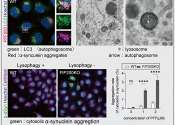
Parkinson's disease protein gums up garbage disposal system in cells
(Medical Xpress)—Clumps of α-synuclein protein in nerve cells are hallmarks of many degenerative brain diseases, most notably Parkinson's disease.
Parkinson's & Movement disorders
Mar 28, 2013 |
5 / 5 (2) |
0
|
Infant tests for debilitating diseases set for mainstream
(Medical Xpress)—Michael Gelb and František Tureček have worked more than a decade to devise and implement newborn screening for some debilitating, often-fatal conditions that show up in the first year ...
Diseases, Conditions, Syndromes
Apr 02, 2013 |
5 / 5 (1) |
0
Cell metabolism: Muscle loss can be caused by mitochondrial degradation induced by protein Mul1
Muscle withering can occur as part of the progression of many diseases, including cancer and muscular dystrophy, as well as during the normal aging process. Cellular organelles known as mitochondria provide ...
Medical research
Mar 13, 2013 |
5 / 5 (1) |
0
Study reveals insight into how key protein protects against viral infections
Scientists from the University of Utah School of Medicine have discovered that a mouse protein called IFITM3 contributes to the body's defense against some types of viral infections by binding to an enzyme responsible for ...
Immunology
Apr 02, 2012 |
not rated yet |
0
|
Scientists find link between master gene and neurodegenerative disorders
Garbage comes in all shapes and sizes. Cells, the body's functional units of life, also produce 'garbage' - debris and dysfunctional elements the body must get rid of. Failure to dispose of this garbage could ...
Genetics
Jun 24, 2011 |
5 / 5 (3) |
0
New technology for more efficient treatment of Pompe disease, other metabolic disorders
VIB researchers from UGent and Vrije Universiteit Brussel , together with a team of the firm Oxyrane have developed a new technology that can lead to a more efficient and possibly also cheaper therapy for diseases such as ...
Medical research
Nov 19, 2012 |
not rated yet |
0
Lysosome
Lysosomes are cellular organelles that contain acid hydrolase enzymes to break down waste materials and cellular debris. They are found in animal cells, while in yeast and plants the same roles are performed by lytic vacuoles. Lysosomes digest excess or worn-out organelles, food particles, and engulf viruses or bacteria. The membrane around a lysosome allows the digestive enzymes to work at the 4.5 pH they require. Lysosomes fuse with vacuoles and dispense their enzymes into the vacuoles, digesting their contents. They are created by the addition of hydrolytic enzymes to early endosomes from the Golgi apparatus. The name lysosome derives from the Greek words lysis, to separate, and soma, body. They are frequently nicknamed "suicide-bags" or "suicide-sacs" by cell biologists due to their role in autolysis. Lysosomes were discovered by the Belgian cytologist Christian de Duve in the 1960s.
The size of lysosomes varies from 0.1–1.2 μm. At pH 4.8, the interior of the lysosomes is acidic compared to the slightly alkaline cytosol (pH 7.2). The lysosome maintains this pH differential by pumping protons (H+ ions) from the cytosol across the membrane via proton pumps and chloride ion channels. The lysosomal membrane protects the cytosol, and therefore the rest of the cell, from the degradative enzymes within the lysosome. The cell is additionally protected from any lysosomal acid hydrolases that drain into the cytosol, as these enzymes aren't pH-sensitive and function as well in the alkaline environment of the cytosol.
For more information about Lysosome, read the full article at
Wikipedia.
This text uses material from Wikipedia and is available under the GNU Free Documentation License.