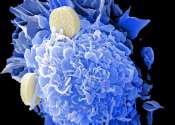
Research reveals cancer-suppressing protein 'multitasks'
The understanding of how a powerful protein called p53 protects against cancer development has been upended by a discovery by Walter and Eliza Hall Institute researchers.
Cancer cells are a problem for the body because they multiply recklessly, refuse to die and blithely metastasize to set up shop in places where they don't belong. One protein that keeps healthy cells from behaving this way ...
Adenosine-5'-triphosphate (ATP) is the main energy source for all forms of work inside our cells. Scientists from the University of Helsinki, Finland, have found that even a short-term shortage of ATP supply ...
(Medical Xpress)—Researchers at the University of Dundee have identified a new way of killing cancer cells in patients with a certain kind of leukaemia, which could lead to the development of safer anti-leukaemic drugs.
(Medical Xpress)—One of the hallmarks of cancer is unchecked cellular growth. Fortunately, our cells contain a number of tumor suppressor proteins, including the cell cycle regulator p21, to keep cell growth ...
(Medical Xpress)—UC Irvine biologists, chemists and computer scientists have identified an elusive pocket on the surface of the p53 protein that can be targeted by cancer-fighting drugs. The finding heralds a new treatment ...
The p53 tumor suppressor protein manages DNA repair mechanisms in response to genetic damage and kills off precancerous cells before they multiply. The loss of p53 due to mutation greatly increases risk of ...
The tumor suppressor protein p53 is an attractive target for drug developers. But this path has so far proven difficult, as most p53 regulatory proteins operate via protein-protein interactions, which make for poor drug targets, ...
Depriving cancer cells of a key amino acid dramatically cuts their ability to grow and multiply, according to a new Cancer Research UK study published in Nature.
Cold viruses generally get a bad rap—which they've certainly earned—but new findings by a team of scientists at the Salk Institute for Biological Studies suggest that these viruses might also be a valuable ...
(Medical Xpress)—Squamous cell carcinoma (SCC) is diagnosed in about 700,000 people in the United States every year. Commonly contributing to SCC is a protein called DNp63a – it goes abnormally high and the ability of ...
A new discovery that sheds light on the genetic make up of ovarian cancer cells could explain why some women survive longer than others with this deadly disease. A multi-disciplinary team led by the Research Institute of ...
Researchers at Moffitt Cancer Center and colleagues have identified PHF20, a novel transcriptional factor, and clarified its role in maintaining the stability and transcription of p53, a gene that allows for both normal cell ...
Researchers at Mount Sinai School of Medicine, the University of Manchester, and the MD Anderson Cancer Center have found a new role for an oncogenic signaling pathway in embryonic stem cell (ESC) self-renewal and in reprogramming ...
Researchers at Mayo Clinic have completed the world's first genome-wide sequencing analysis of peripheral T-cell lymphomas, unlocking the genetic secrets of this poorly understood and highly aggressive cancer of the immune ...