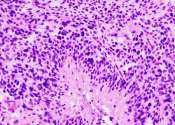
Making cancer less cancerous: Blocking a single gene renders tumors less aggressive
Researchers at Johns Hopkins have identified a gene that, when repressed in tumor cells, puts a halt to cell growth and a range of processes needed for tumors to enlarge and spread to distant sites. The researchers hope that ...
Cancer
May 02, 2013 |
4.7 / 5 (10) |
0
|
Compound in grapes, red wine could be key to fighting prostate cancer
Resveratrol, a compound found commonly in grape skins and red wine, has been shown to have several beneficial effects on human health, including cardiovascular health and stroke prevention. Now, a University ...
Cancer
Nov 10, 2012 |
5 / 5 (6) |
5
|
Genetic master controls expose cancers' Achilles' heel
In a surprising finding that helps explain fundamental behaviors of normal and diseased cells, Whitehead Institute scientists have discovered a set of powerful gene regulators dubbed "super-enhancers" that control cell state ...
Cancer
Apr 11, 2013 |
4.8 / 5 (6) |
0
|
Lack of oxygen in cancer cells leads to growth and metastasis
(Medical Xpress)—It seems as if a tumor deprived of oxygen would shrink. However, numerous studies have shown that tumor hypoxia, in which portions of the tumor have significantly low oxygen concentrations, ...
Cancer
Sep 13, 2012 |
5 / 5 (5) |
1
|
Scientists find promising new approach to preventing progression of breast cancer
February 15, 2013 – Doctors currently struggle to determine whether a breast tumor is likely to shift into an aggressive, life-threatening mode—an issue with profound implications for treatment. Now a group from The Scripps ...
Cancer
Feb 15, 2013 |
4.6 / 5 (5) |
0
|
Sickle cells show potential to attack aggressive cancer tumors
By harnessing the very qualities that make sickle cell disease a lethal blood disorder, a research team led by Duke Medicine and Jenomic, a private cancer research company in Carmel, Calif., has developed ...
Cancer
Jan 09, 2013 |
5 / 5 (4) |
0
|
Study reveals trigger that may speed melanoma growth
(HealthDay) -- Growth of the deadly skin cancer melanoma may be triggered by the immune system turning on itself, according to a new study that also identified the mechanism that causes this to happen.
Cancer
Mar 28, 2012 |
5 / 5 (3) |
0
|
Scientists make mouse model of human cancer, demonstrate cure
UT Southwestern Medical Center scientists report the first successful blocking of tumor development in a genetic mouse model of an incurable human cancer.
Cancer
Mar 05, 2013 |
5 / 5 (3) |
0
|
Researchers find cancer aggression differences in different types of prostate cells
(Medical Xpress)—A research team made up of representatives from several cancer research centers in the United States has found that cancers that develop in the prostate of mice may be either aggressive or sluggish depending ...
Cancer
Feb 25, 2013 |
4.7 / 5 (3) |
0
|
Five inherited genetic variants linked to the most lethal prostate cancers
An international team of researchers led by Fred Hutchinson Cancer Research Center has identified five inherited genetic variants that are strongly associated with aggressive, lethal prostate cancer. The discovery ultimately ...
Cancer
Aug 16, 2011 |
5 / 5 (2) |
2
|
Breaking oncogene's hold on cancer cell provides new treatment direction
Just as people's bodies and minds can become addicted to substances such as drugs, caffeine, alcohol, their cancers can become addicted to certain genes that insure their continued growth and dominance.
Cancer
Dec 08, 2011 |
5 / 5 (2) |
0
|
How early breast tumors become deadly: A small group of molecules might hold the answer
Researchers have discovered a restricted pattern of molecules that differentiate early-stage breast tumors from invasive, life-threatening cancer. They also found a similar molecular signature that correlated with the aggressiveness ...
Cancer
Feb 07, 2012 |
5 / 5 (2) |
0
|
'First-in-human' drug for malignant glioma available in experimental trial
The UC Cancer Institute is one of three centers internationally approved to test an experimental drug's safety and pharmacokinetics and also assess the clinical benefit against recurrent malignant glioma, an aggressive form ...
Cancer
Feb 15, 2012 |
5 / 5 (2) |
0
Tumors evolve rapidly in a childhood cancer, leaving fewer obvious tumor targets
An extensive genomic study of the childhood cancer neuroblastoma reinforces the challenges in treating the most aggressive forms of this disease. Contrary to expectations, the scientists found relatively few recurrent gene ...
Genetics
Jan 20, 2013 |
5 / 5 (2) |
0
|
Virus-like particles provide vital clues about brain tumors
Exosomes are small, virus-like particles that can transport genetic material and signal substances between cells. Researchers at Lund University, Sweden, have made new findings about exosomes released from aggressive brain ...
Medical research
Apr 17, 2013 |
4.5 / 5 (2) |
0
|