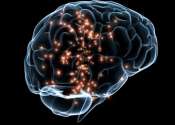
Brain oscillations reveal that our senses do not experience the world continuously
(Medical Xpress) -- It has long been suspected that humans do not experience the world continuously, but rather in rapid snapshots.
Neuroscience
May 14, 2012 |
4.3 / 5 (36) |
13
|
Seeing is as seeing does: Spatially-structured retinal input in early development of cortical maps
(Medical Xpress) -- Remarkably, cortical maps show that neurons in the primary visual cortex have specific preferences for the location and orientation of a given visual field stimulus but how these ...
Neuroscience
Apr 26, 2012 |
5 / 5 (6) |
1
|
How your eyes deceive you
(Medical Xpress) -- Researchers at the University of Sydney have thrown new light on the tricks the brain plays as it struggles to make sense of the visual and other sensory signals it constantly receives.
Neuroscience
Apr 24, 2012 |
4.5 / 5 (2) |
0
|
Experiment shows visual cortex in women quiets when viewing porn
(Medical Xpress) -- Researchers from the University of Groningen Medical Centre in the Netherlands have found that for women at least, watching pornographic videos tends to quiet the part of the brain most heavily involved ...
Neuroscience
Apr 20, 2012 |
4.5 / 5 (19) |
0
|
Distinct brain cells recognize novel sights
No matter what novel objects we come to behold, our brains effortlessly take us from an initial "What's that?" to "Oh, that old thing" after a few casual encounters. In research that helps shed light on the ...
Neuroscience
Apr 11, 2012 |
not rated yet |
0
|
Microchip success for bionic eye
(Medical Xpress) -- Research to restore sight to the clinically blind has reached a critical stage, with testing underway of the prototype microchips that will power the bionic eye.
Ophthalmology
Apr 03, 2012 |
4.4 / 5 (9) |
0
|
Seeing Beyond the Visual Cortex
(Medical Xpress) -- It's a chilling thought--losing the sense of sight because of severe injury or damage to the brain's visual cortex. But, is it possible to train a damaged or injured brain to "see" again after such a catastrophic ...
Neuroscience
Apr 03, 2012 |
5 / 5 (3) |
0
|
Human attention to a particular portion of an image alters the way the brain processes visual cortex responses to that i
Our ability to ignore some, but not other stimuli, allows us to focus our attention and improve our performance on a specific task. The ability to respond to visual stimuli during a visual task hinges on altered ...
Neuroscience
Mar 30, 2012 |
5 / 5 (1) |
0
Study suggest that conscious perception has little to do with the primary visual cortex
From a purely intuitive point of view, it is easy to believe that our ability to actively pay attention to a target is inextricably connected with our capacity to consciously perceive it. However, this proposition ...
Neuroscience
Mar 05, 2012 |
5 / 5 (1) |
1
Open your eyes and smell the roses: Activating the visual cortex improves our sense of smell
A new study reveals for the first time that activating the brain's visual cortex with a small amount of electrical stimulation actually improves our sense of smell. The finding published in the Journal of Neuroscience by res ...
Neuroscience
Feb 28, 2012 |
5 / 5 (1) |
1
|
Neuroscientists identify how the brain works to select what we (want to) see
If you are looking for a particular object say a yellow pencil on a cluttered desk, how does your brain work to visually locate it?
Neuroscience
Feb 21, 2012 |
5 / 5 (7) |
1
|
Mouse brains keyed to speed
(Medical Xpress) -- Its hard to be a mouse. Youre a social animal, but your fellows are small and scattered. Youre a snack to a bestiary of fast, eagle-eyed predators, not least the eagle. ...
Neuroscience
Jan 25, 2012 |
5 / 5 (3) |
0
|
Neural balls and strikes: Where categories live in the brain
Hundreds of times during a baseball game, the home plate umpire must instantaneously categorize a fast-moving pitch as a ball or a strike. In new research from the University of Chicago, scientists have pinpointed an area ...
Neuroscience
Jan 15, 2012 |
5 / 5 (2) |
2
|
Why evolutionarily ancient brain areas are important
Structures in the midbrain that developed early in evolution can be responsible for functions in newborns which in adults are taken over by the cerebral cortex. New evidence for this theory has been found in the visual system ...
Neuroscience
Nov 30, 2011 |
not rated yet |
7
Brain study explores what makes colors and numbers collide
Someone with the condition known as grapheme-color synesthesia might experience the number 2 in turquoise or the letter S in magenta. Now, researchers reporting their findings online in the Cell Press journal Current Biology on Nov ...
Neuroscience
Nov 17, 2011 |
5 / 5 (1) |
2
|