UN urges deeper probe into hormone-disrupting chemicals
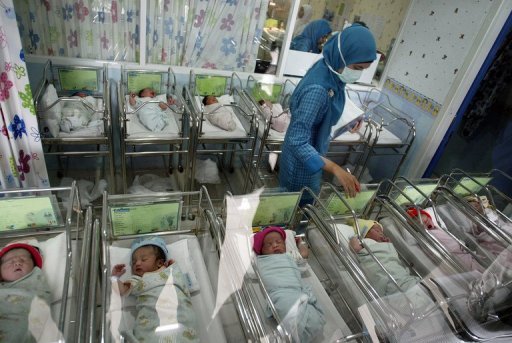
A nurse at the Mother and Child Hospital in Surabaya in East Java province looks after 13 newborn babies born on December 12, 2012. Scientists suspect chemicals which disrupt the hormone system are linked to early breast development, poor semen quality, low birthweight in babies and other problems, but more research is needed, UN agencies reported.
Scientists suspect chemicals which disrupt the hormone system are linked to early breast development, poor semen quality, low birthweight in babies and other problems, but more research is needed, UN agencies reported on Wednesday.
The UN Environment Programme (UNEP) and World Health Organisation (WHO) said evidence is mounting that so-called endocrine disrupting chemicals (EDCs) become a health risk when they enter the environment, but key knowledge gaps remain.
"Close to 800 chemicals are known or suspected to be capable of interfering with hormone receptors, hormone synthesis or hormone conversion," the agencies said in a report.
"However, only a small fraction of these chemicals have been investigated in tests capable of identifying overt endocrine effects in intact organisms."
The report was commissioned against a backdrop of concern that EDCs—found in some pesticides, electronics, personal care products, cosmetics and food additives—are entering water supplies and the food chain through agricultural runoff, waste dumps and other sources.
In recent decades, scientists have observed a rise in endocrine-related disorders in humans and wildlife, including studied populations of deer, sea lions and sea otters.
In some countries, up to 40 percent of young men have low semen quality, which reduces their ability to father children, said the report, State of the Science of Endocrine Disrupting Chemicals.
"Global rates of endocrine-related cancers—breast, endometrial, ovarian, prostate, testicular and thyroid—have been increasing over the past 40 to 50 years," it said.
"There is a trend towards earlier onset of breast development in young girls in all countries where this has been studied. This is a risk factor for breast cancer."
Incidence of genital malformation in young boys, such as non-descending testes, has increased over time or levelled off "at unfavourably high rates," it added.
The emergence of these disorders over such a short time means that genetic factors can be ruled out, it said.
Laboratory studies back suspicions that EDCs are to blame, it said.
But there are big gaps in knowledge, especially grass-roots studies that compare incidence of these disorders and exposure to the chemicals, it said.
There could be other environmental causes, and age and nutrition could play a role, it added.
In the quest for a fuller picture, the report called for more research and better international coordination on testing standards and urged governments, in the meantime, to be vigilant.
"Worldwide, there has been a failure to adequately address the underlying environmental causes of trends in endocrine diseases and disorders," it said. "(...) (The) disease risk due to EDCs may be significantly underestimated."
The document was issued on the second day of a meeting of UNEP's governing ministers, which ends in Nairobi on Friday.
(c) 2013 AFP
-
Current chemical testing missing low-dosage effects of endocrine-disrupting chemicals
Mar 29, 2012 |
not rated yet |
0
-
Experts say protocols for identifying endocrine-disrupting chemicals inadequate
Jun 26, 2012 |
not rated yet |
0
-
Environmental chemicals found in breast milk and high incidence of testicular cancer
Sep 24, 2009 |
not rated yet |
0
-
Researchers craft tool to minimize threat of endocrine disruptors in new chemicals
Dec 06, 2012 |
not rated yet |
0
-
Prenatal exposure to endocrine-disrupting chemicals linked to breast cancer
May 21, 2010 |
not rated yet |
0
-
Motion perception revisited: High Phi effect challenges established motion perception assumptions
Apr 23, 2013 |
3 / 5 (2) |
2
-
Anything you can do I can do better: Neuromolecular foundations of the superiority illusion (Update)
Apr 02, 2013 |
4.5 / 5 (11) |
5
-
The visual system as economist: Neural resource allocation in visual adaptation
Mar 30, 2013 |
5 / 5 (2) |
9
-
Separate lives: Neuronal and organismal lifespans decoupled
Mar 27, 2013 |
4.9 / 5 (8) |
0
-
Sizing things up: The evolutionary neurobiology of scale invariance
Feb 28, 2013 |
4.8 / 5 (10) |
14
-
Classical and Quantum Mechanics via Lie algebras
Apr 15, 2011
- More from Physics Forums - Independent Research
More news stories
Driving and hands-free talking lead to spike in errors, study shows
Talking on a hands-free device while behind the wheel can lead to a sharp increase in errors that could imperil other drivers on the road, according to new research from the University of Alberta.
Health
13 hours ago |
not rated yet |
0
About one in four uninsured could be excluded from ACA
(HealthDay)—More than one in four of those eligible for new premium assistance tax credits under the Affordable Care Act (ACA) do not have a checking account and will not be able to receive premiums from ...
Health
15 hours ago |
not rated yet |
0
Audiologists recommend smart phone apps to monitor noise levels
After studying noise in one French Quarter neighborhood of New Orleans to determine whether or not noise levels exceeded municipal ordinances, Annette Hurley, PhD, Assistant Professor of Audiology at LSU Health Sciences Center ...
Health
17 hours ago |
not rated yet |
0
Young children who miss well-child visits are more likely to be hospitalized
Young children who missed more than half of recommended well-child visits had up to twice the risk of hospitalization compared to children who attended most of their visits, according to a study published today in the American Jo ...
Health
17 hours ago |
not rated yet |
0
Do doctors understand the individualisation of treatments?
The individualisation of drug treatments to support patients to self-manage their conditions is a concept that sits at the heart of policy, but a recent study in BMJ Open shows that there is no concrete defini ...
Health
19 hours ago |
3 / 5 (1) |
0
Engineered cytomegalovirus protects monkeys from HIV equivalent
(Medical Xpress)—A new study by researchers in the US has shown that an ancient virus can be modified to help in the fight against the simian immunodeficiency virus SIV, which is the equivalent in monkeys ...
Researchers identify first drug targets in childhood genetic tumor disorder
Two mutations central to the development of infantile myofibromatosis (IM)—a disorder characterized by multiple tumors involving the skin, bone, and soft tissue—may provide new therapeutic targets, according to researchers ...
Hormone levels may provide key to understanding psychological disorders in women
Women at a particular stage in their monthly menstrual cycle may be more vulnerable to some of the psychological side-effects associated with stressful experiences, according to a study from UCL.
Going live: Immune cell activation in multiple sclerosis
Biological processes are generally based on events at the molecular and cellular level. To understand what happens in the course of infections, diseases or normal bodily functions, scientists would need to ...
Help at hand for people with schizophrenia
How can healthy people who hear voices help schizophrenics? Finding the answer for this is at the centre of research conducted at the University of Bergen.
Alzheimer's disease, the soft target of the euthanasia debate
(Medical Xpress)—The way Alzheimer's disease is portrayed by advocacy groups and the media is having undue influence on the euthanasia debate, according to a Deakin University nursing ethics professor.