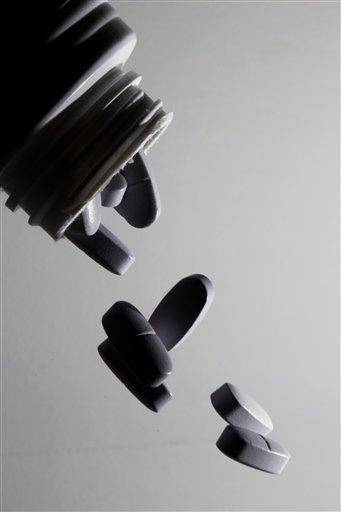
In this Thursday, Oct. 13, 2011 photo illustration, multivitamins are poured from a bottle in Philadelphia. Two studies released in Oct. 2011 raised gnawing worries about the safety of vitamin supplements and a host of questions. Vitamins have long had a "health halo" - many people think they won't hurt and at worst might be unnecessary. The industry calls them an insurance policy against bad eating. But our foods increasingly are pumped full of them - even junk foods and drinks often are fortified with nutrients to give them a healthier profile - so the risk is rising that we're getting too much. Add a supplement and you may exceed the upper limit. (AP Photo/Matt Rourke)
Two studies this week raised gnawing worries about the safety of vitamin supplements and a host of questions. Should anyone be taking them? Which ones are most risky? And if you do take them, how can you pick the safest ones?
Vitamins have long had a "health halo." Many people think they're good for you and at worst might simply be unnecessary. The industry calls them an insurance policy against bad eating.
But our foods are increasingly pumped full of them already. Even junk foods and drinks often are fortified with nutrients to give them a healthier profile, so the risk is rising that we're getting too much. Add a supplement and you may exceed the upper limit.
"We're finding out they're not as harmless as the industry might have us believe," said David Schardt, a nutritionist at the consumer group Center for Science in the Public Interest.
This week, a study of nearly 40,000 older women found a slightly higher risk of death among those taking dietary supplements, including multivitamins, folic acid, iron and copper. It was just an observational study, though, not a rigorous test.
Another study found that men taking high doses of vitamin E - 400 units a day - for five years had a slightly increased risk of prostate cancer.
As many as one-third of Americans take vitamins and nearly half of people 50 and older take multivitamins, surveys suggest. Americans spent $9.6 billion on vitamins last year, up from $7.2 billion in 2005, according to the Nutrition Business Journal. Multivitamins top the list, at nearly $5 billion in sales.
Yet there is no clear evidence that multivitamins lower the risk of cancer, heart disease or any other chronic health problems. No government agency recommends them "regardless of the quality of a person's diet," says a fact sheet from the federal Office of Dietary Supplements. And vitamins aren't required to undergo the strict testing required of U.S.-approved prescription medicines.
Some fads, such as the antioxidant craze over vitamins A and E and beta-carotene, backfired when studies found more health risk, not less. And studies that find more disease in people with too little of a certain vitamin can be misleading: Correcting a deficiency so you have the right daily amount is different from supplementing beyond recommended levels.
The best way to get vitamins is to eat foods that naturally contain them, said Jody Engel, a nutritionist with Office of Dietary Supplements. "Foods provide more than just vitamins and minerals, such as fiber and other ingredients that may have positive health effects."
Schardt adds: "It's virtually impossible to overdose on the nutrients in food."
Some folks may need more of certain nutrients and should talk with their doctors about supplements:
- Postmenopausal women regarding calcium and vitamin D to protect bones.
- Women planning on pregnancy regarding folate, or folic acid, to prevent birth defects.
- People over age 50 and vegans who may need vitamin B12. "As we get older, a number of us no longer produce enough acid in the stomach to extract the B12 in food," Schardt explained.
- Pregnant women, who may need extra iron.
- Breastfed infants and possibly other infants concerning vitamin D.
Vitamin D is a nutrient many of us may need to supplement. Last fall, the Institute of Medicine, a panel of scientists who advise the government, raised the recommended amount but also warned against overdoing it. People ages 1 to 70 should get 600 international units a day, older folks 800 units.
If you do need a supplement, beware: Quality varies. Consumerlab.com, a company that tests supplements and publishes ratings for subscribers, has found a high rate of problems in the 3,000 products it has tested since 1999.
"One out of 4 either doesn't contain what it claims or has some other problems such as contamination or the pills won't break apart properly," said company president Dr. Tod Cooperman.
For example, one gummy bear calcium product had 250 percent of the amount of vitamin D claimed on the label. Another liquid product made with rose hips had just over half the amount of vitamin C listed.
"You don't have to pay a lot. Price is not necessarily linked to quality," he said. "The quality doesn't really relate to where you're buying it. I know many people are surprised by that or don't want to believe it, but that is the case. We find good and bad products in every venue."
Mark Blumenthal, executive director of the American Botanical Council, suggests looking for "seals of approval" or certifications of quality from groups that spot-test supplements such as the USP, or United States Pharmacopeia; NSF International and NPA, the Natural Products Association.
Experts offered this advice:
- Keep it simple. The more ingredients there are in a supplement combo, the more chance that one of them will not be the right amount, Cooperman said.
- Consider a supplement combo tailored to your gender and age, the Office of Dietary Supplements suggests. Multivitamins often contain little iron, and ones for seniors give more calcium and vitamin D than products aimed at younger adults.
- Take vitamin D with dinner. A study found significantly more absorption of that nutrient when it was consumed at the largest meal, which tends to have more fat, than at breakfast, Cooperman said.
- Watch out for vitamin K - it promotes clotting and can interfere with common heart medicines and blood thinners such as warfarin, sold as Coumadin and other brands.
- Current and former smokers are advised to avoid multivitamins with lots of beta-carotene or vitamin A; two studies have tied them to increased risk of lung cancer.
- For cancer patients, "vitamins C and E might reduce the effectiveness of certain types of chemotherapy," Engel said.
- People having surgery should know that some vitamins can affect bleeding and response to anesthesia.
With any supplement - ask your doctor.
More information:
Vitamin facts: ods.od.nih.gov/factsheets/list-VitaminsMinerals
and ods.od.nih.gov/factsheets/MVMS-HealthProfessional
FAQs: ods.od.nih.gov/Health-Informat … Asked-Questions.aspx
Dietary advice: www.dietaryguidelines.gov
Vitamin E and prostate study: jama.ama-assn.org/content/306/14/1549
Video interview with author: jama.ama-assn.org/content/306/14/1549/suppl/DC1
©2011 The Associated Press. All rights reserved. This material may not be published, broadcast, rewritten or redistributed.


