Researchers search for culprit behind dry eyes, mouths and more
November 21, 2011 in Medical research
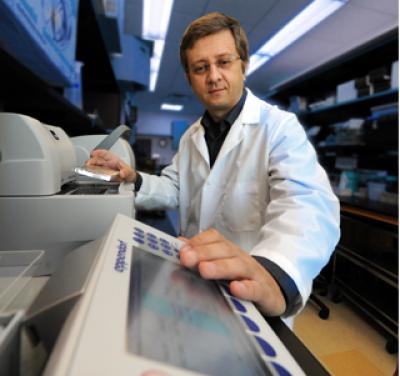
Researchers at Georgia Health Sciences University want to find the main culprit behind the dry, irritated eyes, mouth, throat, skin, nose and more afflicting 1-3 percent of the population. Credit: Phil Jones, GHSU Photographer
Researchers want to find the main culprit behind the dry, irritated eyes, mouth, throat, skin, nose and more afflicting 1-3 percent of the population.
It's called Sjögren's syndrome, a painful condition affecting moisture production that takes an average of 6.5 years to diagnose and is difficult to treat. Georgia Health Sciences University researchers say learning more about how it develops should improve diagnosis and treatment.
"We want to identify the early events just after onset of the disease so it can be diagnosed more quickly," said Dr. Rafal Pacholczyk, immunologist in the GHSU Center for Biotechnology and Genomic Medicine. "Knowing more about how the disease unfolds also will help us identify more targeted ways to treat it."
Armed with a $1.9 million grant from the National Institutes of Health, he's using a variety of mouse models to parse how the immune system begins to attack saliva, tear and other moisture-producing glands. Sjögren's blocks receptors that activate one or more of these glands, impeding messages from the brain to make tears or saliva. Gland cells also can be destroyed. A key question is which immune cells are to blame for the friendly fire.
It's the dendritic cells that scour the body for invaders, typically taking their finds to the draining lymph nodes to show T cells. Effector T cells can then initiate an attack, such as prompting B cell production of antibodies that, in this case, block receptors and attack cells. Regulatory T cells are supposed to prevent the attack on "self" tissues that occurs in autoimmune diseases such as Sjögren's. Still unidentified genes likely increase disease risk; environmental factors such as an infection may pull the trigger.
Pacholczyk is tracking T cell development in mice that start to develop Sjögren's by 8-10 weeks of age, trying to determine what causes the cells to become harmful.
He wants to identify the T cell receptors that distinguish self from non-self in this syndrome and whether the dendritic cells really are to blame. Another group of mice missing T cells enables him to use different cell combinations such as regulatory cells from a healthy animal with effector cells from a diseased one to see which combination produces disease. Part of what Pacholczyk wants to learn is whether fault lies with the hypersensitivity of the effector T cells or the ineffectiveness of regulatory T cells to keep them in line.
"At the end it comes down to this T cell detecting some part of a protein and deciding it's not self. Now the question becomes: Is it this the fault of the T cell recognizing something incorrectly or maybe it is the fault of the presenting cell that gives information to the T cell in a bad context?
"Once we know to what extent each arm of the immune response is at fault, we can focus on the genes that are involved and see if we can find along the way biomarkers that tell us who is predisposed to the disease or what preventive measures we can use to at least slow the disease down," he said.
Sjögren's is most often is diagnosed in women in their 40s, according to the Sjögren's Research Foundation. While the tear and salivary gland problems are disease hallmarks, moisture dysfunction can cause problems throughout the body, including the gastrointestinal tract, lungs and liver in the 4 million Americans living with the syndrome, the foundation reports.
Sjögren's often coexists with other autoimmune diseases such as lupus which can cut a wider, more destructive path across the body. Current therapies include medication to increase moisture production by cells that still function. Therapy to suppress the immune response also can help, but risk unleashing a host of other medical problems, including infection and cancer. Diagnostic tests include measuring tear and saliva flow as well as detecting autoantibodies that attack the glands and a gland biopsy to detect cell destruction.
Provided by Georgia Health Sciences University
-
Inability to cry in patients with Sjogrens syndrome affect emotional and mental well-being
May 26, 2011 |
not rated yet |
0
-
High blood sugar's impact on immune system holds clues to improving islet cell transplants
Dec 17, 2008 |
not rated yet |
0
-
Accurate interpretation of antinuclear antibodies test key to confirming autoimmune disease
Jan 04, 2011 |
not rated yet |
0
-
Immune police recognize good and bad guys in the body
Sep 14, 2007 |
not rated yet |
0
-
First lupus breakthrough in 50 years
Apr 28, 2011 |
not rated yet |
0
-
Of mice and mental models: Neuroscientific implications of risk-optimized behavior in the mouse
May 25, 2012 |
not rated yet |
0
-
Limits to growth: Scientists identify key metastasis-enabling enzyme
May 22, 2012 |
5 / 5 (4) |
0
-
Seeing is as seeing does: Spatially-structured retinal input in early development of cortical maps
Apr 26, 2012 |
5 / 5 (4) |
1
-
Dreamless nights: Brain activity during nonrapid eye movement sleep
Apr 09, 2012 |
4.4 / 5 (12) |
0
-
Take your time: Neurobiology sheds light on the superiority of spaced vs. massed learning
Mar 28, 2012 |
4.5 / 5 (21) |
3
-
Potential Breakthrough in Seizure Control
10 hours ago
-
Popping/Cracked sternum.
15 hours ago
-
Which Mental Illness Encompasses This Problem?
15 hours ago
-
A question about drug tolerance
May 23, 2012
-
Poor nutrition leading to overeating?
May 23, 2012
-
Math and dyslexia?
May 21, 2012
- More from Physics Forums - Medical Sciences
More news stories
Implantable pain disk may help those with cancer
An estimated 3.5 million cancer patients around the globe are in severe pain from their disease, but many get no relief.
Medical research
May 25, 2012 |
not rated yet |
0
|
Energy levels link sleep control mechanisms
Sleep, or lack of it, can determine level of cognitive performance which is linked with accidents as well as increased risk of serious health problems. Links between cell energy levels, gene transcription ...
Medical research
May 25, 2012 |
not rated yet |
0
Researchers identify key brain cell in antidepressant action
(Medical Xpress) -- Antidepressant medications such as Prozac have helped improve mood and lessen anxiety in millions of people with major depression. But scientists know surprisingly little about how these drugs work.
Medical research
May 25, 2012 |
4.7 / 5 (3) |
0
|
Rockefeller scientists pioneer new method to determine mechanisms of drug action
(Medical Xpress) -- Knowing that a drug works is great. Knowing how it works is a luxury. And until now, determining a drugs mechanism of action has been a tedious and difficult process for scientists.
Medical research
May 25, 2012 |
not rated yet |
0
|
Like curry? New biological role identified for compound used in ancient medicine
Scientists have just identified a new reason why some curry dishes, made with spices humans have used for thousands of years, might be good for you.
Medical research
May 25, 2012 |
4.5 / 5 (12) |
2
|
Travel to high altitudes tied to Crohn's, colitis flare-ups
(HealthDay) -- People with inflammatory bowel disease, which includes Crohn's disease and colitis, may be at increased risk for flare-ups when they fly or travel to high altitudes for skiing or mountain climbing, ...
Family history of Alzheimer's affects functional connectivity
(HealthDay) -- Cognitively normal individuals with a family history of late-onset Alzheimer's disease (AD) may display lower resting state functional connectivity in the default mode network (DMN) of the brain, ...
Transvaginal mesh op restores pelvic organ prolapse at price
(HealthDay) -- Transvaginal mesh (TVM) procedures are effective for anatomical restoration of pelvic organ prolapse (POP), but patients report a worsening of sexual function following surgery, according to ...
Tongue analysis software uses ancient Chinese medicine to warn of disease
For 5,000 years, the Chinese have used a system of medicine based on the flow and balance of positive and negative energies in the body. In this system, the appearance of the tongue is one of the measures used to classify ...
Skp2 activates cancer-promoting, glucose-processing Akt
HER2 and its epidermal growth factor receptor cousins mobilize a specialized protein to activate a major player in cancer development and sugar metabolism, scientists report in the May 25 issue of Cell.
Early physical therapist treatment associated with reduced risk of healthcare utilization and reduced overall healthcare
A new study published in Spine shows that early treatment by a physical therapist for low back pain (LBP), as compared to delayed treatment, was associated with reduced risk of subsequent healthcare utilization and lower ...