New imaging test aids Alzheimer's diagnosis

August 23, 2012 in Alzheimer's disease & dementia

New imaging test aids Alzheimer’s diagnosis

Enlarge

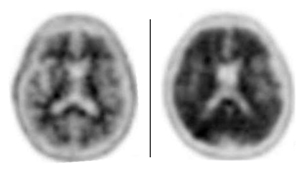
The image on the left is a PET scan of a normal brain. The image on the right is heavily blackened throughout the cerebral cortex due to the the presence of amyloid plaques. Amyloid is found in the brains of patients with dementia due to Alzheimer’s disease

In research studies, scientists regularly use positron emission tomography (PET) scans to detect signs of Alzheimer's disease. Now, Washington University physicians at Barnes-Jewish Hospital are the first in Missouri to offer a new type of PET scan for patients with memory disorders and other forms of cognitive impairment who are not involved in research studies.

This new imaging test is now available to patients being evaluated for Alzheimer's disease because the U.S. (FDA) recently approved the use of a radioactive diagnostic agent, Amyvid™ (Florbetapir F 18 Injection), for use in a clinical setting.

The agent detects neuritic plaques, a hallmark of Alzheimer's disease, by binding to abnormal deposits of the protein beta-amyloid that develop in the brains of patients with the disorder. This makes the plaques "light up" during a PET scan.

This video is not supported by your browser at this time.

"We're using the scans in patients whose cognitive function is impaired," says Farrokh Dehdashti, MD, professor of radiology in the Division of Nuclear Medicine at the Mallinckrodt Institute of Radiology. "First, the patient sees a neurologist, or other specialist in cognitive disorders, to confirm that a test like this would be appropriate, and then we conduct the to learn whether are present. In that way, the test allows both doctors and patients to have a better idea of whether the patient's is related to Alzheimer's disease or some other illness."

With , nuclear medicine specialists like Dehdashti can now use the diagnostic agent, which has a longer half-life than the compound used in research studies, making it better suited for clinical use. As a single test, PET scans can't confirm Alzheimer's disease, but a negative test that finds no evidence of elevated beta-amyloid can help rule out the disease as the cause for the patient's cognitive impairment.

"What complicates the results of a scan is that although Alzheimer's disease is very common, it's not the only reason that we might detect amyloid," according to Jonathan McConathy, MD, PhD, assistant professor of radiology. "A positive scan could mean that a person has Alzheimer's disease, or it could be related to some other neurologic disorder. It's also possible to find amyloid in the brain of a person who has no symptoms of Alzheimer's disease or other cognitive problems, so a positive test doesn't confirm that someone has the disease."

He says a positive scan indicates only that elevated levels of amyloid are present. But amyloid plaques can accumulate in the brains of people with other types of neurologic problems, such as dementia with Lewy bodies or cerebral amyloid angiopathy. Plaques also can occur in some older adults who are cognitively normal.

"The test should be used in conjunction with other diagnostic evaluations from a neurologist," Dehdashti says. "But when a scan is negative, it's highly unlikely that the cognitive impairment is due to Alzheimer's disease."

"These PET scans have the potential to be really useful as treatments for Alzheimer's are developed," McConathy says. "Once we have treatments to significantly slow down or stop the progression of Alzheimer's , then I think this kind of imaging will become very important in deciding who should be treated and, potentially, whether a treatment is working."

Washington University in St. Louis search and more info website

5 /5 (1 vote)  

Rank 5 /5 (1 vote)
Relevant PhysicsForums posts

More news stories

Study identifies new approach to improving treatment for MS and other conditions

(Medical Xpress)—Working with lab mice models of multiple sclerosis (MS), UC Davis scientists have detected a novel molecular target for the design of drugs that could be safer and more effective than current FDA-approved ...

Alzheimer's disease & dementia created May 17, 2013 | popularity 5 / 5 (2) | comments 0 | with audio podcast

Nonmelanoma skin cancer tied to lower Alzheimer's risk

(HealthDay)—Older individuals with nonmelanoma skin cancer (NMSC) seem to have a significantly reduced risk of developing Alzheimer's disease (AD), according to a study published online May 15 in Neurology.

Alzheimer's disease & dementia created May 16, 2013 | popularity 5 / 5 (1) | comments 0

Skin cancer may be linked to lower risk of Alzheimer's disease

People who have skin cancer may be less likely to develop Alzheimer's disease, according to new research published in the May 15, 2013, online issue of Neurology®, the medical journal of the American Academy of Neurology. The li ...

Alzheimer's disease & dementia created May 15, 2013 | popularity 5 / 5 (1) | comments 0 | with audio podcast

Alzheimer's markers predict start of mental decline

(Medical Xpress)—Scientists at Washington University School of Medicine in St. Louis have helped identify many of the biomarkers for Alzheimer's disease that could potentially predict which patients will develop the disorder ...

Alzheimer's disease & dementia created May 14, 2013 | popularity 3 / 5 (1) | comments 0 | with audio podcast

Scientists develop drug that slows Alzheimer's in mice

A drug developed by scientists at the Salk Institute for Biological Studies, known as J147, reverses memory deficits and slows Alzheimer's disease in aged mice following short-term treatment. The findings, ...

Alzheimer's disease & dementia created May 13, 2013 | popularity 4.2 / 5 (5) | comments 0 | with audio podcast


Ketamine shows significant therapeutic benefit in people with treatment-resistant depression

Patients with treatment-resistant major depression saw dramatic improvement in their illness after treatment with ketamine, an anesthetic, according to the largest ketamine clinical trial to-date led by researchers from the ...

Consuming coffee linked to lower risk of detrimental liver disease, study finds

Regular consumption of coffee is associated with a reduced risk of primary sclerosing cholangitis (PSC), an autoimmune liver disease, Mayo Clinic research shows. The findings were being presented at the Digestive Disease ...

Research examines new methods for managing digestive health

Research presented at Digestive Disease Week (DDW) explores new methods for managing digestive health through diet and lifestyle.

New research identifies risks, interventions for children's GI health

An increasing number of U.S. children are experiencing gastrointestinal issues that require interventions to resolve, according to research presented at Digestive Disease Week (DDW).

New smartphone application improves colonoscopy preparation

The use of a smartphone application significantly improves patients' preparation for a colonoscopy, according to new research presented today at Digestive Disease Week (DDW). The preparation process, which begins days in ...

New research identifies practice changes to improve value and quality of GI procedures

There are significant cost and risk factors associated with two procedures commonly used to diagnose or treat gastrointestinal problems, according to research presented at Digestive Disease Week (DDW).