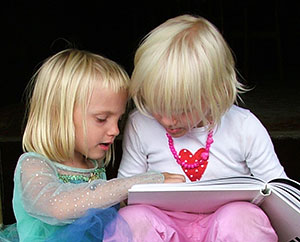
New studies link gene to selfish behavior in kids, find other children natural givers
February 27, 2013 by Susan Guibert & Jp Shortall in Psychology & Psychiatry
(Medical Xpress)—Most parents would agree that raising a generous child is an admirable goal—but how, exactly, is that accomplished? New results from the University of Notre Dame's Science of Generosity initiative, which funds generosity research around the world, sheds light on how generosity and related behaviors—such as kindness, caring and empathy—develop, or don't develop, in children from 2 years old through adolescence.
As part of Notre Dame's Science of Generosity-funded research, psychology professor Ariel Knafo of Hebrew University focused on the complex interactions between genetics and socialization practices, more commonly known as the "nature v. nurture" question. Knafo's study, published in PLoS ONE, showed a significant link between a particular gene variation and less altruistic behavior in preschoolers. Those with a genetic variation known as the AVPR1A RS3 327 bp allele exhibited lower allocations in dictator game experiments, in which the first player (the "proposer") determines the split of an endowment, such as a cash prize. The second player (the "responder"), who has no strategic input into the outcome of the game, passively receives the remainder of the endowment left by the proposer.
In another Notre Dame-funded study, Harvard University psychology professor Felix Warneken found that children as young as two years old begin to exhibit spontaneous helping behavior, which challenges the conventional wisdom that young children are innately selfish and have to be "taught" to give. According to a study published in Cognition, young children can be natural, proactive helpers, often willing to help others without being asked and while involved in their own tasks.
This video is not supported by your browser at this time.
In a separate study, Warneken found that children's sharing behavior is more sophisticated than once thought and suggests that children as young as three years old begin to consider merit when sharing with others, even if that consideration costs them cherished resources.While Warneken and Knafo focus on generosity in young children, economist Mark Ottoni-Wilhelm, of Indiana University-Purdue University Indianapolis, examined how older children up to the age of 13 learn to be generous or not.
Ottoni-Wilhelm explored the ways in which parents transmit their generous identities to their school-age and adolescent children. Until now, the consensus has been that role modeling was more effective than verbal socialization when it came to raising generous children; but the experiments that led to those conclusions were conducted in laboratory settings, and Wilhelm wanted to see whether role modeling or verbal socialization was more effective in the setting where it was most likely to happen: the home.
There he found that talking with children about giving raises the probability of their giving by 18.5 percent over not talking to them about it. He did not find that role modeling increased the probability of their giving, except among non-African-American girls. Evidence suggests that over time parents tend to stop talking about giving to their children.
Journal reference:
PLoS ONE
Cognition
Provided by
University of Notre Dame
-
When it comes to understanding fairness, young children get it
Sep 14, 2012 |
not rated yet |
0
-
5 year olds are generous only when they're watched
Oct 31, 2012 |
not rated yet |
0
-
Young children share rewards based on merit
Aug 29, 2012 |
not rated yet |
0
-
New report finds Catholics less generous than other Christians
Jan 22, 2013 |
not rated yet |
0
-
Marital problems in childhood affect teen adjustment
Jun 14, 2012 |
not rated yet |
0
-
Motion perception revisited: High Phi effect challenges established motion perception assumptions
Apr 23, 2013 |
3 / 5 (2) |
2
-
Anything you can do I can do better: Neuromolecular foundations of the superiority illusion (Update)
Apr 02, 2013 |
4.5 / 5 (11) |
5
-
The visual system as economist: Neural resource allocation in visual adaptation
Mar 30, 2013 |
5 / 5 (2) |
9
-
Separate lives: Neuronal and organismal lifespans decoupled
Mar 27, 2013 |
4.9 / 5 (8) |
0
-
Sizing things up: The evolutionary neurobiology of scale invariance
Feb 28, 2013 |
4.8 / 5 (10) |
14
-
Why is zone 1 in liver more prone to ischemic injury?
May 23, 2013
-
How can there be villous adenoma in colon, if there are no villi there
May 22, 2013
-
How can there be a term called "intestinal metaplasia" of stomach
May 21, 2013
-
Pressure-volume curve: Elastic Recoil Pressure don't make sense
May 18, 2013
-
If you became brain-dead, would you want them to pull the plug?
May 17, 2013
-
MRI bill question
May 15, 2013
- More from Physics Forums - Medical Sciences
More news stories
Hormone levels may provide key to understanding psychological disorders in women
Women at a particular stage in their monthly menstrual cycle may be more vulnerable to some of the psychological side-effects associated with stressful experiences, according to a study from UCL.
Psychology & Psychiatry
1 minute ago |
not rated yet |
0
|
Are there atheists in foxholes? Study says they're the minority
Ernie Pyle – an iconic war correspondent in World War II – reportedly said "There are no atheists in foxholes." A new joint study between two brothers at Cornell and Virginia Wesleyan found that only ...
Psychology & Psychiatry
2 hours ago |
2.5 / 5 (4) |
0
Breathing exercises help veterans find peace after war, scholar says
(Medical Xpress)—Research by Stanford scholar Emma Seppala at the Center for Compassion and Altruism Research and Education found that post-traumatic stress disorder decreased in veterans who participated ...
Psychology & Psychiatry
3 hours ago |
not rated yet |
0
Depression raises diabetics' risk of severe low blood sugar episodes
(Medical Xpress)—Patients with diabetes who are depressed are much more likely to develop episodes of dangerously low blood sugars, or hypoglycemia, than are those who are not depressed, a new study has ...
Psychology & Psychiatry
4 hours ago |
not rated yet |
0
|
Motion quotient: IQ predicted by ability to filter motion (w/ video)
A brief visual task can predict IQ, according to a new study. This surprisingly simple exercise measures the brain's unconscious ability to filter out visual movement. The study shows that individuals whose ...
Psychology & Psychiatry
May 23, 2013 |
4.6 / 5 (12) |
2
|
Going live: Immune cell activation in multiple sclerosis
Biological processes are generally based on events at the molecular and cellular level. To understand what happens in the course of infections, diseases or normal bodily functions, scientists would need to ...
ACOG: Hormone therapy not recommended to prevent CHD
(HealthDay)—Menopausal hormone therapy should not be used for prevention of coronary heart disease, according to a Committee Opinion from the American College of Obstetricians and Gynecologists (ACOG) published ...
Youth with type 2 diabetes at much higher risk for heart, kidney disease
The news about youth and diabetes keeps getting worse. The latest data from the national TODAY diabetes study shows that children who develop Type 2 diabetes are at high risk to develop heart, kidney and eye problems faster ...
New animal model gives insights into mechanisms of Parkinson's disease pathogenesis
In Parkinson's disease, the protein "alpha-synuclein" aggregates and accumulates within neurons. Specific areas of the brain become progressively affected as the disease develops and advances. The mechanism underlying this ...
Audiologists recommend smart phone apps to monitor noise levels
After studying noise in one French Quarter neighborhood of New Orleans to determine whether or not noise levels exceeded municipal ordinances, Annette Hurley, PhD, Assistant Professor of Audiology at LSU Health Sciences Center ...
Registry confirms TAVI efficacy and safety in Asian patients
Transcatheter aortic valve implantation (TAVI) is effective and safe in Asian patients, according to early experience based on first results from a multicentre Asian registry reported at EuroPCR 2013.