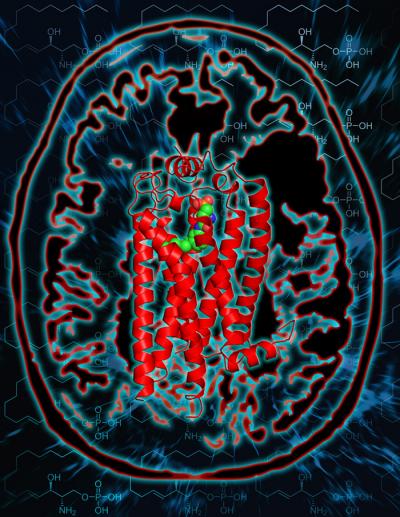
Scientists at Scripps Research and Receptos have created the first high-resolution virtual image of cellular structures called S1P1 receptors, which are critical in controlling the onset and progression of multiple sclerosis and other diseases. Credit: Image courtesy of the Rosen and Stevens labs, the Scripps Research Institute.
A team of scientists from the Scripps Research Institute, collaborating with members of the drug discovery company Receptos, has created the first high-resolution virtual image of cellular structures called S1P1 receptors, which are critical in controlling the onset and progression of multiple sclerosis and other diseases. This new molecular map is already pointing researchers toward promising new paths for drug discovery and aiding them in better understanding how certain existing drugs work.
The molecular structure, described in the February 17, 2012 issue of the journal Science, is unique as the first-ever-to-be-determined lipid G protein-coupled receptor (GPCR). Molecules of this type play important roles in everything from cancer to metabolism, and this recent success should pave the way for researchers to establish the structures of other family members.
"There's something special about the S1P1 receptor," said Hugh Rosen, MD, PhD, a Scripps Research chemical biologist who co-led the work with Raymond Stevens, PhD, a structural biologist also from The Scripps Research Institute. "The biological consequences of even small changes with this receptor are profound. Understanding its structure provides clues about fundamental processes important in both health and disease."
"Being able to finally look at a lipid GPCR and the occluded cell surface binding pocket was a surprise but explains many of the issues we wondered about," said Stevens. "It is likely that other members of this subfamily will have a similar protein architecture."
The study is a result of decades of research by the Stevens lab to develop methods to determine the structure of GPCRs, much work in the Rosen lab on the receptor biology and chemical tools to stabilize such molecules, and a multi-disciplinary collaboration between the two labs, which Rosen notes is one of the hallmarks of research at The Scripps Research Institute. The scientists acknowledge the support of the National Institutes of Health Common Fund as making the new findings possible.
"This work promises to underscore the importance of research collaboration to accelerate scientific discovery and development of new drug therapies," said James M. Anderson, MD, PhD, director of the Division of Program Coordination, Planning, and Strategic Initiatives that guides the NIH Common Fund. "Combining structure-based analysis with small molecule screening serves as a model for effective drug design."
Controlling Multiple Sclerosis
The new work reveals the structure of the S1P1 receptor, a protein embedded in the membranes of various cell types. When natural ligands such as the signaling lipid sphingosine 1-phosphate or potential drugs make specific interactions deep in receptor, portions of the receptor change shape to trigger cascades of chemical reactions inside the cell important to the maintenance of health.
Researchers have long known that S1P1 receptors play critical roles in controlling multiple sclerosis and other diseases. One way these receptors do this is by regulating the flow of certain white blood cells, or lymphocytes, out of lymph nodes.
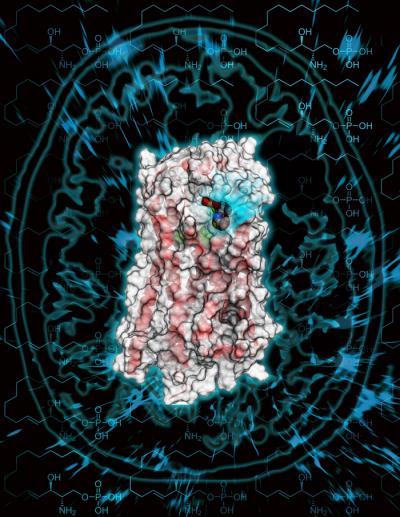
Scientists at Scripps Research and Receptos have created the first high-resolution virtual image of cellular structures called S1P1 receptors, which are critical in controlling the onset and progression of multiple sclerosis and other diseases. Credit: Image courtesy of the Rosen and Stevens labs, the Scripps Research Institute.
This is critical because in patients with multiple sclerosis, auto-reactive lymphocytes attack the protective sheaths of nerve cells in the brain, causing malfunctions in the way the central nervous system transmits signals through the body. The S1P1 receptors are also involved in the progressions of harmful scarring and swelling in response to lymphocyte damages in the brain.
Gilenya, the first oral drug approved to treat multiple sclerosis, reduces this lymphocyte flow out of the lymph nodes in ways first identified by Rosen's lab about 10 years ago. Based on a screening lead from the National Institutes of Health Molecular Libraries Small Molecule Repository, Rosen and Scripps Research Chemistry Professor Ed Roberts discovered and optimized other modulators of S1P1 receptors. This led to RPC-1063, a compound in clinical trials for multiple sclerosis by Receptos, a company co-founded by Rosen and Stevens.
Rosen's lab has also shown that modulating S1P1 receptors can protect mice from a pandemic flu virus. This shows that the receptors may also be good drug development targets for other conditions tied to immune responses.
A Shifting Binding Pocket
The new study used the technique of x-ray crystallography to reveal the high-resolution three-dimensional image of the S1P1 receptor. The results provide scientists with important new details about the receptor's mechanism of action.
One aspect of the receptor structure that is of particular interest is the binding pocket for the natural ligand or potential drugs that activate the receptor responses. The structure revealed how the binding pocket shifts to activate signaling. Understanding how that occurs makes it easier to identify additional compounds that might have effects in controlling the receptors.
With this structural information in hand, the scientists can now advance efforts to understand the specific chemical transformations that drive the cellular responses tied to multiple sclerosis and other diseases. "Better understanding always allows you to think about applications in a variety of ways that you might not have thought about before," said Rosen. "This is an area that will keep us busy for many years to come."
The S1P1 receptor structure has already yielded benefits, according to Michael Hanson, a scientist and director at Receptos, and lead author of the new paper. "The structure has helped us understand the details regarding receptor-ligand interactions for this receptor and structural data can be used more routinely for drug discovery projects of other GPCRs," he said.
More information: "Crystal Structure of a Lipid G protein-Coupled Receptor," Science, February 17, 2012.
Journal information: Science
Provided by The Scripps Research Institute


