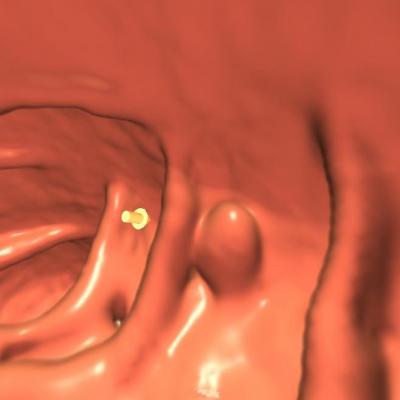
This is a CT colonography image, after electronic cleansing, showing an intestinal polyp. The yellow arrow indicating the location of a potential polyp was produced by the computer-aided polyp detection system. Credit: Michael Zalis, M.D., Massachusetts General Hospital Imaging
A CT-scan-based form of virtual colonoscopy that does not require laxative preparation appears to be as effective as standard colonoscopy in identifying the intestinal polyps most likely to become cancerous. In the May 15 issue of Annals of Internal Medicine, a Massachusetts General Hospital (MGH)-based research team reports finding that the new technique, which uses computer-aided systems both to virtually cleanse and to analyze the images acquired, was able to identify more than 90 percent of the common polyps called adenomas that were 10 mm or larger.
"While we know that colon screening can save lives, not enough people participate, in part because of the discomfort of the required laxative preparation," says Michael Zalis, MD, director of CT Colonography at MGH Imaging, who led the study. "In our study, the laxative-free form of CT colonography performed well enough that it might someday become an option for screening, which we hope would increase patient participation."
Optical colonoscopy, the most common form of screening for colon cancer, allows examination of the internal surface of the colon through a fiberoptic tube with a light and camera at the end. In addition to being sedated for the examination, patients must ingest laxative preparations – sometimes up to a gallon of liquid – the preceding day in order to completed clean out the colon, a process universally regarded as unpleasant. CT colonography, which produces images via CT scanning and not direct visualization, has become available in recent years. But while it is as effective as colonoscopy for detecting polyps, does not require sedation, and can be used in some patients for whom colonoscopy is not appropriate, CT colonography still requires the laxative preparation that many patients choose to avoid.
Preparation for the procedure tested in the current study involves two days of a low-fiber diet and oral ingestion of small doses of a contrast agent to label fecal material in the colon. Software programs developed by the MGH team subtract labeled feces from the CT images and analyze the images for the presence of lesions – primarily adenomas, the type of polyps most likely to develop into cancer. The investigators recruited patients scheduled for screening colonoscopy between June 2005 and October 2010 at the MGH, Brigham and Women's Hospital, North Shore Medical Center and the Veteran's Administration Medical Center at the University of California at San Francisco; and 604 patients completed the full protocol.
The laxative-free CT colonography procedures were done within the 5 weeks before the scheduled optical colonoscopies. Gastroenterologists performing the colonoscopies were not informed of polyps identified in the first procedure until they had completed the initial examination, allowing a second-pass colonoscopy to confirm and if necessary remove any missed polyps. CT colonography results were interpreted by three MGH radiologists trained in the use of both the virtual cleansing and the lesion detection systems but blinded to the results of the colonoscopies and to the diagnosis of any removed tissues. Patients also completed written surveys of their experiences with both procedures and were asked which they preferred.
Study results showed the effectiveness of computer-assisted, laxative-free CT colonography to be comparable to that of optical colonoscopy for detecting adenomas 10 mm or larger. While it did not do as well finding smaller polyps, those lesions are less likely to show cellular changes associated with higher risk for cancer development. Among colonoscopy-confirmed lesions that showed such risk-associated changes, 85 percent were 10 mm or larger. Three cases of colon cancer were diagnosed among the study group, and all of those lesions were 10 mm or larger and were detected by both screening methods. Participants completing the survey indicated that laxative-free CT colonography is more comfortable and easier to prepare for, and it was the preferred screening method for 62 percent of respondents.
"Colon cancer is common, with more than 120,000 new cases and approximately 50,000 deaths in the U.S. each year; and it is largely preventable through screening. So the most important thing is for all adults over 50 to be screened," Zalis stresses. "After the question of access to care, the biggest public health issue is getting people to participate in any type of colon screening. While optical colonoscopy is a very effective test, not enough people are willing or able to undertake it. Our results suggest that this more patient-friendly form of screening is feasible and can perform well enough to really help screen patients.
"If these results hold up in larger trials, we would expect this procedure would first be offered to moderate-risk patients who are otherwise unable or unwilling to be screened," he adds. "If we can validate that this form of CT colonography performs reasonably well for screening and is easier for patients, it could have a significant impact on reducing the incidence of colon cancer and related cancer deaths." An associate professor of Radiology at Harvard Medical School, Zalis notes that the radiation dose associated with CT colonography is much lower than that of diagnostic CT scanning and would be considered safe for widespread screening.
Journal information: Annals of Internal Medicine
Provided by Massachusetts General Hospital


