Blue light helps tired workers and motorists regulate their internal clocks

August 1, 2012 in Health

Blue light helps tired workers and motorists regulate their internal clocks

Enlarge

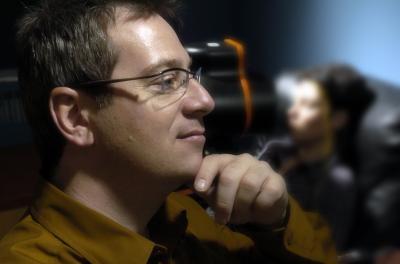
Professor Marc Hebert works in the Department of Ophthalmology at Universite Laval and is a researcher at the Centre de recherche de l'Institut universitaire en sante mentale de Quebec. Credit: Université Laval

Researchers at Universite Laval have developed a blue light to help bleary eyed shift workers regulate their internal clocks and get the sleep they need when they need it.

One-third of 's – approximately 6.5 million people – work shifts that keep them awake at night and require them to sleep during the day. From police officers and firefighters to manufacturers and truck drivers, many Canadians rely on an assortment of coffee, energy drinks and medication to keep themselves alert at night and sleep when the sun is shining.

But now, researchers at Université Laval have developed a that helps to better regulate people's biological clocks, ensuring they are awake while on the job and that they can sleep when their shift ends. Université Laval, which has received funding from the Government of Canada through the Canada Foundation for Innovation (CFI),has partnered with Canada Post, forestry company Abitibi-Bowater and the Quebec City police department to test the effectiveness of the blue light when it comes to managing the of night .

" and their families know the toll that this lifestyle can take on their health," says Marc Hébert, a professor in the Department of Ophthalmology at Université Laval and researcher at the Centre de recherche de l'Institut universitaire en santé mentale de Québec (IUSMQ)."We are using light to help people's bodies adjust in a more natural way – without the need to ingest a lot of caffeine or pills."

Low level blue light simulates the sky and tricks the body into thinking it is daytime. Special glasses are later worn to block the blue light, giving the body a signal that it is nighttime. This causes the body to relax and prepare for .

Professor Hébert's team recently installed machines that emit blue light in a number of police patrol cars to study the effects. Preliminary results show that Quebec City police officers who were exposed to the blue light fell asleep easier and slept longer than their counterparts who did not have the light in their cars. Similar results were found with workers at Canada Post and Abitibi-Bowater who, on average, slept 40 minutes more when exposed to the blue light.

"Our government is investing in the well-being of our communities by funding research that will help keep workers and their families safe," said the Honourable Gary Goodyear, Minister of State for Science and Technology. "This is a great example of research innovation at universities and colleges that is delivering results for Canadians."

The blue light also has the potential to help relieve driver fatigue and make Canada's roads and highways safer. According to Transport Canada, 20 percent of fatal driving accidents are caused by driver fatigue. In Quebec, more than 100 motorists' deaths a year are attributed to people being overtired. Getting workers home safely means ensuring that they aren't dozing off during their commute. The blue light could eventually be used with truck drivers, airline pilots and other people who need to remain alert behind the wheel or at the controls.

Professor Hébert is working to take his invention to market. A spin-off company called Chronophotonix Inc. has been established in Quebec City to commercialize the unique blue light and ensure that Canada's shift workers benefit from this research innovation.

Provided by Canada Foundation for Innovation

5 /5 (1 vote)  

Filter


Move the slider to adjust rank threshold, so that you can hide some of the comments.


Display comments: newest first

knikiy
Aug 03, 2012

Rank: not rated yet
And coffee makes me think I can drive when I'm soused. But who cares? Its all about numbers. There are so many of us and we be must be increasingly and continually improving our efficiency to serve industry (unless you're on the top floor & you can fudge the numbers).
Rank 5 /5 (1 vote)
Related Stories
Relevant PhysicsForums posts

More news stories

Aggressive behavior linked specifically to secondhand smoke exposure in childhood

Children who are exposed to secondhand smoke in early childhood are more likely to grow up to physically aggressive and antisocial, regardless of whether they were exposed during pregnancy or their parents have a history ...

Health created 1 hour ago | popularity 1 / 5 (1) | comments 0

Most elite athletes believe doping substances are effective in improving performance

Most elite athletes consider doping substances "are effective" in improving performance, while recognising that they constitute cheating, can endanger health and entail the obvious risk of sanction. At the same time, the ...

Health created 2 hours ago | popularity not rated yet | comments 0

New rice contamination reported in China

Authorities are investigating rice mills in southern China following tests that found almost half of the staple grain in one of the country's largest cities was contaminated with a toxic metal.

Health created 5 hours ago | popularity 5 / 5 (1) | comments 0

Warning images for cigarette packs do not make a strong enough emotional impact

The warning images Brussels proposes to include on tobacco packages in order to reduce consumption do not make the desired impact on smokers because they only find some of them really unpleasant. So, if the ...

Health created 6 hours ago | popularity not rated yet | comments 0

Cancer and birth defects in Iraq: The nuclear legacy

Ten years after the Iraq war of 2003 a team of scientists based in Mosul, northern Iraq, have detected high levels of uranium contamination in soil samples at three sites in the province of Nineveh which, coupled with dramatically ...

Health created 6 hours ago | popularity not rated yet | comments 0


Drugs found to both prevent and treat Alzheimer's disease in mice

Researchers at USC have found that a class of pharmaceuticals can both prevent and treat Alzheimer's Disease in mice.

Decisions to forgo life support may depend heavily on the ICU where patients are treated

The decision to limit life support in patients in the intensive care unit (ICU) appears to be significantly influenced by physician practices and/or the culture of the hospital, suggests new findings from researchers at the ...

Better behavior after tonsil/adenoid surgery for kids with sleep breathing trouble?

Children with obstructive sleep apnea who had a common surgery to remove their tonsils and adenoids showed notable improvements in behavior, quality of life and other symptoms compared to those treated with "watchful waiting" ...

If you can remember it, you can remember it wrong

(Medical Xpress)—Native peoples in regions where cameras are uncommon sometimes react with caution when their picture is taken. The fear that something must have been stolen from them to create the photo ...

B vitamins could delay dementia

(Medical Xpress)—Despite spending billions of dollars on research and development, drug companies have been unable to come up with effective treatments for dementia and Alzheimer's Disease (AD). Now, A. ...

Insight into the dazzling impact of insulin in cells

Australian scientists have charted the path of insulin action in cells in precise detail like never before. This provides a comprehensive blueprint for understanding what goes wrong in diabetes.