The screening of thousands of fluorescent molecules has revealed a specific label for neural stem cells
October 24, 2012 in Medical research
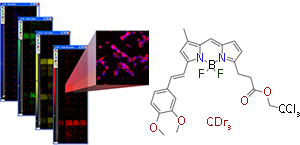
In a high-throughput screening of fluorescent molecules, the fluorescent compound CDr3 stained neural stem cells the most brightly and specifically. Credit: 2012 National Academy of Sciences, USA (inset, pink); © 2012 A*STAR Singapore Bioimaging Consortium (main image)
Neural stem cells are the precursors of cells in the nervous system. As well as being crucial for early development, they are present throughout life, contributing to flexibility and repair of the nervous system. As such, they can be used to study the brain, and may offer new ways of treating neurological disease.
Current techniques for identifying and labeling live neural stem cells use antibodies to detect specific cell-surface molecules. Small fluorescent molecules, which are commonly used to visualize the locations and movements of molecules and cells, may offer a more convenient and safer alternative.
Young-Tae Chang at the A*STAR Singapore Bioimaging Consortium and co-workers have now identified a fluorescent compound that specifically labels neural stem cells by binding to an intracellular protein. The molecule, named CDr3, was singled out for its selective labeling of neural stem cells after testing thousands of fluorescent compounds from a 'Diversity Oriented Fluorescence Library', or DOFL.
"A DOFL is a collection of intrinsically fluorescent low molecular weight compounds which have been synthesized, purified and characterized in our lab," says co-author Seong-Wook Yun. "We have generated more than 10,000 DOFL compounds so far, each with different chemical and biological properties."
The researchers narrowed down the number of potentially useful molecules by assessing how strongly they labeled stem cells, and finally determined that CDr3 stained them the most selectively and brightly (see image). They confirmed the specificity of labeling by incubating CDr3 with different cell types and showing that it only stained neural stem cells. Growing stem cells in the presence of CDr3 also showed that it does not affect their survival or division.
A combination of molecular biology techniques revealed that CDr3 labeled the cells by binding to a neural stem cell-specific protein called FABP7. This is found inside the cell, unlike other labeling targets. "Conventionally, live neural stem cells have been identified by detecting cell surface molecules," explains Yun. "However, these molecules are also highly expressed in other types of cells. FABP7 is a specific intracellular marker of neural stem cells."
Labeling of neural stem cells with CDr3 not only allowed them to be identified, but also to be separated from other types of cells. According to Yun, this is important for practical applications.
"Detection and isolation of live neural stem cells from heterogeneous cell populations is a key technology, not only for basic research but also for the development of cell-based therapeutics and drug development," he says.
More information: Yun, S.-W., Leong, C., Duanting, Z., Tan, Y. L., Lim, L. et al. Neural stem cell specific fluorescent chemical probe binding to FABP7. Proceedings of the National Academy of Sciences 109, 10214–10217 (2012). www.pnas.org/conte… 109/26/10214
Journal reference:
Proceedings of the National Academy of Sciences
Provided by
Agency for Science, Technology and Research (A*STAR), Singapore
-
New study hopeful on neural stem cells
Aug 05, 2006 |
not rated yet |
0
-
The sweet mysteries of the nervous system
May 10, 2011 |
not rated yet |
0
-
When is a stem cell not really a stem cell?
Aug 26, 2007 |
not rated yet |
0
-
Small molecules for neural stem cells
Apr 23, 2012 |
not rated yet |
0
-
Identification of a novel neural stem cell type
Jan 14, 2008 |
not rated yet |
0
-
Motion perception revisited: High Phi effect challenges established motion perception assumptions
Apr 23, 2013 |
3 / 5 (2) |
2
-
Anything you can do I can do better: Neuromolecular foundations of the superiority illusion (Update)
Apr 02, 2013 |
4.5 / 5 (11) |
5
-
The visual system as economist: Neural resource allocation in visual adaptation
Mar 30, 2013 |
5 / 5 (2) |
9
-
Separate lives: Neuronal and organismal lifespans decoupled
Mar 27, 2013 |
4.9 / 5 (8) |
0
-
Sizing things up: The evolutionary neurobiology of scale invariance
Feb 28, 2013 |
4.8 / 5 (10) |
14
-
Pressure-volume curve: Elastic Recoil Pressure don't make sense
May 18, 2013
-
If you became brain-dead, would you want them to pull the plug?
May 17, 2013
-
MRI bill question
May 15, 2013
-
Ratio of Hydrogen of Oxygen in Dessicated Animal Protein
May 13, 2013
-
Alcohol and acetaminophen
May 13, 2013
-
Marie Curie's leukemia
May 13, 2013
- More from Physics Forums - Medical Sciences
More news stories
Study suggests new source of kidneys for transplant
Nearly 20 percent of kidneys that are recovered from deceased donors in the U.S. are refused for transplant due to factors ranging from scarring in small blood vessels of the kidney's filtering units to the organ going too ...
Medical research
15 hours ago |
5 / 5 (2) |
0
|
Discovery of circadian clock in mice hair reveals period of time when damage from radiotherapy can be quickly repaired
Discovering that mouse hair has a circadian clock - a 24-hour cycle of growth followed by restorative repair - researchers suspect that hair loss in humans from toxic cancer radiotherapy and chemotherapy ...
Medical research
15 hours ago |
5 / 5 (2) |
1
|
Do salamanders hold the solution to regeneration?
Salamanders' immune systems are key to their remarkable ability to regrow limbs, and could also underpin their ability to regenerate spinal cords, brain tissue and even parts of their hearts, scientists have ...
Medical research
16 hours ago |
4.9 / 5 (7) |
2
|
New study finds blind people have the potential to use their 'inner bat' to locate objects
New research from the University of Southampton has shown that blind and visually impaired people have the potential to use echolocation, similar to that used by bats and dolphins, to determine the location of an object.
Medical research
19 hours ago |
not rated yet |
1
|
Germ-fighting vaccine system makes great strides in delivery
A novel vaccine study from South Dakota State University (SDSU) will headline the groundbreaking research that will be unveiled at the American Association of Pharmaceutical Scientists' (AAPS) National Biotechnology Conference ...
Medical research
19 hours ago |
not rated yet |
0
Sugar injections for knee arthritis may ease pain
(HealthDay)—Injections of a sugar solution appear to help relieve knee pain and stiffness related to osteoarthritis, a new study suggests.
Anti-CD47 antibody may offer new route to successful cancer vaccination
(Medical Xpress)—Scientists at the School of Medicine have shown that their previously identified therapeutic approach to fight cancer via immune cells called macrophages also prompts the disease-fighting killer T cells ...
Evaluating a new way to open clogged arteries
Over the past few decades, scientists have developed many devices that can reopen clogged arteries, including angioplasty balloons and metallic stents. While generally effective, each of these treatments ...
Losing weight may ease chronic heartburn
(HealthDay)—Obese and overweight men and women who suffer from heartburn often report relief when they lose weight, a new study shows.
Primary care docs should play role in kids' dental health, experts say
(HealthDay)—When it comes to the care of your children's teeth, dentists aren't the only experts who can help.
ATS: Early prone positioning reduces mortality in ARDS
(HealthDay)—For patients with acute respiratory distress syndrome (ARDS), prolonged prone positioning during mechanical ventilation is associated with significantly reduced mortality at 28 and 90 days, ...