Artificial liver cells win their creator prize for their potential to reduce animal experiments

February 29, 2012 in Medical research

Artificial liver cells win their creator prize for their potential to reduce animal experiments

Enlarge

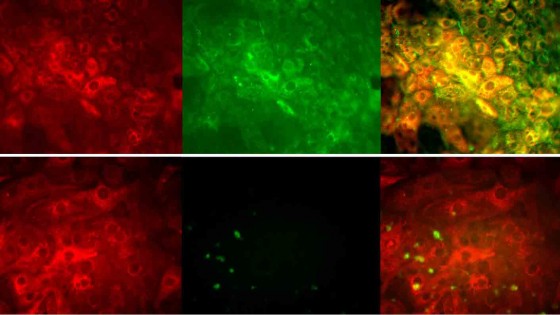
Top images diseased liver cells, bottom images healthy liver cells. Credit: Tamir-Rashid

Cambridge research that created liver cells from stem cells has today been recognised with a national prize by the National Centre for the Replacement, Refinement and Reduction of Animals in Research (NC3Rs).

Producing liver cells that demonstrate inherited from has earned Dr. Ludovic Vallier from the University of Cambridge a major prize from the National Centre for the Replacement, Refinement and Reduction of Animals in Research (NC3Rs). These cells, known as human induced (hIPSCs), have already attracted attention for the they offer to regenerate damaged tissues and organs. But it is their potential to reduce the number of animals used for screening potential drug treatments that led to Dr. Vallier receiving the Centre’s 3Rs prize for 2011.

The prize, sponsored by GlaxoSmithKline, of a £2,000 personal award and a £18,000 research grant, is for the scientific paper published in the last three years that contributes most to the advancement of the 3Rs (Replacement, Reduction and Refinement). Dr Vallier’s winning paper was published in The Journal of Clinical Investigation in 2010. He received his prize from Professor Paul Matthews OBE of GlaxoSmithKline at the NC3Rs Annual Science Review Meeting in London on 28 February.

Human liver cells (hepatocytes) cannot be grown in the laboratory and differences between rodents and humans mean that it is rarely possible to recreate the human disease completely in mice or rats or to use cultures of rat or mouse liver cells. Dr Vallier’s team took skin cells (dermal fibroblasts) from seven patients with a variety of inherited liver diseases and three healthy individuals (the controls). They then reprogrammed cells from the skin samples back into . These stem cells were then used to generate liver cells which mimicked a broad range of liver diseases – and to create ‘healthy’ liver cells from the control group.

These hIPSC-generated liver cells can provide in vitro models for basic research and drug discovery. Their use has already reduced the use of animals needed for the production of in the laboratories that have adopted this technology. The cells could also transform the investigation of chemical/drug-induced liver injury, a major concern for the chemical and pharmaceutical industries, by reducing dependence on animal testing.

Sharmila Nebhrajani, chief executive of the Association of Medical Research Charities (AMRC) said:  “Charities invest over £1bn in health research each year, money raised by patients, their families and carers to understand the causes of disease and search for possible cures. Using 3Rs techniques, these prize winning researchers are bringing real hope to people with liver disease. What’s more – they are developing new methods for medical research which should benefit patients with all kinds of conditions.”

On presenting Dr. Vallier with his , Professor Paul Matthews, Vice-President for Imaging at GlaxoSmithKline, commented: “Ludovic Vallier’s innovative study describes the development and validation of a method to produce cells similar to those in a human liver. Such cells could replace animals for some types of early drug testing and could also help us to predict adverse clinical reactions. Using these cells for drug testing could be transformative.  Ludovic and his colleagues have well illustrated how addressing the 3Rs converges with improving the quality of science!”

Provided by University of Cambridge search and more info website

not rated yet  

Rank not rated yet
Related Stories
Relevant PhysicsForums posts

More news stories

H. pylori, smoking trends, and gastric cancer in US men

Trends in Helicobacter pylori (H. pylori) and smoking explain a significant proportion of the decline of intestinal-type noncardia gastric adenocarcinoma (NCGA) incidence in US men between 1978 and 2008, and are estimated ...

Medical research created 13 hours ago | popularity not rated yet | comments 0

Common food supplement fights degenerative brain disorders

Widely available in pharmacies and health stores, phosphatidylserine is a natural food supplement produced from beef, oysters, and soy. Proven to improve cognition and slow memory loss, it's a popular treatment for older ...

Medical research created 18 hours ago | popularity 5 / 5 (3) | comments 0 | with audio podcast

Finding a family for a pair of orphan receptors in the brain

Researchers at Emory University have identified a protein that stimulates a pair of "orphan receptors" found in the brain, solving a long-standing biological puzzle and possibly leading to future treatments for neurological ...

Medical research created 18 hours ago | popularity 5 / 5 (1) | comments 0 | with audio podcast

Insight into the dazzling impact of insulin in cells

Australian scientists have charted the path of insulin action in cells in precise detail like never before. This provides a comprehensive blueprint for understanding what goes wrong in diabetes.

Medical research created 19 hours ago | popularity 4.6 / 5 (7) | comments 0 | with audio podcast

Do men's and women's hearts burn fuel differently?

Researchers at the University of Illinois at Chicago College of Medicine will study gender differences in how the heart uses and stores fat—its main energy source—and how changes in fat metabolism play ...

Medical research created 22 hours ago | popularity not rated yet | comments 0


Study says empathy plays a key role in moral judgments

Is it permissible to harm one to save many? Those who tend to say "yes" when faced with this classic dilemma are likely to be deficient in a specific kind of empathy, according to a report published in the scientific journal ...

Phthalates: Study links chemicals widely found in plastics, processed food to elevated blood pressure in children, teens

Plastic additives known as phthalates (pronounced THAL-ates) are odorless, colorless and just about everywhere: They turn up in flooring, plastic cups, beach balls, plastic wrap, intravenous tubing and—according to the ...

If you can remember it, you can remember it wrong

(Medical Xpress)—Native peoples in regions where cameras are uncommon sometimes react with caution when their picture is taken. The fear that something must have been stolen from them to create the photo ...

B vitamins could delay dementia

(Medical Xpress)—Despite spending billions of dollars on research and development, drug companies have been unable to come up with effective treatments for dementia and Alzheimer's Disease (AD). Now, A. ...

Reducing caloric intake delays nerve cell loss

Activating an enzyme known to play a role in the anti-aging benefits of calorie restriction delays the loss of brain cells and preserves cognitive function in mice, according to a study published in the May ...

New sleeping pill poised to hit US markets

An experimental sleeping pill from US drug company Merck is effective at helping people fall and stay asleep, according to reviewers at the US Food and Drug Administration, which could soon approve the new drug.