Epigenetic processes orchestrate neuronal migration
January 11, 2013 in Neuroscience
(Medical Xpress)—Neurobiologists at the Friedrich Miescher Institute for Biomedical Research (FMI) are the first to show that directional migration of neurons during brain development is controlled through epigenetic processes. In an elaborate study bridging epigenetics and neurobiology, the scientists found that the migratory pattern is orchestrated through epigenetic regulation of genes within neurons and spatial signals in the environment. Their study has been published in Science.
As the foundation for our mind is laid, 100 billion cells are formed and appropriately connected in the brain. Despite the huge number of cells, no aspect of this process is left entirely to chance. Neurons divide, take on defined identities, migrate to the correct nodes in the network and send out their connecting axons along predefined paths to make contact with specific target neurons. The blueprint for these arrangements is encoded in the genome. However, how coordinated transcription of genes is finely tuned to achieve the precision of these processes is not yet clear.
A study by the research group of Filippo Rijli, group leader at the FMI and Professor of Neurobiology at the University of Basel, shows now for the first time that long-distance neuronal migration in the developing brain is regulated through transcriptional programs that are epigenetically controlled.
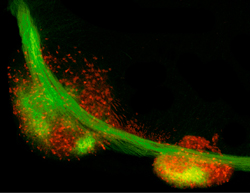
In their study published in Science, the neurobiologists have looked at a part of the brain called the brain stem and, in particular, at the neuronal ensembles forming the so-called precerebellar pontine nuclei. These nuclei are particularly important for the relay of information from the sensory and motor cortex to the cerebellum. During development, neurons, which will gather to form the pontine nuclei, migrate a long way from a distant progenitor compartment to their final positions, where they form connections that are vital for coordinated movement. The migratory path of these cells is defined by the relative position of the neuron in the progenitor compartment and is controlled by its specific combinatorial expression of Hox genes. Hox genes encode transcription factors and play an important role in many developmental processes that rely on a body plan and confer cellular identity.
It has been known that neurons in the precerebellar pontine nuclei start to migrate in the wrong direction as soon as their Hox identity has been disrupted. The Rijli team has now shown that epigenetic processes control the maintenance of appropriate Hox expression during migration. The key player in this scenario is a major contributor to mammalian epigenetic control, the histone methyl-transferase Ezh2. Ezh2 methylates histones and silences specific stretches of DNA, thus maintaining certain Hox genes repressed, while allowing expression of others.
Ezh2 also regulates the appropriate response to environmental clues that direct neuronal migration. The cells in the brain stem bathe in a sea of attractants and repellants. They respond to these stimuli depending on their identity and adapt their migratory paths. Rijli and colleagues found that Ezh2 controls transcription of both environmental Netrin, a neuronal attractant molecule and of its repellant receptor Unc5b in migrating neurons, such that the appropriate balance between attraction and repulsion is maintained throughout migration to keep neurons on track.
"Being able to link epigenetic regulation with a complex process such as long-distance directional neuronal migration during brain development is extremely exciting," comments Rijli. "All the more we were delighted to see that the migratory pattern is not only epigenetically maintained through an intrinsic program established in the progenitor, but is also coordinated with an Ezh2-dependent silencing program that regulates the spatial distribution of extrinsic signals in the migratory environment. The knowledge gained from our studies contributes as well to our understanding of certain neurological syndromes that are caused by faulty neuronal migration and are currently incurable."
More information: Di Meglio T. et al., (2013) Ezh2 orchestrates topographic tangential migration and connectivity of mouse precerebellar neurons. Science, 339:204-207. www.sciencemag.org… 204.abstract
Journal reference:
Science
Provided by
Friedrich Miescher Institute for Biomedical Research
-
Keeping retinoic acid in check
Apr 19, 2011 |
not rated yet |
0
-
Study characterizes epigenetic signatures of autism in brain tissue
Nov 07, 2011 |
not rated yet |
0
-
Novel epigenetic patterns involved in cell fate regulation
Dec 15, 2011 |
not rated yet |
0
-
Researchers identify a molecular switch that controls neuronal migration in the developing brain
Nov 25, 2010 |
not rated yet |
0
-
Driving developing brain neurons in the right direction
Jul 16, 2012 |
not rated yet |
0
-
Motion perception revisited: High Phi effect challenges established motion perception assumptions
Apr 23, 2013 |
3 / 5 (2) |
2
-
Anything you can do I can do better: Neuromolecular foundations of the superiority illusion (Update)
Apr 02, 2013 |
4.5 / 5 (11) |
5
-
The visual system as economist: Neural resource allocation in visual adaptation
Mar 30, 2013 |
5 / 5 (2) |
9
-
Separate lives: Neuronal and organismal lifespans decoupled
Mar 27, 2013 |
4.9 / 5 (8) |
0
-
Sizing things up: The evolutionary neurobiology of scale invariance
Feb 28, 2013 |
4.8 / 5 (10) |
14
-
Why is zone 1 in liver more prone to ischemic injury?
20 hours ago
-
How can there be villous adenoma in colon, if there are no villi there
May 22, 2013
-
How can there be a term called "intestinal metaplasia" of stomach
May 21, 2013
-
Pressure-volume curve: Elastic Recoil Pressure don't make sense
May 18, 2013
-
If you became brain-dead, would you want them to pull the plug?
May 17, 2013
-
MRI bill question
May 15, 2013
- More from Physics Forums - Medical Sciences
More news stories
Controlling mood through the motions of mitochondria
(Medical Xpress)—Regulating the distribution of power in neurons is done by a system that makes the national electric grid look simple by comparison. Each neuron has several thousand mitochondria confined ...
Neuroscience
6 hours ago |
4.8 / 5 (5) |
0
|
Brain uses internal 'average voice' prototype to identify who is talking
(Medical Xpress)—The human brain is able to identify individuals' voices by comparing them against an internal 'average voice' prototype, according to neuroscientists.
Neuroscience
10 hours ago |
1 / 5 (1) |
0
|
Depression common among children with temporal lobe epilepsy
A new study determined that children and adolescents with seizures involving the temporal lobe are likely to have clinically significant behavioral problems and psychiatric illness, especially depression. Findings published ...
Neuroscience
10 hours ago |
not rated yet |
0
The secret lives, and deaths, of neurons
As the human body fine-tunes its neurological wiring, nerve cells often must fix a faulty connection by amputating an axon—the "business end" of the neuron that sends electrical impulses to tissues or other ...
Neuroscience
12 hours ago |
5 / 5 (2) |
0
|
Regenerating spinal cord fibers may be treatment for stroke-related disabilities
A study by researchers at Henry Ford Hospital found "substantial evidence" that a regenerative process involving damaged nerve fibers in the spinal cord could hold the key to better functional recovery by most stroke victims.
Neuroscience
12 hours ago |
not rated yet |
0
|
ACP issues recommendations for management of high blood glucose in hospitalized patients
High blood glucose is associated with poor outcomes in hospitalized patients, and use of intensive insulin therapy (IIT) to control hyperglycemia is a common practice in hospitals. But the recent evidence does not show a ...
Motion quotient: IQ predicted by ability to filter motion (w/ video)
A brief visual task can predict IQ, according to a new study. This surprisingly simple exercise measures the brain's unconscious ability to filter out visual movement. The study shows that individuals whose ...
Multiple research teams unable to confirm high-profile Alzheimer's study
Teams of highly respected Alzheimer's researchers failed to replicate what appeared to be breakthrough results for the treatment of this brain disease when they were published last year in the journal Science.
Scientists discover molecule triggers sensation of itch
Scientists at the National Institutes of Health report they have discovered in mouse studies that a small molecule released in the spinal cord triggers a process that is later experienced in the brain as ...
Researchers find common childhood asthma unconnected to allergens or inflammation
Little is known about why asthma develops, how it constricts the airway or why response to treatments varies between patients. Now, a team of researchers at Weill Cornell Medical College, Columbia University Medical Center ...
Type 2 diabetes progresses faster in kids, study finds
(HealthDay)—Type 2 diabetes is more aggressive in children than adults, with signs of serious complications seen just a few years after diagnosis, new research finds.