Researchers uncover new clues about the origin of cancer

June 6, 2012 in Cancer

Researchers uncover new clues about the origin of cancer

Enlarge

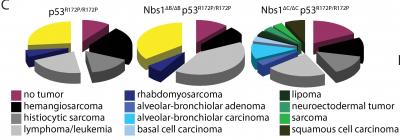
Different types of tumor arise, depending on the mutation of certain proteins involved in DNA damage response, cell cycle check-points and apoptosis. Credit: Travis H. Stracker (IRB Barcelona)

A study by Travis H. Stracker, researcher at the Institute for Research in Biomedicine (IRB Barcelona), in collaboration with scientists at the Memorial Sloan Kettering Cancer Center (MSKCC) in New York, reveals new information about the origin of tumors.

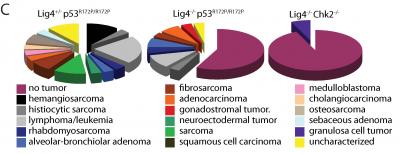
In this study, published in the journal (PNAS), the scientists postulate that the initiation of a tumor and the type and aggressivity of the same depend on a specific combination of defects in several processes that safeguard cell integrity, such as DNA repair pathways and check-points. The study also demonstrates that mice with a high degree of chromosomal instability and defective programmed cell death (apoptosis), two hallmarks of cancer, rarely develop tumors.

"Whether or not a tumor develops depends on the moment of the cell cycle in which the damage occurs, which repair pathways components are affected, and which others are impaired in terms of apoptosis and cell cycle arrest", explains the North-American Travis H. Stracker, head of the "Genomic Instability and Cancer" group and an expert in DNA repair pathways and its implications on human health. In this study, H. Stracker and his team report on some of these combinations for the initiation of cancer and in different kinds of tissue. "The paper points out that our understanding of which aspects of damage response promote tumorigenesis and where they play a role in the process needs to be investigated further because it shows that it has been generalized and that there is a lot of specifics that are not at all clear."
Researchers uncover new clues about the origin of cancer
Enlarge

Different types of tumor arise, depending on the mutation of certain proteins involved in DNA damage response, cell cycle check-points and apoptosis. Credit: Travis H. Stracker (IRB Barcelona)

The researchers utilized mice carrying mutations in key involved in cancer. Next, they combined them with other mutations affecting cell cycle checkpoints or apoptosis until they hit upon the combinations that are sufficient to initiate tumorigenesis or to generate certain types of tumors. "It is like deconstructing cancer to find the factors responsible for it appearing", says H. Stracker.

During DNA replication in a dividing cell there is a series of checkpoints to test that duplication is taking place properly. If the cell detects errors in any of these phases, cell growth is halted and highly complex DNA repair processes are triggered. If the repair is defective and the cell accumulates many genomic errors, "watch-out" proteins step in, such as tumor suppressor p53. Such proteins activate (apoptosis) or cell cycle arrest (senescence). "A very complex network of pathways and proteins are involved", explains the researcher. "This study demonstrates that genomic instability per se is not sufficient to initiate a tumor and that we cannot generalize. We need to study the origin of different kinds of cancer in much greater depth and although it is as difficult as trying to find a needle in a haystack, we are slowly identifying the parts on which we should focus", he goes on to explain. The detection of the main players that cause different kinds of could be of great interest for the design of new diagnostic tools and specific treatments.

Journal reference: Proceedings of the National Academy of Sciences search and more info website

Provided by Institute for Research in Biomedicine (IRB Barcelona) search and more info website

not rated yet  

Rank not rated yet
Relevant PhysicsForums posts

More news stories

Small cancer risk following CT scans in childhood and adolescence confirmed

The gap between life expectancy in patients with a mental illness and the general population has widened since 1985 and efforts to reduce this gap should focus on improving physical health, suggest researchers in a paper ...

Cancer created 5 hours ago | popularity not rated yet | comments 0

Changing cancer's environment to halt its spread

By studying the roles two proteins, thrombospondin-1 and prosaposin, play in discouraging cancer metastasis, a trans-Atlantic research team has identified a five-amino acid fragment of prosaposin that significantly reduces ...

Cancer created 6 hours ago | popularity not rated yet | comments 0

Novel RNA-based classification system for colorectal cancer

A novel transcriptome-based classification of colon cancer that improves the current disease stratification based on clinicopathological variables and common DNA markers is presented in a study published in PLOS Medicine this w ...

Cancer created 6 hours ago | popularity not rated yet | comments 0

Low radiation scans help identify cancer in earliest stages

A study of veterans at high risk for developing lung cancer shows that low-dose computed tomography (LDCT) can be highly effective in helping clinicians spot tiny lung nodules which, in a small number of patients, may indicate ...

Cancer created 8 hours ago | popularity not rated yet | comments 0

Poliovirus vaccine trial shows early promise for recurrent glioblastoma

An attack on glioblastoma brain tumor cells that uses a modified poliovirus is showing encouraging results in an early study to establish the proper dose level, researchers at Duke Cancer Institute report.

Cancer created 10 hours ago | popularity not rated yet | comments 0


If you can remember it, you can remember it wrong

(Medical Xpress)—Native peoples in regions where cameras are uncommon sometimes react with caution when their picture is taken. The fear that something must have been stolen from them to create the photo ...

B vitamins could delay dementia

(Medical Xpress)—Despite spending billions of dollars on research and development, drug companies have been unable to come up with effective treatments for dementia and Alzheimer's Disease (AD). Now, A. ...

Reducing caloric intake delays nerve cell loss

Activating an enzyme known to play a role in the anti-aging benefits of calorie restriction delays the loss of brain cells and preserves cognitive function in mice, according to a study published in the May ...

New sleeping pill poised to hit US markets

An experimental sleeping pill from US drug company Merck is effective at helping people fall and stay asleep, according to reviewers at the US Food and Drug Administration, which could soon approve the new drug.

Insight into the dazzling impact of insulin in cells

Australian scientists have charted the path of insulin action in cells in precise detail like never before. This provides a comprehensive blueprint for understanding what goes wrong in diabetes.

Antidepressant reduces stress-induced heart condition

A drug commonly used to treat depression and anxiety may improve a stress-related heart condition in people with stable coronary heart disease, according to researchers at Duke Medicine.