New evidence on easing inflammation of brain cells for Alzheimer's disease
October 3, 2012 in Alzheimer's disease & dementia
New research proves the validity of one of the most promising approaches for combating Alzheimer's disease (AD) with medicines that treat not just some of the symptoms, but actually stop or prevent the disease itself, scientists are reporting. The study, in the journal ACS Medicinal Chemistry Letters, also identifies a potential new oral drug that the scientists say could lead the way.
Wenhui Hu and colleagues point out that existing drugs for AD provide only "minimal" relief of memory loss and other symptoms, creating an urgent need for new medicines that actually combat the underlying destruction of brain cells. Research suggests that inflammation of nerve cells in the brain is a key part of that process. One medicine, Minozac, is in clinical trials. But Hu says Minozac still has more space to improve its efficacy. So the scientists sifted through compounds with a molecular architecture similar to Minozac in an effort to find more active substances.
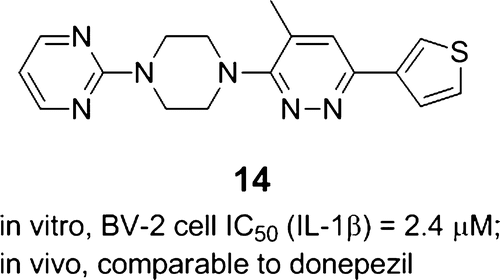
The report describes success in doing so. They discovered one compound that appeared especially effective in relieving nerve inflammation and in improving learning and memory in lab mice widely used in AD research. "In general, this study not only proves that countering neuroinflammation is indeed a potential therapeutic strategy for Alzheimer's disease, but also provides a good lead compound with efficacy comparable to donepezil [an existing AD medicine] for further oral anti-AD drug discovery and development," the report states.
More information: "Identification of Aminopyridazine-Derived Anti-neuroinflammatory Agents Effective in An Alzheimer's Mouse Model" ACS Med. Chem. Lett., Article ASAP
DOI: 10.1021/ml3001769
Abstract
Targeting neuroinflammation may be a new strategy to combat Alzheimer's disease. An aminopyridazine 1b previously reported as a novel antineuroinflammatory agent was considered to have a potential therapeutic effect for Alzheimer's disease. In this study, we further explored the chemical space to identify more potent antineuroinflammatory agents and validate their in vivo efficacy in an animal model. Compound 14 was finally identified as an effective agent with comparable in vivo efficacy to the marketed drug donepezil in counteracting spatial learning and working memory impairment in an Aβ-induced Alzheimer's mouse model.
Journal reference:
ACS Medicinal Chemistry Letters
Provided by
American Chemical Society
-
Advance toward an imaging agent for diagnosing Alzheimer's disease
Jan 11, 2012 |
not rated yet |
0
-
Researchers crack degeneration process that leads to Alzheimer's
Mar 08, 2012 |
not rated yet |
0
-
Chronic inflammation in the brain leads the way to Alzheimer's disease
Jul 02, 2012 |
not rated yet |
0
-
Evidence lacking for efficacy of memantine in treating mild Alzheimer's disease
Apr 11, 2011 |
not rated yet |
0
-
Anti-inflammatory drug blocks brain plaques
Jun 24, 2008 |
not rated yet |
0
-
Motion perception revisited: High Phi effect challenges established motion perception assumptions
Apr 23, 2013 |
3 / 5 (2) |
2
-
Anything you can do I can do better: Neuromolecular foundations of the superiority illusion (Update)
Apr 02, 2013 |
4.5 / 5 (11) |
5
-
The visual system as economist: Neural resource allocation in visual adaptation
Mar 30, 2013 |
5 / 5 (2) |
9
-
Separate lives: Neuronal and organismal lifespans decoupled
Mar 27, 2013 |
4.9 / 5 (8) |
0
-
Sizing things up: The evolutionary neurobiology of scale invariance
Feb 28, 2013 |
4.8 / 5 (10) |
14
-
question on coriolis effect with drag force
5 hours ago
-
Question of reflection and transmission of TEM wave in normal incidenc
11 hours ago
-
the rudyak-krasnolutski effective potencial
12 hours ago
-
Normal force for a lever model
13 hours ago
-
gravity is std. therefore can we rate a 'mass at height' by watts?
19 hours ago
-
Calculating on-axis elements of a solenoid
May 22, 2013
- More from Physics Forums - Classical Physics
More news stories
Scientists discover cinnamon compounds' potential ability to prevent Alzheimer's
Cinnamon: Can the red-brown spice with the unmistakable fragrance and variety of uses offer an important benefit? The common baking spice might hold the key to delaying the onset of –– or warding off ...
Alzheimer's disease & dementia
12 hours ago |
5 / 5 (5) |
0
|
Drug reverses Alzheimer's disease deficits in mice, research confirms
An anti-cancer drug reverses memory deficits in an Alzheimer's disease mouse model, University of Pittsburgh Graduate School of Public Health researchers confirm in the journal Science.
Alzheimer's disease & dementia
14 hours ago |
not rated yet |
0
|
Multiple research teams unable to confirm high-profile Alzheimer's study
Teams of highly respected Alzheimer's researchers failed to replicate what appeared to be breakthrough results for the treatment of this brain disease when they were published last year in the journal Science.
Alzheimer's disease & dementia
14 hours ago |
5 / 5 (1) |
2
|
Major human drug trial underway for Alzheimer's
A potentially ground-breaking human drug trial is currently underway, which aims to discover whether blood pressure medication can slow or halt the progression of Alzheimer's Disease (AD). This is the latest ...
Alzheimer's disease & dementia
17 hours ago |
not rated yet |
0
Drugs found to both prevent and treat Alzheimer's disease in mice
Researchers at USC have found that a class of pharmaceuticals can both prevent and treat Alzheimer's Disease in mice.
Alzheimer's disease & dementia
May 21, 2013 |
5 / 5 (7) |
0
|
Controlling mood through the motions of mitochondria
(Medical Xpress)—Regulating the distribution of power in neurons is done by a system that makes the national electric grid look simple by comparison. Each neuron has several thousand mitochondria confined ...
Motion quotient: IQ predicted by ability to filter motion (w/ video)
A brief visual task can predict IQ, according to a new study. This surprisingly simple exercise measures the brain's unconscious ability to filter out visual movement. The study shows that individuals whose ...
Scientists discover molecule triggers sensation of itch
Scientists at the National Institutes of Health report they have discovered in mouse studies that a small molecule released in the spinal cord triggers a process that is later experienced in the brain as ...
Researchers find common childhood asthma unconnected to allergens or inflammation
Little is known about why asthma develops, how it constricts the airway or why response to treatments varies between patients. Now, a team of researchers at Weill Cornell Medical College, Columbia University Medical Center ...
Diabetes' genetic underpinnings can vary based on ethnic background, studies say
Ethnic background plays a surprisingly large role in how diabetes develops on a cellular level, according to two new studies led by researchers at the Stanford University School of Medicine.
Study reveals new mechanism for estrogen suppression of liver lipid synthesis
By discovering the new mechanism by which estrogen suppresses lipid synthesis in the liver, UC Irvine endocrinologists have revealed a potential new approach toward treating certain liver diseases.