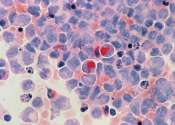
Chronic Lymphocytic Leukemia

New protein-targeting drug shows promise in early trial for patients with high-risk CLL

A new oral targeted drug, idelalisib (GS-1101), has the potential to stave off the need for additional treatments for relapsed or treatment-resistant chronic lymphocytic leukemia (CLL), according to a study led in part by ...

Cancer created May 17, 2013 | popularity not rated yet | comments 0 | with audio podcast

Leap in leukemia treatment reported by Dartmouth researchers

Doctors at Dartmouth-Hitchcock's Norris Cotton Cancer Center (NCCC) have found a combination of drugs to potentially treat chronic lymphocytic leukemia (CLL) more effectively. The research was published online on May 3, 2013, ...

Cancer created May 13, 2013 | popularity 5 / 5 (3) | comments 0

Molecule treats leukemia by preventing cancer cell repair, scientists report

(Medical Xpress)—Researchers at The Jackson Laboratory have identified a molecule that prevents repair of some cancer cells, providing a potential new "genetic chemotherapy" approach to cancer treatment ...

Cancer created Apr 17, 2013 | popularity 4.7 / 5 (3) | comments 0 | with audio podcast

Monoclonal antibody targets, kills leukemia cells

Researchers at the University of California, San Diego Moores Cancer Center have identified a humanized monoclonal antibody that targets and directly kills chronic lymphocytic leukemia (CLL) cells.

Cancer created Mar 25, 2013 | popularity 5 / 5 (4) | comments 0 | with audio podcast

T-cell therapy eradicates an aggressive leukemia in two children

Two children with an aggressive form of childhood leukemia had a complete remission of their disease-showing no evidence of cancer cells in their bodies-after treatment with a novel cell therapy that reprogrammed their immune ...

Cancer created Mar 25, 2013 | popularity 5 / 5 (4) | comments 0 | with audio podcast

Immune therapy shows early promise for advanced leukemia

(HealthDay)—An experimental therapy that targets the immune system might offer a new way to treat an often deadly form of adult leukemia, a preliminary study suggests.

Cancer created Mar 20, 2013 | popularity 5 / 5 (3) | comments 0 | with audio podcast

Study tracks leukemia's genetic evolution, may help predict disease course, tailor care

Tumors are not factories for the mass production of identical cancer cells, but are, in reality, patchworks of cells with different patterns of gene mutations. In a new study, researchers at Dana-Farber Cancer Institute and ...

Cancer created Feb 14, 2013 | popularity 5 / 5 (1) | comments 0

Experimental drug combination selectively destroys lymphoma cells

Laboratory experiments conducted by scientists at Virginia Commonwealth University Massey Cancer Center suggest that a novel combination of the drugs ibrutinib and bortezomib could potentially be an effective ...

Cancer created Feb 06, 2013 | popularity 4.5 / 5 (2) | comments 0 | with audio podcast

Recently identified receptor helps trigger first wave of immune response

B cells can generate different 'classes' of antibodies, each of which carries a specific type of protein chain that triggers a specific downstream cascade of immune responses. Immunoglobulin M (IgM) antibodies, ...

Immunology created Feb 01, 2013 | popularity 5 / 5 (1) | comments 0

NIH clinical trial begins for treatment of rare, fatal neurological disorder

A clinical trial to evaluate a drug candidate called cyclodextrin as a possible treatment for Niemann-Pick disease type C1 (NPC), a rare and fatal genetic disease, will start today, researchers announced. Scientists from ...

Diseases, Conditions, Syndromes created Jan 23, 2013 | popularity 5 / 5 (1) | comments 0

Gene in eye melanomas linked to good prognosis

Melanomas that develop in the eye often are fatal. Now, scientists at Washington University School of Medicine in St. Louis report they have identified a mutated gene in melanoma tumors of the eye that appears ...

Genetics created Jan 16, 2013 | popularity not rated yet | comments 0 | with audio podcast

CNIO researchers develop new databases for understanding the human genome

Scientists from the Structural Computational Biology Group at the Spanish National Cancer Research Centre (CNIO), led by Alfonso Valencia, together with French and American researchers, have published recently two articles ...

Genetics created Dec 17, 2012 | popularity not rated yet | comments 0

Older and younger chronic leukemia patients may need different therapy

Doctors should use different therapies when treating older and younger patients with chronic lymphocytic leukemia, according to a new study led by researchers at the Ohio State University Comprehensive Cancer Center – Arthur ...

Cancer created Dec 12, 2012 | popularity not rated yet | comments 0 | with audio podcast

Drug combination acts against aggressive chronic lymphocytic leukemia

A two-prong approach combining ibrutinib and rituximab (Rituxin®) to treat aggressive chronic lymphocytic leukemia (CLL) produced profound responses with minor side effects in a Phase 2 clinical trial at the University of ...

Cancer created Dec 10, 2012 | popularity 5 / 5 (2) | comments 0

Leukemia patients remain in remission more than two years after engineered T cell therapy

Nine of twelve leukemia patients who received infusions of their own T cells after the cells had been genetically engineered to attack the patients' tumors responded to the therapy, which was pioneered by scientists in the ...

Cancer created Dec 10, 2012 | popularity 5 / 5 (2) | comments 0


B-cell chronic lymphocytic leukemia (B-CLL), also known as chronic lymphoid leukemia (CLL), is the most common type of leukemia. Leukemias are cancers of the white blood cells (leukocytes). CLL affects B cell lymphocytes. B cells originate in the bone marrow, develop in the lymph nodes, and normally fight infection by producing antibodies. In CLL, the DNA of a B cell is damaged, so that it cannot produce antibodies.[citation needed] Additionally, B cells grow out of control and accumulate in the bone marrow and blood, where they crowd out healthy blood cells. CLL is a stage of small lymphocytic lymphoma (SLL), a type of B-cell lymphoma, which presents primarily in the lymph nodes. CLL and SLL are considered the same underlying disease, just with different appearances.

CLL is a disease of adults, but, in rare cases, it can occur in teenagers and occasionally in children (inherited). Most (>75%) people newly diagnosed with CLL are over the age of 50, and the majority are men.

Most people are diagnosed without symptoms as the result of a routine blood test that returns a high white blood cell count, but, as it advances, CLL results in swollen lymph nodes, spleen, and liver, and eventually anemia and infections. Early CLL is not treated, and late CLL is treated with chemotherapy and monoclonal antibodies.

DNA analysis has distinguished two major types of CLL, with different survival times. CLL that is positive for the marker ZAP-70 has an average survival of 5 years. CLL that is negative for ZAP-70 has an average survival of more than 25 years. Many patients, especially older ones, with slowly progressing disease can be reassured and may not need any treatment in their lifetimes.

This text uses material from Wikipedia and is available under the GNU Free Documentation License.

Latest Spotlight News

Engineered cytomegalovirus protects monkeys from HIV equivalent

(Medical Xpress)—A new study by researchers in the US has shown that an ancient virus can be modified to help in the fight against the simian immunodeficiency virus SIV, which is the equivalent in monkeys ...

Researchers identify first drug targets in childhood genetic tumor disorder

Two mutations central to the development of infantile myofibromatosis (IM)—a disorder characterized by multiple tumors involving the skin, bone, and soft tissue—may provide new therapeutic targets, according to researchers ...

Hormone levels may provide key to understanding psychological disorders in women

Women at a particular stage in their monthly menstrual cycle may be more vulnerable to some of the psychological side-effects associated with stressful experiences, according to a study from UCL.

Going live: Immune cell activation in multiple sclerosis

Biological processes are generally based on events at the molecular and cellular level. To understand what happens in the course of infections, diseases or normal bodily functions, scientists would need to ...

Depression raises diabetics' risk of severe low blood sugar episodes

(Medical Xpress)—Patients with diabetes who are depressed are much more likely to develop episodes of dangerously low blood sugars, or hypoglycemia, than are those who are not depressed, a new study has ...

Controlling mood through the motions of mitochondria

(Medical Xpress)—Regulating the distribution of power in neurons is done by a system that makes the national electric grid look simple by comparison. Each neuron has several thousand mitochondria confined ...

New immune system discovered

(Medical Xpress)—A research team, led by Jeremy Barr, a biology post-doctoral fellow, unveils a new immune system that protects humans and animals from infection.

Brain can be trained in compassion, study shows

Until now, little was scientifically known about the human potential to cultivate compassion—the emotional state of caring for people who are suffering in a way that motivates altruistic behavior.

Multiple research teams unable to confirm high-profile Alzheimer's study

Teams of highly respected Alzheimer's researchers failed to replicate what appeared to be breakthrough results for the treatment of this brain disease when they were published last year in the journal Science.

Motion quotient: IQ predicted by ability to filter motion (w/ video)

A brief visual task can predict IQ, according to a new study. This surprisingly simple exercise measures the brain's unconscious ability to filter out visual movement. The study shows that individuals whose ...