Chronic Lymphocytic Leukemia
New protein-targeting drug shows promise in early trial for patients with high-risk CLL
A new oral targeted drug, idelalisib (GS-1101), has the potential to stave off the need for additional treatments for relapsed or treatment-resistant chronic lymphocytic leukemia (CLL), according to a study led in part by ...
Cancer
May 17, 2013 |
not rated yet |
0
|
Leap in leukemia treatment reported by Dartmouth researchers
Doctors at Dartmouth-Hitchcock's Norris Cotton Cancer Center (NCCC) have found a combination of drugs to potentially treat chronic lymphocytic leukemia (CLL) more effectively. The research was published online on May 3, 2013, ...
Cancer
May 13, 2013 |
5 / 5 (3) |
0
T-cell therapy eradicates an aggressive leukemia in two children
Two children with an aggressive form of childhood leukemia had a complete remission of their disease-showing no evidence of cancer cells in their bodies-after treatment with a novel cell therapy that reprogrammed their immune ...
Cancer
Mar 25, 2013 |
5 / 5 (4) |
0
|
Monoclonal antibody targets, kills leukemia cells
Researchers at the University of California, San Diego Moores Cancer Center have identified a humanized monoclonal antibody that targets and directly kills chronic lymphocytic leukemia (CLL) cells.
Cancer
Mar 25, 2013 |
5 / 5 (4) |
0
|
Immune therapy shows early promise for advanced leukemia
(HealthDay)—An experimental therapy that targets the immune system might offer a new way to treat an often deadly form of adult leukemia, a preliminary study suggests.
Cancer
Mar 20, 2013 |
5 / 5 (3) |
0
|
Gene in eye melanomas linked to good prognosis
Melanomas that develop in the eye often are fatal. Now, scientists at Washington University School of Medicine in St. Louis report they have identified a mutated gene in melanoma tumors of the eye that appears ...
Genetics
Jan 16, 2013 |
not rated yet |
0
|
Tumor cells' inner workings predict cancer progression
Using a new assay method to study tumor cells, researchers at the University of California, San Diego School of Medicine and UC San Diego Moores Cancer Center have found evidence of clonal evolution in chronic ...
Cancer
Jul 27, 2012 |
5 / 5 (1) |
0
|
Modified killer T-cells wipe out leukemia: study
Three US cancer patients were brought back from the brink by a new therapy that turned their own immune cells into tumor killers, wiping out an advanced form of leukemia, researchers said Wednesday.
Cancer
Aug 10, 2011 |
5 / 5 (18) |
3
Molecule treats leukemia by preventing cancer cell repair, scientists report
(Medical Xpress)—Researchers at The Jackson Laboratory have identified a molecule that prevents repair of some cancer cells, providing a potential new "genetic chemotherapy" approach to cancer treatment ...
Cancer
Apr 17, 2013 |
4.7 / 5 (3) |
0
|
Experimental drug combination selectively destroys lymphoma cells
Laboratory experiments conducted by scientists at Virginia Commonwealth University Massey Cancer Center suggest that a novel combination of the drugs ibrutinib and bortezomib could potentially be an effective ...
Cancer
Feb 06, 2013 |
4.5 / 5 (2) |
0
|
Chernobyl cleanup workers had significantly increased risk of leukemia
A 20-year study following 110,645 workers who helped clean up after the 1986 Chernobyl nuclear power plant accident in the former Soviet territory of Ukraine shows that the workers share a significant increased risk of developing ...
Cancer
Nov 08, 2012 |
not rated yet |
0
Study tracks leukemia's genetic evolution, may help predict disease course, tailor care
Tumors are not factories for the mass production of identical cancer cells, but are, in reality, patchworks of cells with different patterns of gene mutations. In a new study, researchers at Dana-Farber Cancer Institute and ...
Cancer
Feb 14, 2013 |
5 / 5 (1) |
0
Melanoma up to 2.5 times likelier to strike transplant, lymphoma patients
Melanoma is on the rise nationally, and transplant recipients and lymphoma patients are far likelier than the average person to get that form of skin cancer and to die from it, a Mayo Clinic review has found. That is because ...
Cancer
Oct 03, 2012 |
not rated yet |
0
Recently identified receptor helps trigger first wave of immune response
B cells can generate different 'classes' of antibodies, each of which carries a specific type of protein chain that triggers a specific downstream cascade of immune responses. Immunoglobulin M (IgM) antibodies, ...
Immunology
Feb 01, 2013 |
5 / 5 (1) |
0
Researchers unravel the first epigenomes of chronic lymphocytic leukemia
Researchers of the University of Oviedo have contributed to decipher the first epigenomes of chronic lymphocytic leukemia. Professor of Biochemistry and Molecular Biology Carlos López-Otín and two members ...
Cancer
Oct 22, 2012 |
not rated yet |
0
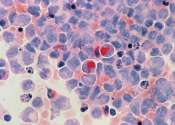
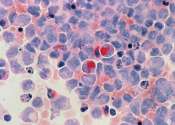
B-cell chronic lymphocytic leukemia (B-CLL), also known as chronic lymphoid leukemia (CLL), is the most common type of leukemia. Leukemias are cancers of the white blood cells (leukocytes). CLL affects B cell lymphocytes. B cells originate in the bone marrow, develop in the lymph nodes, and normally fight infection by producing antibodies. In CLL, the DNA of a B cell is damaged, so that it cannot produce antibodies.[citation needed] Additionally, B cells grow out of control and accumulate in the bone marrow and blood, where they crowd out healthy blood cells. CLL is a stage of small lymphocytic lymphoma (SLL), a type of B-cell lymphoma, which presents primarily in the lymph nodes. CLL and SLL are considered the same underlying disease, just with different appearances.
CLL is a disease of adults, but, in rare cases, it can occur in teenagers and occasionally in children (inherited). Most (>75%) people newly diagnosed with CLL are over the age of 50, and the majority are men.
Most people are diagnosed without symptoms as the result of a routine blood test that returns a high white blood cell count, but, as it advances, CLL results in swollen lymph nodes, spleen, and liver, and eventually anemia and infections. Early CLL is not treated, and late CLL is treated with chemotherapy and monoclonal antibodies.
DNA analysis has distinguished two major types of CLL, with different survival times. CLL that is positive for the marker ZAP-70 has an average survival of 5 years. CLL that is negative for ZAP-70 has an average survival of more than 25 years. Many patients, especially older ones, with slowly progressing disease can be reassured and may not need any treatment in their lifetimes.
This text uses material from Wikipedia and is available under the GNU Free Documentation License.
Latest Spotlight News
Ketamine shows significant therapeutic benefit in people with treatment-resistant depression
Patients with treatment-resistant major depression saw dramatic improvement in their illness after treatment with ketamine, an anesthetic, according to the largest ketamine clinical trial to-date led by researchers from the ...
Consuming coffee linked to lower risk of detrimental liver disease, study finds
Regular consumption of coffee is associated with a reduced risk of primary sclerosing cholangitis (PSC), an autoimmune liver disease, Mayo Clinic research shows. The findings were being presented at the Digestive Disease ...
New research identifies risks, interventions for children's GI health
An increasing number of U.S. children are experiencing gastrointestinal issues that require interventions to resolve, according to research presented at Digestive Disease Week (DDW).
Body clocks of depressed people altered at cell level, researchers show
Every cell in our bodies runs on a 24-hour clock, tuned to the night-day, light-dark cycles that have ruled us since the dawn of humanity. The brain acts as timekeeper, keeping the cellular clock in sync ...
Human brain frontal lobes not relatively large, not sole center of intelligence
Human intelligence cannot be explained by the size of the brain's frontal lobes, say researchers.
Returning genetic incidental findings without patient consent violates basic rights, experts say
Informed consent is the backbone of patient care. Genetic testing has long required patient consent and patients have had a "right not to know" the results. However, as 21st century medicine now begins to use the tools of ...
Melon focus headband turns to Kickstarter for rollout plans
(Medical Xpress)—What if the quality of your work depends more on your focus on the piano keys or canvas or laptop than your musical or painting or computing skills? If target users can be convinced, they ...
Vicious cycle: Obesity sustained by changes in brain biochemistry
With obesity reaching epidemic levels in some parts of the world, scientists have only begun to understand why it is such a persistent condition. A study in the Journal of Biological Chemistry adds substantially to the st ...
Temporal processing in the olfactory system
The neural machinery underlying our olfactory sense continues to be an enigma for neuroscience. A recent review in Neuron seeks to expand traditional ideas about how neurons in the olfactory bulb might encode information about ...
To suppress or to explore? Emotional strategy may influence anxiety
When trouble approaches, what do you do? Run for the hills? Hide? Pretend it isn't there? Or do you focus on the promise of rain in those looming dark clouds? New research suggests that the way you regulate ...