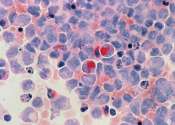
Lung Cancer
Men's bowel cancer rates up by more than a quarter in last 35 years
(Medical Xpress)—Bowel cancer rates among men have risen by nearly 30 per cent in the last 35 years, while women have seen an increase of only six per cent, according to a new report from Cancer Research UK.
Cancer
Apr 02, 2013 |
5 / 5 (1) |
0
Smoking immediately upon waking may increase risk of lung and oral cancer
The sooner a person smokes a cigarette upon waking in the morning, the more likely he or she is to acquire lung or oral cancer, according to Penn State researchers.
Cancer
Mar 29, 2013 |
not rated yet |
0
|
Many doctors do not provide tobacco cessation assistance to lung cancer patients
Physicians who care for lung cancer patients recognize the importance of tobacco cessation, but often do not provide cessation assistance to their patients according to a recent study published in the Journal of Thoracic On ...
Cancer
Mar 28, 2013 |
not rated yet |
0
Number of cancer survivors expected to increase to 18 million by 2022
The American Association for Cancer Research released its second Annual Report on Cancer Survivorship in the United States in advance of the AACR Annual Meeting 2013, which will be held in Washington, D.C., April 6-10.
Cancer
Mar 27, 2013 |
not rated yet |
0
Scientists find new gene markers for cancer risk
A huge international effort involving more than 100 institutions and genetic tests on 200,000 people has uncovered dozens of signposts in DNA that can help reveal further a person's risk for breast, ovarian ...
Genetics
Mar 27, 2013 |
5 / 5 (4) |
1
Researchers help test cancer drug in clinical trial leading to FDA approval
The FDA has approved a thyroid cancer drug successfully tested at Virginia G. Piper Cancer Center Clinical Trials, a partnership of Scottsdale Healthcare and the Translational Genomics Research Institute (TGen).
Cancer
Mar 27, 2013 |
not rated yet |
0
Hospital remains most common place of death for cancer patients in England
In England, hospital is still the most common place for patients with cancer to die but an increase in home and hospice deaths since 2005 suggests that the National End of Life Care Programme (a Programme to promote the rollout ...
Cancer
Mar 26, 2013 |
not rated yet |
0
Ganetespib shows potency against ALK-positive lung cancer and overcomes crizotinib resistance
A drug that indirectly impairs the function of several cancer-driving proteins, including anaplastic lymphoma kinase (ALK), may be an effective new treatment for patients with ALK—positive non-small cell lung cancer.
Cancer
Mar 26, 2013 |
not rated yet |
0
Higher soy intake prior to lung cancer diagnosis linked to longer survival in women
New results from a large observational follow-up study conducted in Shanghai, China, indicate that women with lung cancer who consumed more soy food prior to their cancer diagnosis lived longer than those who consumed less ...
Cancer
Mar 25, 2013 |
not rated yet |
0
No overall survival benefit tied to bilateral oophorectomy
(HealthDay)—At no age is there an overall survival benefit associated with bilateral oophorectomy compared with ovarian conservation at the time of hysterectomy for benign disease, according to a study ...
Obstetrics & gynaecology
Mar 25, 2013 |
not rated yet |
0
New lung cancer study takes page from Google's playbook
A new study shows that the same sort of mathematical model that Google uses to predict which websites people want to visit may help researchers predict how lung cancer spreads through the human body.
Cancer
Mar 25, 2013 |
not rated yet |
0
|
46 gene sequencing test for cancer patients on the NHS
The first multi-gene DNA sequencing test that can help predict cancer patients' responses to treatment has been launched in the National Health Service (NHS), thanks to a partnership between scientists at the University of ...
Cancer
Mar 25, 2013 |
not rated yet |
0
New treatment option for brain metastases associated with lung cancer
Lung cancer is the world's most common cause of death from cancer. In Austria, around 4,000 people develop this type of cancer every year. One particular problem is the development of brain metastases in ...
Cancer
Mar 25, 2013 |
not rated yet |
0
Cigarette relighting tied to tough economy
In what is believed to be a first of its kind study, a research member at The Cancer Institute of New Jersey and colleagues have found that an accelerating trend of smokers relighting cigarettes is related ...
Addiction
Mar 23, 2013 |
4 / 5 (2) |
1
|
Pathologists identify patterns of mutations to help inform design of future trials
Molecular driven therapeutic targets have resulted in a paradigm shift in the treatment of advanced lung adenocarcinoma. However, in early non-small cell lung cancer (NSCLC), surgical resection remains the treatment of choice ...
Cancer
Mar 22, 2013 |
not rated yet |
0
Lung cancer is a disease characterized by uncontrolled cell growth in tissues of the lung. If left untreated, this growth can spread beyond the lung in a process called metastasis into nearby tissue and, eventually, into other parts of the body. Most cancers that start in lung, known as primary lung cancers, are carcinomas that derive from epithelial cells. Worldwide, lung cancer is the most common cause of cancer-related death in men and women, and is responsible for 1.3 million deaths annually, as of 2004. The most common symptoms are shortness of breath, coughing (including coughing up blood), and weight loss.
The main types of lung cancer are small-cell lung cancer (SCLC), also called oat cell cancer, and non-small-cell lung cancer (NSCLC). The most common cause of lung cancer is long-term exposure to tobacco smoke. Nonsmokers account for 15% of lung cancer cases, and these cases are often attributed to a combination of genetic factors, radon gas, asbestos, and air pollution including secondhand smoke.
Lung cancer may be seen on chest radiograph and computed tomography (CT scan). The diagnosis is confirmed with a biopsy. This is usually performed by bronchoscopy or CT-guided biopsy. Treatment and prognosis depend on the histological type of cancer, the stage (degree of spread), and the patient's general wellbeing, measured by performance status. Common treatments include surgery, chemotherapy, and radiotherapy. NSCLC is sometimes treated with surgery, whereas SCLC usually responds better to chemotherapy and radiation therapy. This is partly because SCLC often spreads quite early, and these treatments are generally better at getting to cancer cells that have spread to other parts of the body.
Survival depends on stage, overall health, and other factors, but overall 14% of people in the United States diagnosed with lung cancer survive five years after the diagnosis.
This text uses material from Wikipedia and is available under the GNU Free Documentation License.
Latest Spotlight News
Whole-cell vaccine was more effective than acellular vaccine during CA pertussis outbreak
Whole-cell pertussis vaccines were more effective at protecting against pertussis than acellular pertussis vaccines during a large recent outbreak, according to a new Kaiser Permanente study published in Pediatrics.
Treatment of sleep apnea improves glucose levels in prediabetes
Optimal treatment of sleep apnea in patients with prediabetes improves blood sugar (glucose) levels and thus can reduce cardiometabolic risk, according to a study to be presented at the ATS 2013 International Conference in ...
Blame your parents for bunion woes
A novel study reports that white men and women of European descent inherit common foot disorders, such as bunions (hallux valgus) and lesser toe deformities, including hammer or claw toe. Findings from the Framingham Foot ...
New theory on genesis of osteoarthritis comes with successful therapy in mice
Scientists at Johns Hopkins have turned their view of osteoarthritis (OA) inside out. Literally. Instead of seeing the painful degenerative disease as a problem primarily of the cartilage that cushions joints, ...
Computational tool translates complex data into simplified 2-dimensional images
In their quest to learn more about the variability of cells between and within tissues, biomedical scientists have devised tools capable of simultaneously measuring dozens of characteristics of individual ...
Researchers identify a potential new risk for sleep apnea: Asthma
Researchers at the University of Wisconsin have identified a potential new risk factor for obstructive sleep apnea: asthma. Using data from the National Institutes of Health (Heart, Lung, and Blood Institute)-funded Wisconsin ...
Study finds that sleep apnea and Alzheimer's are linked
A new study looking at sleep-disordered breathing (SDB) and markers for Alzheimer's disease (AD) risk in cerebrospinal fluid (CSF) and neuroimaging adds to the growing body of research linking the two.
'Gap' for HIV vaccine efforts after latest setback
The hunt for an HIV vaccine has gobbled up $8 billion in the past decade, and the failure of the most recent efficacy trial has delivered yet another setback to 26 years of efforts.
Returning genetic incidental findings without patient consent violates basic rights, experts say
Informed consent is the backbone of patient care. Genetic testing has long required patient consent and patients have had a "right not to know" the results. However, as 21st century medicine now begins to use the tools of ...
Vicious cycle: Obesity sustained by changes in brain biochemistry
With obesity reaching epidemic levels in some parts of the world, scientists have only begun to understand why it is such a persistent condition. A study in the Journal of Biological Chemistry adds substantially to the st ...