Malaria
After a decade, global AIDS program looks ahead
(AP)—The decade-old law that transformed the battle against HIV and AIDS in developing countries is at a crossroads. The dream of future generations freed from the epidemic is running up against an era ...
HIV & AIDS
May 21, 2013 |
not rated yet |
0
No idle chatter: Study finds malaria parasites 'talk' to each other
Melbourne scientists have made the surprise discovery that malaria parasites can 'talk' to each other – a social behaviour to ensure the parasite's survival and improve its chances of being transmitted ...
Medical research
May 15, 2013 |
not rated yet |
0
|
New malaria test kit gives a boost to elimination efforts worldwide
A new, highly sensitive blood test that quickly detects even the lowest levels of malaria parasites in the body could make a dramatic difference in efforts to tackle the disease in the UK and across the world, according to ...
Diseases, Conditions, Syndromes
May 17, 2013 |
not rated yet |
0
Human disease leptospirosis identified in new species, the banded mongoose, in Africa
(Medical Xpress)—The newest public health threat in Africa, scientists have found, is coming from a previously unknown source: the banded mongoose. Leptospirosis, the disease is called. And the banded mongoose ...
Diseases, Conditions, Syndromes
May 14, 2013 |
not rated yet |
0
|
Palivizumab cuts number of days of wheezing in preemies
(HealthDay)—Many pre-term babies suffer recurrent episodes of wheezing. Now, researchers say a common infection is a likely culprit and they may be able to prevent the breathing problems.
Diseases, Conditions, Syndromes
May 09, 2013 |
not rated yet |
0
|
Mystery of resistance to malaria solved in new study
(Medical Xpress) -- Malaria is a disease caused by parasites passed to humans via the bites of infected mosquitoes. Globally, the disease causes over a million deaths every year, and is especially rife in ...
Medical research
Nov 11, 2011 |
4.8 / 5 (16) |
2
|
Gene clues point to Cambodia for resistant malaria
Gene analysis of malaria parasites has pinpointed western Cambodia as the hotspot of strains that are dangerously resistant to artesiminin, the frontline drug against the disease, scientists said on Sunday.
Genetics
Apr 28, 2013 |
5 / 5 (1) |
0
New malaria tool shows which kids at greatest risk
Researchers at Michigan State University have identified a test that can determine which children with malaria are likely to develop cerebral malaria, a much more life-threatening form of the disease.
Diseases, Conditions, Syndromes
May 08, 2013 |
not rated yet |
0
New invasive non-Typhoidal Salmonella epidemic identified in sub-Saharan Africa
(Medical Xpress)—A new study out today reveals that the emergence and spread of a rapidly evolving invasive intestinal disease, that has a significant mortality rate (up to 45%) in infected people in sub-Saharan ...
Genetics
Sep 30, 2012 |
5 / 5 (3) |
1
|
Recently published research targets malaria mosquito control woes
(Medical Xpress)—Malaria is responsible for about 700,000 deaths annually in sub-Saharan Africa alone, and a team of Texas A&M University researchers is doing their best to help stem this perpetual tide of human suffering.
Genetics
May 07, 2013 |
not rated yet |
0
|
Study finds protein in platelets fight malaria but only for some people
(Medical Xpress)—Researchers in Australia have found that a protein in platelets found naturally in blood has a protective effect against malaria. In their paper published in the journal Science, the team describes how th ...
Medical research
Dec 07, 2012 |
5 / 5 (1) |
0
|
Toxic waste sites cause healthy years of life lost
Toxic waste sites with elevated levels of lead and chromium cause a high number of "healthy years of life lost" in individuals living near 373 sites located in India, Philippines and Indonesia, according to a study by a Mount ...
Health
May 04, 2013 |
not rated yet |
0
Mutant parasite could stop malaria in its tracks
(Medical Xpress)—University of Nottingham Malaria experts have found a way of disabling one of the many phosphatase proteins which breathe life into the malaria parasite. The result is a mutant which is ...
Diseases, Conditions, Syndromes
Sep 21, 2012 |
4.5 / 5 (4) |
0
|
Hong Kong prescribes new dose of old Chinese medicine
The young woman pours a pack of brown powder into a glass of hot water, stirs it well and drinks the murky mixture down, hoping the traditional Chinese medicine will cure her feverish cold.
Medications
Apr 30, 2013 |
5 / 5 (1) |
1
Injection-free vaccination technique could address global vaccine challenge for HIV, malaria
Scientists at King's College London have demonstrated the ability to deliver a dried live vaccine to the skin without a traditional needle, and shown for the first time that this technique is powerful enough to enable specialised ...
Medical research
Feb 04, 2013 |
5 / 5 (1) |
0
|
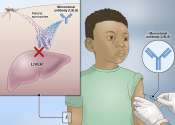
Malaria is a mosquito-borne infectious disease of humans and other animals caused by eukaryotic protists of the genus Plasmodium. The disease results from the multiplication of Plasmodium parasites within red blood cells, causing symptoms that typically include fever and headache, in severe cases progressing to coma or death. It is widespread in tropical and subtropical regions, including much of Sub-Saharan Africa, Asia, and the Americas.
Five species of Plasmodium can infect and be transmitted by humans. Severe disease is largely caused by Plasmodium falciparum while the disease caused by Plasmodium vivax, Plasmodium ovale, and Plasmodium malariae is generally a milder disease that is rarely fatal. Plasmodium knowlesi is a zoonosis that causes malaria in macaques but can also infect humans.
Malaria transmission can be reduced by preventing mosquito bites by distribution of mosquito nets and insect repellents, or by mosquito-control measures such as spraying insecticides and draining standing water (where mosquitoes breed). Despite a clear need, no vaccine offering a high level of protection currently exists. Efforts to develop one are ongoing. A number of medications are also available to prevent malaria in travelers to malaria-endemic countries (prophylaxis).
A variety of antimalarial medications are available. Severe malaria is treated with intravenous or intramuscular quinine or, since the mid-2000s, the artemisinin derivative artesunate, which is superior to quinine in both children and adults. Resistance has developed to several antimalarial drugs, most notably chloroquine.
There were an estimated 225 million cases of malaria worldwide in 2009. An estimated 655,000 people died from malaria in 2010, a 5% decrease from the 781,000 who died in 2009 according to the World Health Organization's 2011 World Malaria Report, accounting for 2.23% of deaths worldwide. Ninety percent of malaria-related deaths occur in sub-Saharan Africa, with ~60% of deaths being young children under the age of five. Plasmodium falciparum, the most severe form of malaria, is responsible for the vast majority of deaths associated with the disease. Malaria is commonly associated with poverty, and can indeed be a cause of poverty and a major hindrance to economic development.
This text uses material from Wikipedia and is available under the GNU Free Documentation License.
Latest Spotlight News
Having both migraines, depression may mean smaller brain
(HealthDay)—Migraines and depression can each cause a great deal of suffering, but new research indicates the combination of the two may be linked to something else entirely—a smaller brain.
Brain can be trained in compassion, study shows
Until now, little was scientifically known about the human potential to cultivate compassion—the emotional state of caring for people who are suffering in a way that motivates altruistic behavior.
Novel approach for influenza vaccination shows promise in early animal testing
A new approach for immunizing against influenza elicited a more potent immune response and broader protection than the currently licensed seasonal influenza vaccines when tested in mice and ferrets. The vaccine ...
Taming suspect gene reverses schizophrenia-like abnormalities in mice
Scientists have reversed behavioral and brain abnormalities in adult mice that resemble some features of schizophrenia by restoring normal expression to a suspect gene that is over-expressed in humans with ...
Researchers complete largest genetic sequencing study of human disease
Researchers from Queen Mary, University of London have led the largest sequencing study of human disease to date, investigating the genetic basis of six autoimmune diseases.
Slowing the aging process—only with antibiotics
Swiss scientists reveal the mechanism responsible for aging hidden deep within mitochondria—and dramatically slow it down in worms by administering antibiotics to the young.
Scientists uncover molecular roots of cocaine addiction in the brain
Researchers at Johns Hopkins have unraveled the molecular foundations of cocaine's effects on the brain, and identified a compound that blocks cravings for the drug in cocaine-addicted mice. The compound, already proven safe ...
Enzyme-activating antibodies revealed as marker for most severe form of rheumatoid arthritis
In a series of lab experiments designed to unravel the workings of a key enzyme widely considered a possible trigger of rheumatoid arthritis, researchers at Johns Hopkins have found that in the most severe ...
Research offers promising new approach to treatment of lung cancer
Researchers have developed a new drug delivery system that allows inhalation of chemotherapeutic drugs to help treat lung cancer, and in laboratory and animal tests it appears to reduce the systemic damage ...
Overeating learned in infancy, study suggests
In the long run, encouraging a baby to finish the last ounce in their bottle might be doing more harm than good.