Tuberculosis
Deadly effects of certain kinds of household air pollution lead to call for biomarker studies
Almost four million people die each year from household air pollution (HAP) caused by exposure to the combustion of biomass fuels (wood, charcoal, crop residues, and dung), kerosene, or coal. These individuals are among the ...
Health
Apr 01, 2013 |
not rated yet |
0
Vitamin D benefits breathing in tuberculosis patients
Maintaining adequate levels of vitamin D can help people breathe better and may even protect against tuberculosis (TB), according to a recent study accepted for publication in The Endocrine Society's Journal of Clinical En ...
Diseases, Conditions, Syndromes
Mar 26, 2013 |
4.5 / 5 (2) |
0
Experts warn of untreatable TB risk
Disease experts called Sunday for decisive leadership and more research funding to fend off the "very real" risk of an untreatable strain of tuberculosis (TB) emerging as more and more people develop resistance to existing ...
Diseases, Conditions, Syndromes
Mar 24, 2013 |
1 / 5 (1) |
0
Impact of budget sequestration on health care discussed
(HealthDay)—The impact of sequestration will have far-reaching consequences in health care, according to a perspective piece published online March 20 in the New England Journal of Medicine.
Health
Mar 21, 2013 |
not rated yet |
0
Tuberculosis in US hits record low
Cases of tuberculosis reached an all-time low in the United States last year, but the disease continued to affect minorities at much higher rates than whites, health authorities said Thursday.
Diseases, Conditions, Syndromes
Mar 21, 2013 |
not rated yet |
0
Massive funding boost needed to beat TB, UN says (Update)
The global fight against tuberculosis needs a massive financial boost as drug-resistant strains of the disease take hold, two international organisations warned on Monday.
Diseases, Conditions, Syndromes
Mar 18, 2013 |
not rated yet |
0
Aggressive regimen reduces mortality in drug-resistant TB
(Medical Xpress)—Aggressive drug regimens used to treat multidrug-resistant tuberculosis reduce the risk of death by about 40 percent when they include at least five drugs likely to be effective against ...
Diseases, Conditions, Syndromes
Mar 15, 2013 |
not rated yet |
0
|
Steroids may help reduce deaths from all types of tuberculosis
The routine use of steroids to treat tuberculosis may help reduce deaths from all types of the disease, according to a new review of existing research.
Diseases, Conditions, Syndromes
Mar 12, 2013 |
not rated yet |
0
Key to tuberculosis cure could lie underwater
The search for a cure for deadly infectious diseases has led Brian Murphy deep underwater. Murphy, assistant professor of medicinal chemistry and pharmacognosy at the University of Illinois at Chicago, is collecting actinomycete ...
Diseases, Conditions, Syndromes
Mar 08, 2013 |
not rated yet |
0
Computerized reminders significantly improve HIV care in resource-limited setting
A large randomized controlled study is among the first to rigorously demonstrate that health information technology can improve compliance with patient care guidelines by clinicians in resource-limited countries. The study ...
Pediatrics
Mar 07, 2013 |
not rated yet |
0
Use of certain therapies for inflammatory diseases does not appear to increase risk of shingles
Although patients with rheumatoid arthritis (RA) have a disproportionately higher incidence of herpes zoster (shingles), an analysis that included nearly 60,000 patients with RA and other inflammatory diseases found that ...
Inflammatory disorders
Mar 05, 2013 |
not rated yet |
0
Wolf in sheep's clothing: Uncovering how deadly bacteria trick immune system
An outbreak of tuberculosis in the skid row area of downtown Los Angeles may have exposed up to 4,500 individuals to the bacterium that causes the deadly disease and has left federal officials scrambling ...
Medical research
Feb 28, 2013 |
5 / 5 (1) |
0
|
Face values: Ability to recognize emotions in others impaired by AIDS
People with HIV are less able to recognise facial emotion than non-infected people finds a study published in the launch edition of BioMed Central's open access journal BMC Psychology. Reduction in their ability to recogn ...
Psychology & Psychiatry
Feb 26, 2013 |
1 / 5 (1) |
0
US budget cuts could jeopardize development of life-saving tools against major killers
Across-the-board cuts to US R&D programs could have a devastating impact on efforts to develop new drugs for tuberculosis (TB) and HIV/AIDS, the world's first malaria vaccine, and other vital global health products in development, ...
Diseases, Conditions, Syndromes
Feb 26, 2013 |
not rated yet |
0
CDC chief: Spending cuts threaten public health
(AP)—The nation's top disease detective says impending budget cuts will make it harder to solve outbreaks, fight hospital infections and keep illnesses overseas from making their way here.
Health
Feb 23, 2013 |
not rated yet |
0
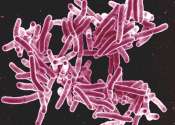
Tuberculosis, MTB, or TB (short for tubercle bacillus) is a common, and in many cases lethal, infectious disease caused by various strains of mycobacteria, usually Mycobacterium tuberculosis. Tuberculosis usually attacks the lungs but can also affect other parts of the body. It is spread through the air when people who have an active MTB infection cough, sneeze, or otherwise transmit their saliva through the air. Most infections in humans result in an asymptomatic, latent infection, and about one in ten latent infections eventually progress to active disease, which, if left untreated, kills more than 50% of those infected.
The classic symptoms are a chronic cough with blood-tinged sputum, fever, night sweats, and weight loss (the last giving rise to the formerly prevalent colloquial term "consumption"). Infection of other organs causes a wide range of symptoms. Diagnosis relies on radiology (commonly chest X-rays), a tuberculin skin test, blood tests, as well as microscopic examination and microbiological culture of bodily fluids. Treatment is difficult and requires long courses of multiple antibiotics. Social contacts are also screened and treated if necessary. Antibiotic resistance is a growing problem in (extensively) multi-drug-resistant tuberculosis. Prevention relies on screening programs and vaccination, usually with Bacillus Calmette-Guérin vaccine.
One third of the world's population is thought to have been infected with M. tuberculosis, and new infections occur at a rate of about one per second. In 2007 there were an estimated 13.7 million chronic active cases, and in 2010 8.8 million new cases, and 1.45 million deaths, mostly in developing countries. The absolute number of tuberculosis cases has been decreasing since 2006 and new cases since 2002. In addition, more people in the developing world contract tuberculosis because their immune systems are more likely to be compromised due to higher rates of AIDS. The distribution of tuberculosis is not uniform across the globe; about 80% of the population in many Asian and African countries test positive in tuberculin tests, while only 5–10% of the U.S. population test positive.
This text uses material from Wikipedia and is available under the GNU Free Documentation License.
Latest Spotlight News
Engineered cytomegalovirus protects monkeys from HIV equivalent
(Medical Xpress)—A new study by researchers in the US has shown that an ancient virus can be modified to help in the fight against the simian immunodeficiency virus SIV, which is the equivalent in monkeys ...
Depression raises diabetics' risk of severe low blood sugar episodes
(Medical Xpress)—Patients with diabetes who are depressed are much more likely to develop episodes of dangerously low blood sugars, or hypoglycemia, than are those who are not depressed, a new study has ...
Controlling mood through the motions of mitochondria
(Medical Xpress)—Regulating the distribution of power in neurons is done by a system that makes the national electric grid look simple by comparison. Each neuron has several thousand mitochondria confined ...
Multiple research teams unable to confirm high-profile Alzheimer's study
Teams of highly respected Alzheimer's researchers failed to replicate what appeared to be breakthrough results for the treatment of this brain disease when they were published last year in the journal Science.
Motion quotient: IQ predicted by ability to filter motion (w/ video)
A brief visual task can predict IQ, according to a new study. This surprisingly simple exercise measures the brain's unconscious ability to filter out visual movement. The study shows that individuals whose ...
Scientists discover molecule triggers sensation of itch
Scientists at the National Institutes of Health report they have discovered in mouse studies that a small molecule released in the spinal cord triggers a process that is later experienced in the brain as ...
Researchers find common childhood asthma unconnected to allergens or inflammation
Little is known about why asthma develops, how it constricts the airway or why response to treatments varies between patients. Now, a team of researchers at Weill Cornell Medical College, Columbia University Medical Center ...
Diabetes' genetic underpinnings can vary based on ethnic background, studies say
Ethnic background plays a surprisingly large role in how diabetes develops on a cellular level, according to two new studies led by researchers at the Stanford University School of Medicine.
Scientists discover cinnamon compounds' potential ability to prevent Alzheimer's
Cinnamon: Can the red-brown spice with the unmistakable fragrance and variety of uses offer an important benefit? The common baking spice might hold the key to delaying the onset of –– or warding off ...
Study reveals new mechanism for estrogen suppression of liver lipid synthesis
By discovering the new mechanism by which estrogen suppresses lipid synthesis in the liver, UC Irvine endocrinologists have revealed a potential new approach toward treating certain liver diseases.