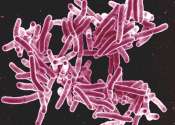
Tuberculosis

Wolf in sheep's clothing: Uncovering how deadly bacteria trick immune system

An outbreak of tuberculosis in the skid row area of downtown Los Angeles may have exposed up to 4,500 individuals to the bacterium that causes the deadly disease and has left federal officials scrambling ...

Medical research created Feb 28, 2013 | popularity 5 / 5 (1) | comments 0 | with audio podcast

Tuberculosis may lurk in bone marrow stem cells of infected patients, researchers say

Tuberculosis is a devastating disease that kills nearly 2 million people worldwide each year. Although antibiotics exist that can ameliorate the symptoms, the courses of therapy last for months and don't completely eradicate ...

Medical research created Jan 30, 2013 | popularity 5 / 5 (2) | comments 0 | with audio podcast

Expert warning: Resistance to antibiotics to be apocalyptic

(Medical Xpress)—The chief medical officer for Britain's Department of Health has issued a warning that resistance to bacteria is a more urgent threat to humanity than global warming, with bacteria becoming ...

Diseases, Conditions, Syndromes created Jan 25, 2013 | popularity 4.9 / 5 (36) | comments 40 | with audio podcast report

Australian study turns HIV against itself (Update)

An Australian scientist said Wednesday he had discovered a way to turn the HIV virus against itself in human cells in the laboratory, in an important advance in the quest for an AIDS cure.

HIV & AIDS created Jan 16, 2013 | popularity 4.9 / 5 (15) | comments 22

Measles vaccine given with a microneedle patch could boost immunization programs

Measles vaccine given with painless and easy-to-administer microneedle patches can immunize against measles at least as well as vaccine given with conventional hypodermic needles, according to research done ...

Medications created Nov 27, 2012 | popularity 5 / 5 (2) | comments 0 | with audio podcast

Survival gene may be key to controlling HIV and hepatitis

(Medical Xpress)—A newly discovered gene that is essential for embryo survival could also hold the key to treating and potentially controlling chronic infections such as HIV, hepatitis and tuberculosis.

Immunology created Nov 26, 2012 | popularity 5 / 5 (3) | comments 0 | with audio podcast

New DNA vaccine technology poised to deliver safe and cost-effective disease protection

New and increasingly sophisticated vaccines are taking aim at a broad range of disease-causing pathogens, targeting them with greater effectiveness at lower cost and with improved measures to ensure safety.

Medical research created Nov 05, 2012 | popularity 4.8 / 5 (4) | comments 5 | with audio podcast

New genetic links for inflammatory bowel disease uncovered

Crohn's disease (CD) and ulcerative colitis (UC) – inflammatory diseases of the gastrointestinal tract – have puzzled the scientific community for decades. Ten years ago, researchers recognized that both genes and the ...

Genetics created Oct 31, 2012 | popularity not rated yet | comments 0 | with audio podcast

Low cost pain drug can kill resistant tuberculosis

An off-patent anti-inflammatory drug that costs around two cents for a daily dose in developing countries has been found by researchers at Weill Cornell Medical College to kill both replicating and non-replicating drug resistant ...

Diseases, Conditions, Syndromes created Sep 10, 2012 | popularity 5 / 5 (5) | comments 4 | with audio podcast

Low cost pain drug can kill resistant tuberculosis

An off-patent anti-inflammatory drug that costs around two cents for a daily dose in developing countries has been found by researchers at Weill Cornell Medical College to kill both replicating and non-replicating drug resistant ...

Diseases, Conditions, Syndromes created Sep 10, 2012 | popularity 5 / 5 (5) | comments 4 | with audio podcast

High doses of Vitamin D help tuberculosis patients recover more quickly

For decades before antibiotics became generally available, sunshine was used to treat tuberculosis, with patients often being sent to Swiss clinics to soak up the sun's healing rays. Now, for the first time scientists have ...

Diseases, Conditions, Syndromes created Sep 03, 2012 | popularity 5 / 5 (5) | comments 0 | with audio podcast

FDA approves use of electronic chips in medications

(Medical Xpress) -- The Food and Drug Administration in the United States has approved a request by Proteus Digital Health to allow for the inclusion of tiny digestible microchips into medicines to assist ...

Medications created Aug 01, 2012 | popularity 3.8 / 5 (5) | comments 3 | with audio podcast report

TB treatment paradox: Mouse studies show body's own response helps TB bacteria survive

Inhibiting a key immune response in mice during initial multi-drug treatment for tuberculosis could — paradoxically — shorten treatment time for the highly contagious lung infection according to new research from ...

Immunology created Jun 28, 2012 | popularity not rated yet | comments 0 | with audio podcast

Apramycin shows promise against drug-resistant TB and other 'superbugs,' without hearing loss

The world needs new antibiotics to overcome the ever increasing resistance of disease-causing bacteria – but it doesn't need the side effect that comes with some of the most powerful ones now available: ...

Medical research created Jun 11, 2012 | popularity 5 / 5 (2) | comments 0 | with audio podcast

Study finds vitamin C can kill drug-resistant TB (w/ video)

In a striking, unexpected discovery, researchers at Albert Einstein College of Medicine of Yeshiva University have determined that vitamin C kills drug-resistant tuberculosis (TB) bacteria in laboratory culture. The finding ...

Diseases, Conditions, Syndromes created May 21, 2013 | popularity 4.4 / 5 (7) | comments 0 | with audio podcast


Tuberculosis, MTB, or TB (short for tubercle bacillus) is a common, and in many cases lethal, infectious disease caused by various strains of mycobacteria, usually Mycobacterium tuberculosis. Tuberculosis usually attacks the lungs but can also affect other parts of the body. It is spread through the air when people who have an active MTB infection cough, sneeze, or otherwise transmit their saliva through the air. Most infections in humans result in an asymptomatic, latent infection, and about one in ten latent infections eventually progress to active disease, which, if left untreated, kills more than 50% of those infected.

The classic symptoms are a chronic cough with blood-tinged sputum, fever, night sweats, and weight loss (the last giving rise to the formerly prevalent colloquial term "consumption"). Infection of other organs causes a wide range of symptoms. Diagnosis relies on radiology (commonly chest X-rays), a tuberculin skin test, blood tests, as well as microscopic examination and microbiological culture of bodily fluids. Treatment is difficult and requires long courses of multiple antibiotics. Social contacts are also screened and treated if necessary. Antibiotic resistance is a growing problem in (extensively) multi-drug-resistant tuberculosis. Prevention relies on screening programs and vaccination, usually with Bacillus Calmette-Guérin vaccine.

One third of the world's population is thought to have been infected with M. tuberculosis, and new infections occur at a rate of about one per second. In 2007 there were an estimated 13.7 million chronic active cases, and in 2010 8.8 million new cases, and 1.45 million deaths, mostly in developing countries. The absolute number of tuberculosis cases has been decreasing since 2006 and new cases since 2002. In addition, more people in the developing world contract tuberculosis because their immune systems are more likely to be compromised due to higher rates of AIDS. The distribution of tuberculosis is not uniform across the globe; about 80% of the population in many Asian and African countries test positive in tuberculin tests, while only 5–10% of the U.S. population test positive.

This text uses material from Wikipedia and is available under the GNU Free Documentation License.

Latest Spotlight News

Slowing the aging process—only with antibiotics

Swiss scientists reveal the mechanism responsible for aging hidden deep within mitochondria—and dramatically slow it down in worms by administering antibiotics to the young.

Researchers complete largest genetic sequencing study of human disease

Researchers from Queen Mary, University of London have led the largest sequencing study of human disease to date, investigating the genetic basis of six autoimmune diseases.

Brain can be trained in compassion, study shows

Until now, little was scientifically known about the human potential to cultivate compassion—the emotional state of caring for people who are suffering in a way that motivates altruistic behavior.

Having both migraines, depression may mean smaller brain

(HealthDay)—Migraines and depression can each cause a great deal of suffering, but new research indicates the combination of the two may be linked to something else entirely—a smaller brain.

Novel approach for influenza vaccination shows promise in early animal testing

A new approach for immunizing against influenza elicited a more potent immune response and broader protection than the currently licensed seasonal influenza vaccines when tested in mice and ferrets. The vaccine ...

Enzyme-activating antibodies revealed as marker for most severe form of rheumatoid arthritis

In a series of lab experiments designed to unravel the workings of a key enzyme widely considered a possible trigger of rheumatoid arthritis, researchers at Johns Hopkins have found that in the most severe ...

Research offers promising new approach to treatment of lung cancer

Researchers have developed a new drug delivery system that allows inhalation of chemotherapeutic drugs to help treat lung cancer, and in laboratory and animal tests it appears to reduce the systemic damage ...

Overeating learned in infancy, study suggests

In the long run, encouraging a baby to finish the last ounce in their bottle might be doing more harm than good.

Research shows how immune system peacefully co-exists with 'good' bacteria

The human gut is loaded with commensal bacteria – "good" microbes that, among other functions, help the body digest food. The gastrointestinal tract contains literally trillions of such cells, and yet the ...

Researchers analyse hunting behaviour of fish larvae in virtual reality

Moving objects attract greater attention – a fact exploited by video screens in public spaces and animated advertising banners on the Internet. For most animal species, moving objects also play a major ...