Ulcerative Colitis

Inflammatory bowel disease raises risk of melanoma

Patients with inflammatory bowel disease (IBD) are at higher risk of melanoma, a form of skin cancer, report researchers at Mayo Clinic. Researchers found that IBD is associated with a 37 percent greater risk for the disease. ...

Inflammatory disorders created May 20, 2013 | popularity 4 / 5 (1) | comments 0

Simponi approved for ulcerative colitis

(HealthDay)—Simponi (golimumab) injection has been approved by the U.S. Food and Drug Administration to treat adults with moderate-to-severe ulcerative colitis.

Medications created May 15, 2013 | popularity not rated yet | comments 0

Thymus teaches immune cells to ignore vital gut bacteria

The tiny thymus teaches the immune system to ignore the teeming, foreign bacteria in the gut that helps you digest and absorb food, researchers say.

Immunology created Apr 29, 2013 | popularity 4.7 / 5 (3) | comments 0 | with audio podcast

Genetically engineered bacteria could help in Crohn's and colitis

(Medical Xpress)—A new study in mice has shown that genetically engineered bacteria can protect against inflammatory bowel disease (IBD), which includes a host of conditions including ulcerative colitis and Crohn's disease.

Medical research created Nov 02, 2012 | popularity 5 / 5 (5) | comments 0 | with audio podcast report

Large-scale genetic study defines relationship between primary sclerosing cholangitis and other autoimmune diseases

For the first time, scientists show that a leading cause of liver transplant, primary sclerosing cholangitis (PSC), is a distinct disease from inflammatory bowel disease, opening up new avenues for specific PSC treatments.

Genetics created Apr 21, 2013 | popularity not rated yet | comments 0 | with audio podcast

Scientists find key to growth of 'bad' bacteria in inflammatory bowel disease

(Medical Xpress)—Scientists have long puzzled over why "bad" bacteria such as E. coli can thrive in the guts of those with inflammatory bowel disease (IBD), causing serious diarrhea. Now UC Davis resear ...

Inflammatory disorders created Feb 07, 2013 | popularity 5 / 5 (6) | comments 0 | with audio podcast

Diabetes may start in the intestines, research suggests

Scientists at Washington University School of Medicine in St. Louis have made a surprising discovery about the origin of diabetes. Their research suggests that problems controlling blood sugar — the hallmark ...

Diabetes created Feb 15, 2012 | popularity 4.1 / 5 (16) | comments 4 | with audio podcast

Antibiotics in childhood may increase bowel disease risk: study

(HealthDay)—Use of certain antibiotics may put children at higher risk for developing bowel diseases, new research has found.

Pediatrics created Sep 24, 2012 | popularity 5 / 5 (1) | comments 1 | with audio podcast

Researchers find link between blood clotting, immune response

Rice University researchers have found an unexpected link between a protein that triggers the formation of blood clots and other proteins that are essential for the body's immune system. The find could lead ...

Immunology created Apr 01, 2013 | popularity 4.7 / 5 (3) | comments 0 | with audio podcast

Parasitologist espouses using parasitic worms for treatment of autoimmune diseases

(Medical Xpress)—Doctor Joel Weinstock, a parasitologist at Tufts Medical Center in a commentary piece published in the journal Nature, describes work that he and colleagues have been involved in that focuses on studyi ...

Immunology created Nov 08, 2012 | popularity 4 / 5 (2) | comments 0 | with audio podcast report

Tension on gut muscles induces cell invasion in zebrafish intestine, mimicking cancer metastasis

The stiffness of breast tissue is increasingly recognized as an important factor explaining the onset of breast cancer. Stiffening induces molecular changes that promote cancerous behavior in cells. Bioengineering ...

Cancer created Sep 07, 2012 | popularity 4 / 5 (5) | comments 0 | with audio podcast

Genes carried by E. coli bacteria linked to colon cancer

What if a key factor ultimately behind a cancer was not a genetic defect but ecological?

Cancer created Aug 16, 2012 | popularity 5 / 5 (3) | comments 1 | with audio podcast

New genetic links for inflammatory bowel disease uncovered

Crohn's disease (CD) and ulcerative colitis (UC) – inflammatory diseases of the gastrointestinal tract – have puzzled the scientific community for decades. Ten years ago, researchers recognized that both genes and the ...

Genetics created Oct 31, 2012 | popularity not rated yet | comments 0 | with audio podcast

Mutant gut bacteria reverse colon cancer in lab models

(Medical Xpress) -- A mutant form of a meek microbe deals a gutsy blow to colon cancer, University of Florida scientists have discovered. The special bacteria halted abnormal inflammation, reduced precancerous growths and ...

Cancer created Jun 13, 2012 | popularity 5 / 5 (3) | comments 1 | with audio podcast

Possible link between bacterium, colon cancer found

For the first time, a specific microorganism has been found to be associated with human colorectal cancer. In two studies published online today in Genome Research, independent research teams have identified Fusobacterium in col ...

Cancer created Oct 17, 2011 | popularity 5 / 5 (5) | comments 0 | with audio podcast


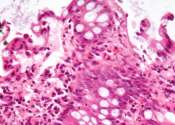
Ulcerative colitis (Colitis ulcerosa, UC) is a form of inflammatory bowel disease (IBD) . Ulcerative colitis is a form of colitis, a disease of the colon (large intestine), that includes characteristic ulcers, or open sores. The main symptom of active disease is usually constant diarrhea mixed with blood, of gradual onset. IBD is often confused with irritable bowel syndrome (IBS), a troublesome, but much less serious, condition. Ulcerative colitis has similarities to Crohn's disease, another form of IBD. Ulcerative colitis is an intermittent disease, with periods of exacerbated symptoms, and periods that are relatively symptom-free. Although the symptoms of ulcerative colitis can sometimes diminish on their own, the disease usually requires treatment to go into remission. Ulcerative colitis occurs in 35–100 people for every 100,000 in the United States, or less than 0.1% of the population. The disease is more prevalent in northern countries of the world, as well as in northern areas of individual countries or other regions. Although ulcerative colitis has no known cause, there is a presumed genetic component to susceptibility. The disease may be triggered in a susceptible person by environmental factors. Although dietary modification may reduce the discomfort of a person with the disease, ulcerative colitis is not thought to be caused by dietary factors. Ulcerative colitis is treated as an autoimmune disease. Treatment is with anti-inflammatory drugs, immunosuppression, and biological therapy targeting specific components of the immune response. Colectomy (partial or total removal of the large bowel through surgery) is occasionally necessary, and is considered to be a cure for the disease.
This text uses material from Wikipedia and is available under the GNU Free Documentation License.

Latest Spotlight News

Drugs found to both prevent and treat Alzheimer's disease in mice

Researchers at USC have found that a class of pharmaceuticals can both prevent and treat Alzheimer's Disease in mice.

If you can remember it, you can remember it wrong

(Medical Xpress)—Native peoples in regions where cameras are uncommon sometimes react with caution when their picture is taken. The fear that something must have been stolen from them to create the photo ...

Insight into the dazzling impact of insulin in cells

Australian scientists have charted the path of insulin action in cells in precise detail like never before. This provides a comprehensive blueprint for understanding what goes wrong in diabetes.

B vitamins could delay dementia

(Medical Xpress)—Despite spending billions of dollars on research and development, drug companies have been unable to come up with effective treatments for dementia and Alzheimer's Disease (AD). Now, A. ...

Enrichment therapy effective among children with autism, study finds

Children with autism showed significant improvement after six months of simple sensory exercises at home using everyday items such as scents, spoons and sponges, according to UC Irvine neurobiologists.

Finding a family for a pair of orphan receptors in the brain

Researchers at Emory University have identified a protein that stimulates a pair of "orphan receptors" found in the brain, solving a long-standing biological puzzle and possibly leading to future treatments for neurological ...

Study finds vitamin C can kill drug-resistant TB (w/ video)

In a striking, unexpected discovery, researchers at Albert Einstein College of Medicine of Yeshiva University have determined that vitamin C kills drug-resistant tuberculosis (TB) bacteria in laboratory culture. The finding ...

Estimates reveal low population immunity to new bird flu virus H7N9 in humans

The level of immunity to the recently circulating H7N9 influenza virus in an urban and rural population in Vietnam is very low, according to the first population level study to examine human immunity to the virus, which was ...

Waiting for a sign? Researchers find potential brain 'switch' for new behavior

You're standing near an airport luggage carousel and your bag emerges on the conveyor belt, prompting you to spring into action. How does your brain make the shift from passively waiting to taking action when ...

Study shows where scene context happens in our brain

In a remote fishing community in Venezuela, a lone fisherman sits on a cliff overlooking the southern Caribbean Sea. This man –– the lookout –– is responsible for directing his comrades on the water, ...