Ultrasound tool, dubbed the 'new stethoscope,' to monitor critically ill patients
April 22, 2011 in Other
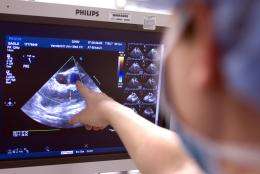
TEE Tool 1: Moving images of a patient’s heart obtained by using transesophageal echocardiography (TEE) help doctors pinpoint abnormalities and assess heart function. Previously used in the operating rooms, TEE is now being used in intensive care units at VUMC to closely monitor patients both before and after surgery
(PhysOrg.com) -- Vanderbilt cardiothoracic anesthesiologists and surgeons are pioneering the use of a tool that many in the cardiac field are calling the new stethoscope when it comes to monitoring critically ill patients.
Transesophageal echocardiography (TEE) is a diagnostic procedure that involves feeding an ultrasound probe through a patient's mouth and into their esophagus to evaluate heart function. Because the esophagus is close to the heart, TEE can generate high-resolution images as the organ pumps. TEE is invaluable in locating cardiac blood clots, masses and tumors and can detect the severity of valve problems, congenital heart diseases and aortic tears.
Vanderbilt's cardiothoracic anesthesiologists have more than 15 years of experience using TEE for patients undergoing cardiac surgery. Now, smaller, disposable TEE probes are being used to monitor the hearts of critically ill patients in intensive care units for as long as three days.
The ability to monitor cardiac function and filling in a serial fashion with miniaturized, disposable TEE probes leads to optimal patient outcome and appropriate resource utilization, said Chad Wagner, M.D., a cardiothoracic anesthesiologist and director of the Cardiovascular Intensive Care Unit (CVICU). The only real barrier to the routine use of this technology is physician training.
Using TEE to monitor cardiac patients in ICUs both before and after surgery allows medical staff to quickly intervene in a crisis and use the resulting information to guide treatment decisions.
This technology is another example of what we describe as 'flying with instruments,' that is, the systematic approach of measuring and recording outcomes so as to guide further care, said John G. Byrne, M.D., chairman of the Department of Cardiac Surgery.
To train physicians in the use of TEE, Wagner and Julian Bick, M.D., a cardiothoracic anesthesiologist, recently directed a course at Vanderbilt's Center for Experiential Learning & Assessment (CELA) that attracted physicians from premier health care systems across the United States, including two critical care doctors from the U.S. Navy.
Participants trained using a TEE simulator, which combines a photo-realistic, three-dimensional computer-generated model, a TEE probe and a simulated ultrasound image to help users visualize and understand complex cardiac anatomy. Bick also received a $100,000 grant from the Foundation for Anesthesia Education and Research to fund TEE simulation training for Vanderbilt University School of Medicine anesthesia resident physicians.
The TEE simulator is highly effective in helping physicians learn TEE in combination with clinical training, Bick said. The simulator mirrors cardiac anatomy and function, and students often comment on the realism.
Bick and Wagner, in collaboration with Byrne, recently published the first case study on using a disposable TEE probe to care for a 66-year-old patient who became unstable in the ICU following open heart surgery.
Sometimes, unstable patients need to return to the operating room for additional surgery, said Wagner. In this case, after placing the miniaturized disposable TEE probe I was able to diagnose and treat the cause of the patient's low blood pressure, which did not require returning to the operating room.
Efforts to train more physicians to use TEE to care for the critically ill are already under way.
Provided by Vanderbilt Medical Center
-
Duke engineers develop new 3-D cardiac imaging probe
May 26, 2005 |
not rated yet |
0
-
Physicians provide top-tier care for patients with heart attacks
Jan 04, 2011 |
not rated yet |
0
-
Doctors treat adults' childhood heart defects
Mar 28, 2011 |
not rated yet |
0
-
Scent of a woman: Men's testosterone responses to olfactory ovulation cues
Jan 13, 2010 |
not rated yet |
0
-
Cardiothoracic surgeons projected to be in short supply by 2025
Jul 28, 2009 |
not rated yet |
0
-
Limits to growth: Scientists identify key metastasis-enabling enzyme
6 hours ago |
not rated yet |
0
-
Seeing is as seeing does: Spatially-structured retinal input in early development of cortical maps
Apr 26, 2012 |
5 / 5 (4) |
1
-
Dreamless nights: Brain activity during nonrapid eye movement sleep
Apr 09, 2012 |
4.4 / 5 (12) |
0
-
Take your time: Neurobiology sheds light on the superiority of spaced vs. massed learning
Mar 28, 2012 |
4.5 / 5 (21) |
3
-
Your brain on 'shrooms: fMRI elucidates neural correlates of psilocybin psychedelic state
Feb 29, 2012 |
4.9 / 5 (42) |
45
-
Classical and Quantum Mechanics via Lie algebras
Apr 15, 2011
- More from Physics Forums - Independent Research
More news stories
U.S. liver transplants declining
(HealthDay) -- The number of liver transplants in the United States has decreased since 2006, a new study finds.
Other
1 hour ago |
not rated yet |
0
Canada should significantly increase its funding of randomized clinical trials
Large randomized controlled trials (RCTs) are critical for determining effectiveness of medical therapies, tests and procedures. Yet Canada provides scant support for these studies compared with other western countries, states ...
Other
3 hours ago |
not rated yet |
0
Pomegranate juice claims deceptive, US rules
Pomegranate juice has not been proven to be an effective treatment for cancer, heart disease or erectile dysfunction, US regulators said Monday, calling a company's ad claims deceptive.
Other
20 hours ago |
not rated yet |
0
Use of in-hospital mortality to assess ICU performance may bias quality measurement
In-hospital mortality for ICU patients is often used as a quality measure, but discharge practices may bias results in a way that disadvantages large academic hospitals, according to a recently conducted study.
Other
May 21, 2012 |
not rated yet |
0
Nighttime intensivist staffing and mortality in the ICU
Nighttime intensivist physician staffing in intensive care units (ICUs) with a low-intensity daytime staffing model is associated with reduced mortality, according to a new study published in the New England Journal of Me ...
Other
May 21, 2012 |
not rated yet |
0
Body building, diet supplements linked to liver damage: study
(HealthDay) -- Body-building and weight-loss products are the types of dietary supplements most likely to cause liver injury, according to a small new study.
Limits to growth: Scientists identify key metastasis-enabling enzyme
(Medical Xpress) -- On the complex road to eradicating cancer, controlling or preventing metastatic growth initiated by primary tumors is high on the to-do list. A key area of such research is the development ...
Do bald men face higher risk of prostate cancer?
(HealthDay) -- Got hair? If you don't, you might have a higher risk of prostate cancer, a preliminary study suggests.
Neuron-nourishing cells appear to retaliate in Alzheimer's
When brain cells start oozing too much of the amyloid protein that is the hallmark of Alzheimer's disease, the astrocytes that normally nourish and protect them deliver a suicide package instead, researchers ...
Learning and memory: The role of neo-neurons revealed
(Medical Xpress) -- Researchers at the Institut Pasteur and the CNRS have recently identified in mice the role played by neo-neurons formed in the adult brain. By using selective stimulation the researchers ...
Asthma medication linked with arrhythmias in children, young adults
Use of inhaled anticholinergics (IACs) has been associated with an increased risk of potentially dangerous heart arrhythmias among young asthma patients, according to a study conducted by researchers at the University of ...