Flu fighter: Physicist is working on faster identification of viruses to enable earlier treatment
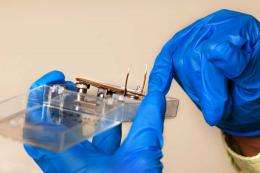
When Zuzanna Siwy was growing up in Poland, she suffered often from the flu. “I was one of the wimpy children,” jokes the UC Irvine associate professor of physics & astronomy.
That childhood misery motivated her to become a scientist on the hunt for influenza and other viruses. She has attracted considerable notice for her work developing techniques that could lead to faster, cheaper ways of identifying infectious agents, so that treatment can begin sooner.
The idea is to have a very easy, inexpensive and quick method of detecting viruses,” Siwy says. “The current techniques are not that precise, and they’re elaborate and expensive. You want to detect them at the very low levels, because one virus is sufficient to make you sick.”
Those methods could someday range from a simple blood draw to swabbing the inside of someone’s cheek to scraping a nearby sample of soil. All could be developed thanks to novel work being done in Siwy’s lab at UCI, in conjunction with the Lawrence Livermore National Laboratory.
She and her team are pinpointing viruses in salt solutions that are crucial for human survival but also provide ideal environments for the tiny disease transmitters. To “corner” the viruses for identification, the scientists use a somewhat radical technique: putting electrical current into the liquid to force them to move. “Do not try this at home!” Siwy cautions. “It can kill you.”
Each type of virus not only has a unique shape but is covered with a particular arrangement of chemical groups that carry certain electrical charges. How the wet viruses move when zapped can tell researchers whether they’re negatively or positively charged. This speeds up the identification process – whether they’re flu or hepatitis or HIV viruses – and could eventually aid in the precisely controlled delivery of drugs through “nanopores.”
Openings in cell membranes one-millionth the width of a human hair, nanopores can govern the movement of even single molecules. Viruses are about the same size as nanopores and often partly block them, impeding the critical flow of salt. The hope is that treatment could eventually be administered at the molecular level to stop them.
“Zuzanna’s work is a great example of basic research that may someday lead to important applications,” says Bill Parker, physics & astronomy chair. “But before applications can arise, the physics at the nanoscale level of fluid flow through a nanopore must be understood.”
Siwy enjoys the interdisciplinary nature of the project – which involves chemistry and a bit of biology along with physics – and puts in long hours. “She’s a really hard worker,” says Matt Powell, one of her postdoctoral assistants. “She’s also really good at convincing people that what we’re doing is important.”
Since her arrival at UCI in 2005, Siwy has won numerous prizes that help support her work, including an Alfred P. Sloan fellowship for young career scientists, a research travel award from the Alexander von Humboldt Foundation, a five-year National Science Foundation grant for career scientists, and a Presidential Early Career Award for Scientists & Engineers that culminated in a meeting last year with President Obama.
“I truly got butterflies in my stomach,” Siwy recalls. “It was just surreal to be in a big ballroom in the White House shaking hands with him.”
Obama, she says, stressed the importance of making sometimes abstract scientific concepts accessible to children – a goal she shares. As part of a public outreach program that began in 2007, Siwy and her graduate students have hosted 250 middle and high school students and teachers, mostly from poor neighborhoods in Santa Ana.
They explained the principles of nanotechnology by having the students fold pieces of paper in half as many times as they could, usually about six. Then the team revealed that it would take 27 folds to get the pieces of paper down to nanopore size, impossible through manual folding.
The exercise shows how quickly scale can shrink, as well as the challenges associated with reaching that level. Students also tried to pick up grains of rice while wearing oven mitts, in a demonstration of how hard it can be to work with extremely small items.
Unfortunately, the program that financed these educational visits was cut last year because of state budget woes. Siwy says that along with efforts to obtain more research support, she’s committed to seeking federal funds to restart it.
“We think outside the box,” she notes.


