Three open-heart surgeries free baby from bleak prognosis
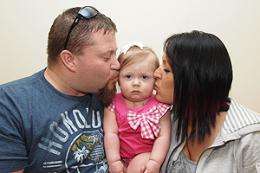
Don and Shawna Albright had almost lost hope. Eighteen weeks into Shawna’s pregnancy, an ultrasound showed deadly, unfixable problems with their baby girl’s heart. Two referrals and two echocardiograms later, doctors said there was no way the baby would survive her complex heart defects.
“They all said it would be best to terminate,” said Shawna.
Devastated, the Albrights decided to seek one more opinion. This produced a breakthrough by way of a Seattle doctor: a referral to pediatric cardiothoracic surgeon Frank Hanley, MD, at Lucile Packard Children’s Hospital, where Hanley repairs congenital heart defects that other doctors won’t touch.
Soon Don and Shawna were traveling from Washington state to Palo Alto, Calif., joining a roster of families from locations such as South Africa, France and Germany who have turned to Hanley to save their children’s lives. “It was an amazing relief,” said Don. “This was the first time we had even a 1 percent chance of saving our baby.”
In May 2010, Shawna delivered baby Kennadee at Packard Children’s so that Hanley and the hospital’s expert neonatology and cardiology teams could care for her from birth. Hanley soon realized the tiny girl was one of the most complex patients he had ever seen. Some infants have serious defects inside the heart; others have a hard-to-repair malformation of the artery leading to the lungs. Kennadee’s case was even worse.
“Kennadee had the ‘10 out of 10’ pulmonary artery problem, but inside her heart she also had a complex defect that is a 9 or 10 out of 10 on the cardiac side of things,” Hanley said. The list of her diagnoses overwhelmed the Albrights: congenitally corrected transposition of the great arteries, severe dextrocardia, pulmonary atresia, major aortopulmonary collateral arteries, an atrial septal defect and a ventricular septal defect.
“Dr. Hanley was the right surgeon for Kennadee because of the rarity of the combination of her heart defects,” said Kimberly Krabill, MD, the pediatric and fetal cardiologist at Seattle’s Swedish Medical Center who referred the Albrights to Hanley. “When families say, ‘Who’s the best surgeon in the U.S.?’ I have to be honest with them. Expertise- and results-wise, Dr. Hanley is one of the top surgeons in the U.S.”
Hanley laid out a surgical strategy for the Albrights. “It would take three open-heart surgeries to achieve a complete repair,” he said.
Kennadee’s first two operations repaired her blood vessel problem. She lacked a pulmonary artery, the large tube that carries blood from the heart to the lungs. Instead, she had many small heart-to-lung vessels widely scattered throughout her chest cavity. Her first surgery, a four-hour operation at age 2 weeks, allowed more blood to be pushed through these little vessels, prompting them to grow. It was a key step to prepare her for surgery number two.
The second operation, in September 2010 when Kennadee was 4 months old, was a marathon repair that Hanley, its pioneering inventor, has performed more than 500 times. This “unifocalization” procedure involved gathering the many small arteries found throughout her chest and bringing them together to construct a single, large blood vessel that mimics the normal pulmonary artery. Then, an artificial heart valve was installed at the junction between the heart and the new artery. Hanley likens this surgery to gathering branches scattered around a field and building them into a tree trunk. The long, arduous procedure takes such stamina, focus and experience that very few surgeons attempt it.
Packard Children’s Cardiovascular Intensive Care Unit director, Stephen Roth, MD, who also worked with Hanley when they were both on staff at Children’s Hospital Boston, confirmed: “Frank Hanley is among the world’s small group of elite pediatric cardiovascular surgeons.”
As Hanley told the Albrights, no two children have identical malformations, so every surgery is a unique challenge. But Kennadee’s 10-hour unifocalization went smoothly, and she healed extremely well.
After that, Hanley needed to fix the last of Kennadee’s problems. In her heart condition, called “corrected transposition,” the left and right sides of the heart have swapped jobs. Although this anatomical abnormality poses no immediate threat to a newborn’s life, it puts long-term strain on the heart and lungs. If the condition is not treated, both organs will fail.
So, in her third surgery in March 2011, in a re-plumbing of Kennadee’s heart, Hanley performed an eight-hour “double switch” procedure on the then-10-month-old. He moved her blood vessels to the correct positions, finally allowing her blood to circulate on a normal path through the right side of her heart, her lungs, and the left side of her heart and then the rest of her body.
“Without these surgeries, the prognosis for her long-term survival would be close to zero,” Hanley said. “Now, all of her cardiac and lung physiology is completely normal.”
Shawna added that when it was all over, “Dr. Hanley was as thrilled as we were. He was so happy for us.” As she outgrows her artificial heart valve, Kennadee will need replacements, but she faces no other restrictions, and the valve replacements are relatively simple procedures.
And now, Kennadee is looking good, feeling good, playing peek-a-boo and planning to celebrate her first birthday on May 21, an event that once seemed unimaginable. Her personality is emerging, too. “She’s not shy,” said Don. “She’s a big flirt with everybody.”
Looking back at their refusal to succumb to the worst diagnoses, Don and Shawna are beyond grateful to the doctors who never gave up. “We are forever thankful that Dr. Krabill knew about the amazing work of Dr. Hanley,” said Shawna, who offered advice for others facing a seemingly hopeless situation. “Keep looking and don’t give up. That’s how we found Dr. Hanley, and without him we wouldn’t have our daughter.”


