Oxytocin connected to postpartum depression
May 16, 2011 by Deborah Braconnier in Psychology & Psychiatry report

Oxytocin connected to postpartum depression

Enlarge

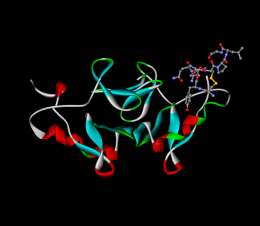
Oxytocin (ball-and-stick) bound to its carrier protein neurophysin (ribbons) Image: Wikipedia

(Medical Xpress) -- According to a new study published in Neuropsychopharmacology, researchers, led by Gunther Meinlschmidt, PhD, may have found a connection between the brain chemical oxytocin and postpartum depression.

Postpartum depression affects close to one in five women and can create bonding issues with a newborn child. It can also cause , and is a leading cause of in the UK. It affects up to 19 percent of mothers and can adversely affect the mental development of a child.

Oxytocin, also known as the ‘love hormone’ or ‘feel good chemical’ is released during human contact. It is also connected to uterine contraction during delivery and the letdown reflex which occurs during breastfeeding.

In the study, researchers measured the blood levels of oxytocin in 73 women during their third trimester of pregnancy. Their blood levels varied from 14.4 to 245.7 picograms per milliliter. The women were given written screenings, both during pregnancy, as well as two weeks after giving birth, to determine their risk of depression. Of the women, 14 went on to develop , and these women also showed the lower level of oxytocin.

While this is just a preliminary study, researchers plan to further explore the possible connection between and postpartum depression, as they believe it is one of several factors. They need to determine if the low levels are a symptom or a cause of the depression. They say, however, that testing a pregnant woman’s blood level could help to determine those who may be at risk and suggest counseling options in advance.

More information: Plasma Oxytocin Concentration during Pregnancy is associated with Development of Postpartum Depression, Neuropsychopharmacology , (11 May 2011) doi:10.1038/npp.2011.74

Abstract
Postpartum depression (PPD) affects up to 19% of all women after parturition. The non-apeptide oxytocin (OXT) is involved in adjustment to pregnancy, maternal behavior, and bonding. Our aim was to examine the possible association between plasma OXT during pregnancy and the development of PPD symptoms. A total of 74 healthy, pregnant women were included in this prospective study. During the third trimester of pregnancy and within 2 weeks after parturition, PPD symptoms were assessed using the Edinburgh Postnatal Depression Scale (EPDS). Blood samples for plasma OXT assessment were collected in the third trimester. Following the literature, participants with postpartum EPDS scores of 10 or more were regarded as being at risk for PPD development (rPPD group). In a logistic regression analysis, plasma OXT was included as a potential predictor for being at risk for PPD. Results were controlled for prepartal EPDS score, sociodemographic and birth-outcome variables. Plasma OXT concentration in mid-pregnancy significantly predicted PPD symptoms at 2 weeks postpartum. Compared with the no-risk-for-PPD group, the rPPD group was characterized by lower plasma OXT concentrations. To our knowledge, this is the first study to show an association between prepartal plasma OXT concentration and postpartal symptoms of PPD in humans. Assuming a causal relationship, enhancing OXT release during pregnancy could serve as a potential target in prepartum PPD prevention, and help to minimize adverse effects of PPD on the mother–child relationship.

© 2010 PhysOrg.com

5 /5 (3 votes)  

Rank 5 /5 (3 votes)
Relevant PhysicsForums posts

More news stories

Motion quotient: IQ predicted by ability to filter motion (w/ video)

A brief visual task can predict IQ, according to a new study. This surprisingly simple exercise measures the brain's unconscious ability to filter out visual movement. The study shows that individuals whose ...

Psychology & Psychiatry created 11 hours ago | popularity 4.9 / 5 (8) | comments 0 | with audio podcast

Anxious men fare worse during job interviews, study finds

Nervous about that upcoming job interview? You might want to take steps to reduce your jitters, especially if you are a man.

Psychology & Psychiatry created 12 hours ago | popularity 5 / 5 (1) | comments 0

Are kids who take music lessons different from other kids?

(Medical Xpress)—Research by U of T Mississauga psychology professor Glenn Schellenberg reveals that two key personality traits – openness-to-experience and conscientiousness—predict better than IQ ...

Psychology & Psychiatry created 14 hours ago | popularity 3 / 5 (2) | comments 1 | with audio podcast

Parents can help preteens with abduction concerns

Parents naturally are concerned for their children's safety, particularly when there is news of a child abduction that happens close to home. Finding the balance between emotions and the "teachable moment" as parents talk ...

Psychology & Psychiatry created 15 hours ago | popularity not rated yet | comments 0

Ireland needs real-time database for teen and young adult suicides

A new report on suicide in Ireland shows that suicide cases experienced a significant number (and intensity) of life events in the 6 months prior to their death.

Psychology & Psychiatry created 15 hours ago | popularity not rated yet | comments 0


Controlling mood through the motions of mitochondria

(Medical Xpress)—Regulating the distribution of power in neurons is done by a system that makes the national electric grid look simple by comparison. Each neuron has several thousand mitochondria confined ...

Multiple research teams unable to confirm high-profile Alzheimer's study

Teams of highly respected Alzheimer's researchers failed to replicate what appeared to be breakthrough results for the treatment of this brain disease when they were published last year in the journal Science.

Scientists discover molecule triggers sensation of itch

Scientists at the National Institutes of Health report they have discovered in mouse studies that a small molecule released in the spinal cord triggers a process that is later experienced in the brain as ...

Researchers find common childhood asthma unconnected to allergens or inflammation

Little is known about why asthma develops, how it constricts the airway or why response to treatments varies between patients. Now, a team of researchers at Weill Cornell Medical College, Columbia University Medical Center ...

Diabetes' genetic underpinnings can vary based on ethnic background, studies say

Ethnic background plays a surprisingly large role in how diabetes develops on a cellular level, according to two new studies led by researchers at the Stanford University School of Medicine.

Study reveals new mechanism for estrogen suppression of liver lipid synthesis

By discovering the new mechanism by which estrogen suppresses lipid synthesis in the liver, UC Irvine endocrinologists have revealed a potential new approach toward treating certain liver diseases.