A better way to remember
June 17, 2011 in Neuroscience
A better way to remember

Enlarge

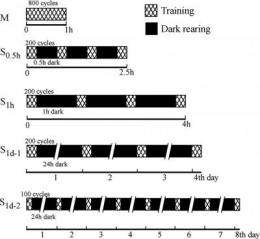
This graphic shows protocols for massed (M) and spaced (S0.5h-S1d-2) learning. Mice were trained their optokinetic eye movements by 1 hour of concentrated protocol or 2.5 hours-8 days of spaced protocols. Credit: RIKEN

Scientists and educators alike have long known that cramming is not an effective way to remember things. With their latest findings, researchers at the RIKEN Brain Science Institute in Japan, studying eye movement response in trained mice, have elucidated the neurological mechanism explaining why this is so. Published in the Journal of Neuroscience, their results suggest that protein synthesis in the cerebellum plays a key role in memory consolidation, shedding light on the fundamental neurological processes governing how we remember.

The "spacing effect", first discovered over a century ago, describes the observation that humans and animals are able to remember things more effectively if learning is distributed over a long period of time rather than performed all at once. The effect is believed to be closely connected to the process of , whereby short-term memories are stabilized into long-term ones, yet the underlying neural mechanism involved has long remained unclear.

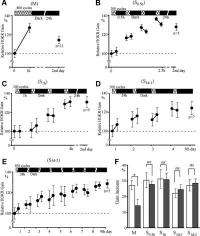
To clarify this mechanism, the researchers developed a technique based around the phenomenon of horizontal optokinetic response (HOKR), a compensatory eye movement which can be used to quantify the effects of motor learning. Studying HOKR in mice, they found that the long-term effects of learning are strongly dependent on whether training is performed all at once ("massed training"), or in spaced intervals ("spaced training"): whereas gains incurred in massed training disappeared within 24 hours, those gained in spaced training were sustained longer.
A better way to remember
Enlarge

This grahic illustrates time course and retention of motor learning induced by the massed (A) and spaced (B-E) training protocols. Learning occurred similarly immediately after the end of these 5 protocols. However, the retention of memory of learning, examined 24 h after the end training, was impaired in the massed protocol, but not in any of 4 spaced protocols (F). *, statistically significant at P < 0.05. ns, non-significant. Credit: RIKEN

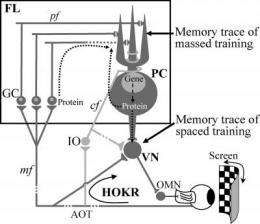
Earlier research suggested that this spacing effect is the product of the transfer of the memory trace from the flocculus, a cerebellar cortex region which connects to motor nuclei involved in eye movement, to another brain region known as the vestibular nuclei. To verify this idea, the team administered to the flocculus and studied its effect on learning. While learning gains in mice that had undergone one hour of massed training were eliminated, those in mice that had undergone the same amount of training spaced out over a four hour period were unaffected.
A better way to remember
Enlarge

This graphic presents a summary of the findings. Pharmacological reversible shutdown experiments of the cerebellar cortex revealed that the memory produced by massed learning is maintained in the cerebellar cortex, whereas the memory produced by spaced learning is maintained in the cerebellar nuclei (VN), indicating "trans-synapse memory trace transfer" occurs by spaced learning. Because local applications of protein synthesis inhibitors (anisomycin or actinomycin D) blocked the spaced learning, the proteins synthesized during spaced training protocols may play a key role in trans-synapse memory trace transfer. Credit: RIKEN

Explaining this observation, the researchers found that the spacing effect was impaired when mice were infused with anisomycin and actinomycin D, antibiotics which inhibit . This final discovery suggests that proteins produced during training play a key role in the formation of long-term memories, providing for the first time a neurological explanation for the well-known benefits of spaced learning - as well as a great excuse to take more breaks.

Provided by RIKEN search and more info website

5 /5 (3 votes)  

Filter


Move the slider to adjust rank threshold, so that you can hide some of the comments.


Display comments: newest first

hush1
Jun 17, 2011

Rank: not rated yet
Fine.
Then "Photographic memory" is "massed learning" the cerebellar cortex as "storage"?

"To verify this idea, the team administered local anesthetic..."
Yes.

"This final discovery suggests that proteins produced during training play a key role in the formation of long-term memories, provides for the first time a neurological explanation for ... learning..."

Yes.
Kudos.
Rank 5 /5 (3 votes)
Relevant PhysicsForums posts
  • A question about drug tolerance
    created20 hours ago
  • Poor nutrition leading to overeating?
    createdMay 23, 2012
  • Math and dyslexia?
    createdMay 21, 2012
  • portable metabolism meter?
    createdMay 21, 2012
  • Rare medical conditions on 20/20 tonight
    createdMay 18, 2012
  • "Good" Cholesterol in Doubt
    createdMay 17, 2012
  • More from Physics Forums - Medical Sciences

More news stories

Persistent sensory experience is good for aging brain

Despite a long-held scientific belief that much of the wiring of the brain is fixed by the time of adolescence, a new study shows that changes in sensory experience can cause massive rewiring of the brain, even as one ages. ...

Neuroscience created 2 hours ago | popularity not rated yet | comments 0

Boundary stops molecule right where it needs to be

A molecule responsible for the proper formation of a key portion of the nervous system finds its way to the proper place not because it is actively recruited, but instead because it can't go anywhere else.

Neuroscience created 2 hours ago | popularity not rated yet | comments 0 | with audio podcast

Locating ground zero: How the brain's emergency workers find the disaster area

Like emergency workers rushing to a disaster scene, cells called microglia speed to places where the brain has been injured, to contain the damage by 'eating up' any cellular debris and dead or dying neurons. ...

Neuroscience created 2 hours ago | popularity 5 / 5 (2) | comments 0 | with audio podcast

Genetic 'reset switch' enables signaling pathway to induce multiple developmental outcomes for olfactory neurons

Within the nervous system, a handful of signaling pathways modulate development of a cornucopia of different neuronal subtypes. “Even small alterations in neuron differentiation pathways can disrupt subsequent ...

Neuroscience created 5 hours ago | popularity not rated yet | comments 0

The auditory cortex adapts agilely with concentration

The birth of sensory perception on the human cerebral cortex is yet to be fully explained. The different areas on the cortex function in cooperation, and no perception is the outcome of only one area working alone. In his ...

Neuroscience created 6 hours ago | popularity not rated yet | comments 0


The cells' petrol pump is finally identified

The oxygen and food we consume are converted into energy by tiny organelles present in each cell, the mitochondria. These 'power plants' must be continuously supplied with fuel, to maintain all vital functions. A team led ...

Researchers identify protein necessary for behavioral flexibility

Researchers have identified a protein necessary to maintain behavioral flexibility, which allows us to modify our behaviors to adjust to circumstances that are similar, but not identical, to previous experiences. Their findings, ...

Thioridazine kills cancer stem cells in human while avoiding toxic side-effects of conventional cancer treatments

A team of scientists at McMaster University has discovered a drug, thioridazine, successfully kills cancer stem cells in the human while avoiding the toxic side-effects of conventional cancer treatments.

Researcher calls for new approach to regulating probiotics

In today's Nature scientific journal Dr. Gregor Reid, Director of the Canadian R&D Centre for Probiotics at Lawson Health Research Institute and a scientist at Western University, calls for a Category Tree system to be imp ...

Male fertility genes discovered

A new study has revealed previously undiscovered genetic variants that influence fertility in men. The findings, published by Cell Press on May 24th in the American Journal of Human Genetics, shed much-needed light on hum ...

Knowing genetic makeup may not significantly improve disease risk prediction

Harvard School of Public Health (HSPH) researchers have found that detailed knowledge about your genetic makeup—the interplay between genetic variants and other genetic variants, or between genetic variants and environmental ...