Drug boosts growth factor to jump-start rapid antidepressant response
June 22, 2011 in Medical research
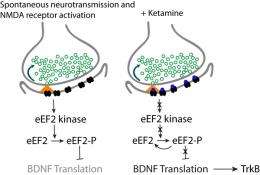
When in their default (resting) state, neurons that mediate ketamine’s action engage in the brain’s equivalent of background chatter. They spontaneously spray out (orange) the chemical messenger glutamate (green circles), which binds to NMDA receptors (black ovals) on adjoining neurons. This activates the enzyme eEF2 kinase, which suppresses synthesis of BDNF, a growth factor that has antidepressant effects. Treatment with ketamine blocks the binding of the neurotransmitter to the receptors (blue dots on black ovals), which inactivates the enzyme, taking the brakes off translation of BDNF into protein. This jump-starts a fast-acting antidepressant effect. Source: Lisa Monteggia, Ph.D., University of Texas Southwestern Medical Center
(Medical Xpress) -- A study in mice has pinpointed a pivotal new player in triggering the rapid antidepressant response produced by ketamine. By deactivating a little-known enzyme, the drug takes the brakes off rapid synthesis of a key growth factor thought to lift depression, say researchers supported by the National Institutes of Health.
Other agents that work through this pathway and block the enzyme may also similarly induce anti-depressant-like effects and hold promise for development of new treatments, said Lisa Monteggia, Ph.D., of the University of Texas Southwestern Medical Center, Dallas, a grantee of the NIHs National Institute of Mental Health.
Monteggia, Ege Kavalali, Ph.D., and colleagues reported their findings online June 15, 2011 in the journal Nature.
Unlike currently available antidepressants that take weeks to work, ketamine can lift mood within hours. Yet adverse side effects of this animal anesthetic and sometime club drug preclude it from becoming a practical treatment. So researchers have been studying its mechanism of action, in hopes of developing safer alternatives that work the same way.
Earlier studies had shown that the growth factor, called brain-derived neurotrophic factor (BDNF), produces antidepressant-like effects. To find out if BDNF is involved in ketamines action, the researchers gave the drug to mice genetically engineered to lack BDNF. Unlike in control mice, ketamine failed to produce a fast-acting antidepressant-like response in such BDNF knockout mice exposed to experimental situations that trigger depression-like behaviors. This and other tests confirmed that ketamines rapid antidepressant effects depend on rapid synthesis of BDNF in the brains memory center, or hippocampus.
The researchers determined that this happens so quickly within 30 minutes because time-consuming intermediate steps have already been completed. It only requires the translation of BDNF mRNA, an intermediate form, into the final protein. By contrast, conventional antidepressants are thought to work through a much more lengthy and indirect process that requires, among other things, the birth of new neurons and their integration into circuits.
Ketamine achieves this boost in BDNF levels by first blocking a protein on neurons (brain cells) called the NMDA receptor. The Texas team discovered that this blockade, in turn, deactivates an enzyme called eukaryotic elongation factor 2 (eEF2) kinase, which restrains BDNF synthesis. So ketamine (and presumably other agents that similarly turn off the enzyme) effectively takes the brakes off of this antidepressant mechanism.
Selectively inhibiting the eEF2 kinase was sufficient to trigger a rapidly acting antidepressant response in control mice but not in mice lacking BDNF, explained Monteggia.
The researchers discovered that the boost in BDNF occurs while neurons are in their default mode not doing anything in particular. But the cells continue communicating via a low level of background chatter, spontaneously releasing chemical messengers that bind to receptors. So when ketamine blocks NMDA receptors, it prevents their naturally occurring messenger chemical, glutamate, from binding to them.
Interference with such spontaneous neurotransmission to trigger production of a protein represents a novel mode of drug action, Monteggia noted. It may also hold clues to what goes awry in the brain in disorders like depression.
Although BDNF levels fall off sharply following the transient increase triggered by ketamine, she says evidence may also support a role for BDNF in the drugs longer-term antidepressant effects. The exact role of another enzyme implicated in ketamines antidepressant action remains to be determined, in light of the new findings. Yale researchers reported last fall that the drug triggered increased connections between neurons via effects on the enzyme, called mTOR.
This discovery of a novel pathway involved in mediating fast-acting antidepressant action holds hope for development of new rapid-acting medications, said Monteggia.
Provided by National Institutes of Health
-
Ketamine helps see how the brain works in clinical depression
Jun 16, 2011 |
not rated yet |
0
-
Researchers explore the antidepressant effects of ketamine
Feb 21, 2008 |
not rated yet |
0
-
Faster-acting antidepressants closer to becoming a reality
Jul 24, 2007 |
not rated yet |
0
-
Researchers describe secrets of 'magic' antidepressant
Aug 19, 2010 |
not rated yet |
0
-
Researchers find possible biomarker to identify seizure-related stress
Oct 04, 2010 |
not rated yet |
0
-
Limits to growth: Scientists identify key metastasis-enabling enzyme
May 22, 2012 |
5 / 5 (3) |
0
-
Seeing is as seeing does: Spatially-structured retinal input in early development of cortical maps
Apr 26, 2012 |
5 / 5 (4) |
1
-
Dreamless nights: Brain activity during nonrapid eye movement sleep
Apr 09, 2012 |
4.4 / 5 (12) |
0
-
Take your time: Neurobiology sheds light on the superiority of spaced vs. massed learning
Mar 28, 2012 |
4.5 / 5 (21) |
3
-
Your brain on 'shrooms: fMRI elucidates neural correlates of psilocybin psychedelic state
Feb 29, 2012 |
4.9 / 5 (42) |
45
-
A question about drug tolerance
22 hours ago
-
Poor nutrition leading to overeating?
May 23, 2012
-
Math and dyslexia?
May 21, 2012
-
portable metabolism meter?
May 21, 2012
-
Rare medical conditions on 20/20 tonight
May 18, 2012
-
"Good" Cholesterol in Doubt
May 17, 2012
- More from Physics Forums - Medical Sciences
More news stories
The cells' petrol pump is finally identified
The oxygen and food we consume are converted into energy by tiny organelles present in each cell, the mitochondria. These 'power plants' must be continuously supplied with fuel, to maintain all vital functions. A team led ...
Medical research
3 hours ago |
5 / 5 (1) |
0
Researchers identify protein necessary for behavioral flexibility
Researchers have identified a protein necessary to maintain behavioral flexibility, which allows us to modify our behaviors to adjust to circumstances that are similar, but not identical, to previous experiences. Their findings, ...
Medical research
5 hours ago |
5 / 5 (1) |
1
|
From stem cell to brain cell - new technique mimics the brain
A new technique that converts stem cells into brain cells has been developed by researchers at Lund University. The method is simpler, quicker and safer than previous research has shown and opens the doors to a shorter route ...
Medical research
7 hours ago |
5 / 5 (1) |
0
A revealing hand
What did you have for lunch yesterday? How many times a month do you eat nuts? How about your kids -- how many servings of vegetables did they consume today?
Medical research
11 hours ago |
5 / 5 (2) |
0
Stem-cell-growing surface enables bone repair
(Medical Xpress) -- University of Michigan researchers have proven that a special surface, free of biological contaminants, allows adult-derived stem cells to thrive and transform into multiple cell types. ...
Medical research
May 23, 2012 |
5 / 5 (9) |
1
|
Gene discovery points towards non-hormonal male contraceptive
A new type of male contraceptive could be created thanks to the discovery of a key gene essential for sperm development.
Infections may be deadly for many dialysis patients
An infection called peritonitis commonly arises in the weeks before many dialysis patients die, according to a study appearing in an upcoming issue of the Journal of the American Society of Nephrology (JASN). The findings sugges ...
Obese patients face increased risk of kidney damage after heart surgery
Oxidative stress may put obese patients at increased risk of developing kidney damage after heart surgery, according to a study appearing in an upcoming issue of the Journal of the American Society of Nephrology (JASN). Effect ...
Amino acid consumption associated with how fast cancer cells divide
For almost a century, researchers have known that cancer cells have peculiar appetites, devouring glucose in ways that normal cells do not. But glucose uptake may tell only part of cancer's metabolic story. Researchers from ...
Cyber exercise partners help you go the distance: Motivation gains can double
A new study testing the benefits of a virtual exercise partner shows the presence of a moderately more capable cycling partner can significantly boost the motivation by as much as 100 percent ...
Report: State tobacco prevention funding lacking
(AP) -- States have spent only about 3 percent of the billions they've received in tobacco taxes and legal settlements over the last decade to fund tobacco prevention programs, making it harder to reduce the death and disease ...