Single gene controls development of many forms of polycystic disease
June 19, 2011 in Genetics
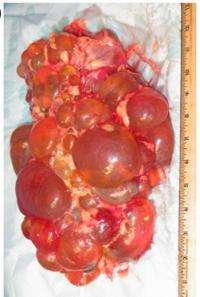
Cysts riddle a kidney from a patient with polycystic kidney disease. Credit: courtesy Yale University
A single gene is central in the development of several forms of polycystic kidney and liver disease, Yale School of Medicine researchers report in the June 19 issue of Nature Genetics.
The findings suggest manipulating activity of PKD1, the gene causing the most common form of polycystic kidney disease, may prove beneficial in reducing cysts in both liver and kidney.
"We found that these conditions are not the result of an all or nothing phenomenon," said Stefan Somlo, the C.N.H. Long Professor of Medicine and Genetics and Chief, Section of Nephrology and senior author of the study. "The less PKD1 is expressed, the more cysts develop. Conversely, expressing more PKD1 can slow the process."
The most common form of this condition is called autosomal dominant polycystic kidney disease (ADPKD), a condition passed on to children from one parent affected with the disease that is found in 600,000 people in the United States alone. Two genes, PKD1 and PKD2, are responsible for the onset of this condition.
PKD patients also develop cysts of the liver and Somlo and colleagues had previously identified families with identical cysts found only in the liver. They found two different genes were responsible for this related condition.
The researchers wanted to know how liver-only polycystic disease was related to ADPKD. In a series of experiments using both genetically engineered mouse models and biochemical studies, they found that the activity of only one of the four genes, PKD1, controlled cyst formation in the other forms of the disease. Experiments in mice showed that modulating dosage of PKD1 could slow disease progression.
"The data suggest the exciting possibility that targeting the activity of PKD1 may be beneficial for treatment of isolated polycystic liver disease, childhood recessive polycystic kidney disease and even a subset of adult ADPKD," said Somlo.
Yale is a leader in the investigation of PKD. For instance basic scientific research conducted at Yale has been crucial in helping to identify cilia, the tiny thread-like structure that extends from a cell's surface, as a critical component in cyst forming pathways. Yale has been the home of one of the four NIH-funded national centers of excellence in PKD research since 1999. In addition, the laboratory of Craig Crews, Lewis B. Cullman Professor of Molecular, Cellular, and Developmental Biology and Professor of Chemistry and of Pharmacology, has identified a compound that has shown promise in reducing number of cysts in some mouse models of PKD.
Provided by
Yale University
-
Paper highlight: Signaling hope for polycystic kidney disease
Sep 13, 2010 |
not rated yet |
0
-
Researchers propose new ultrasound screening criteria for diagnosing polycystic kidney disease
Oct 22, 2008 |
not rated yet |
0
-
Experiments point to new treatments for PKD
Apr 02, 2008 |
not rated yet |
0
-
A new target in polycystic kidney disease
Sep 13, 2010 |
not rated yet |
0
-
Common diabetes drug may halt growth of cysts in polycystic kidney disease
Nov 11, 2010 |
not rated yet |
0
-
Limits to growth: Scientists identify key metastasis-enabling enzyme
May 22, 2012 |
5 / 5 (3) |
0
-
Seeing is as seeing does: Spatially-structured retinal input in early development of cortical maps
Apr 26, 2012 |
5 / 5 (4) |
1
-
Dreamless nights: Brain activity during nonrapid eye movement sleep
Apr 09, 2012 |
4.4 / 5 (12) |
0
-
Take your time: Neurobiology sheds light on the superiority of spaced vs. massed learning
Mar 28, 2012 |
4.5 / 5 (21) |
3
-
Your brain on 'shrooms: fMRI elucidates neural correlates of psilocybin psychedelic state
Feb 29, 2012 |
4.9 / 5 (42) |
45
-
Classical and Quantum Mechanics via Lie algebras
Apr 15, 2011
- More from Physics Forums - Independent Research
More news stories
'Personality genes' may help account for longevity
"It's in their genes" is a common refrain from scientists when asked about factors that allow centenarians to reach age 100 and beyond. Up until now, research has focused on genetic variations that offer a physiological advantage ...
Genetics
1 hour ago |
not rated yet |
0
|
Gene discovery points towards non-hormonal male contraceptive
A new type of male contraceptive could be created thanks to the discovery of a key gene essential for sperm development.
Genetics
1 hour ago |
5 / 5 (3) |
0
|
Key gene found responsible for chronic inflammation, accelerated aging and cancer
Researchers at NYU School of Medicine have, for the first time, identified a single gene that simultaneously controls inflammation, accelerated aging and cancer.
Genetics
6 hours ago |
not rated yet |
0
Knowing genetic makeup may not significantly improve disease risk prediction
Harvard School of Public Health (HSPH) researchers have found that detailed knowledge about your genetic makeupthe interplay between genetic variants and other genetic variants, or between genetic variants and environmental ...
Genetics
6 hours ago |
2 / 5 (1) |
0
|
Male fertility genes discovered
A new study has revealed previously undiscovered genetic variants that influence fertility in men. The findings, published by Cell Press on May 24th in the American Journal of Human Genetics, shed much-needed light on hum ...
Genetics
6 hours ago |
not rated yet |
0
|
Study provides compelling evidence for an effective new treatment for tinnitus
According to new research, a multidisciplinary approach to treating tinnitus that combines cognitive behaviour therapy with sound-based tinnitus retraining therapy is significantly more effective than currently available ...
Brentuximab vedotin effective in large-cell lymphoma
(HealthDay) -- More than half of patients with relapsed or refractory systemic anaplastic large-cell lymphoma (ALCL) treated with the CD30-directed antibody-drug conjugate brentuximab vedotin achieve a complete ...
Autism often not diagnosed until age 5 or older: U.S. report
(HealthDay) -- Even though autism symptoms typically emerge before age 3, most children with autism are diagnosed when they're 5 or older, a new snapshot of autism in America shows.
Doctors report rise in kids eating detergent packs
(AP) -- Miniature laundry detergent packets arrived on store shelves in recent months as an alternative to bulky bottles and messy spills. But doctors across the country say children are confusing the tiny, brightly colored ...
Amino acid consumption associated with how fast cancer cells divide
For almost a century, researchers have known that cancer cells have peculiar appetites, devouring glucose in ways that normal cells do not. But glucose uptake may tell only part of cancer's metabolic story. Researchers from ...
Cyber exercise partners help you go the distance: Motivation gains can double
A new study testing the benefits of a virtual exercise partner shows the presence of a moderately more capable cycling partner can significantly boost the motivation by as much as 100 percent ...