New study finds HIV Achilles Heel
June 21, 2011
by Deborah Braconnier
in HIV & AIDS
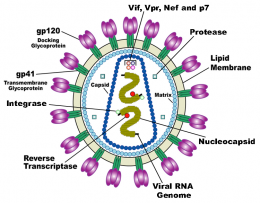
Diagram of the HIV virus. Image: US National Institute of Health/Wikipedia.
(Medical Xpress) -- A new study published in the Proceedings of the National Academy of Sciences shows how scientists have used a mathematical tool to possibly identify an Achilles heel in HIV which may lead to new vaccines and treatments.
One of the main things that make HIV so difficult to combat is its extreme ability to mutate. However, this research has identified what are being called HIV sectors and are groups of amino acids that are rarely seen making mutations. The researchers believe that the virus needs to maintain these sectors in order to survive and it is these sectors that should be the main target of treatments.
Through a joint enterprise combining the Massachusetts Institute of Technology, Harvard, University and Massachusetts General Hospital, the group called the Ragon Institute is behind the study. The Ragon Institute was established in 2009 to bring scientists together for the study in HIV/AIDS and other similar diseases.
The lead researchers were not biologists but rather specialized in chemistry. Professor of chemistry and chemical engineering at MIT Arup Chakraborty partnered with assistant professor of chemistry from the Universite Pierre et Marie Curie Vincent Dahirel. The two chemists joined forces with a long-time HIV researcher and director of the Ragon Institute Bruce Walker.
Using a 1950s statistical method known as random matrix theory, Chakraborty and Dahirel looked at the HIV proteins and sequences taken from a huge database of HIV patients trying to determine which segment was least able to tolerate mutations. What they found was sector three on the HIV protein known as Gag.
It was determined that part of this sector was responsible for the outer edges of the honeycomb structure that makes up the internal shell of the virus. If this structure suffered too many mutations, it would collapse.
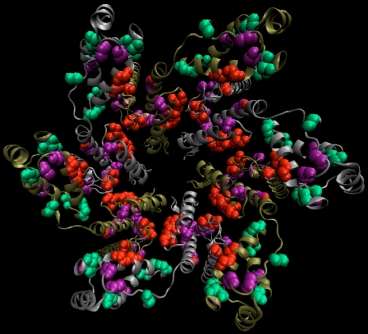
Ragon Institute researchers identified potential HIV vaccine targets in a subunit of the Gag protein. Six of those subunits come together to form the hexagonal proteins that make up the viral capsid. Image: Vincent Dahirel
Dr. Walker has spent years studying the rare HIV patients known as elite controllers. These patients are able to control their HIV virus with their own immune system and no medication. What they found was the main target of these patients immune system was this same sector three.The main hypothesis determined from this study was that new vaccines and treatments should not focus on a random attack but a focused attack on sector three. Professor of Medicine at Harvard and fellow Ragon colleague Dan Barouch plans to test this hypothesis in monkeys.
More information: Coordinate linkage of HIV evolution reveals regions of immunological vulnerability, PNAS, Published online before print June 20, 2011, doi: 10.1073/pnas.1105315108
Abstract
Cellular immune control of HIV is mediated, in part, by induction of single amino acid mutations that reduce viral fitness, but compensatory mutations limit this effect. Here, we sought to determine if higher order constraints on viral evolution exist, because some coordinately linked combinations of mutations may hurt viability. Immune targeting of multiple sites in such a multidimensionally conserved region might render the virus particularly vulnerable, because viable escape pathways would be greatly restricted. We analyzed available HIV sequences using a method from physics to reveal distinct groups of amino acids whose mutations are collectively coordinated (HIV sectors). From the standpoint of mutations at individual sites, one such group in Gag is as conserved as other collectively coevolving groups of sites in Gag. However, it exhibits higher order conservation indicating constraints on the viability of viral strains with multiple mutations. Mapping amino acids from this group onto protein structures shows that combined mutations likely destabilize multiprotein structural interactions critical for viral function. Persons who durably control HIV without medications preferentially target the sector in Gag predicted to be most vulnerable. By sequencing circulating viruses from these individuals, we find that individual mutations occur with similar frequency in this sector as in other targeted Gag sectors. However, multiple mutations within this sector are very rare, indicating previously unrecognized multidimensional constraints on HIV evolution. Targeting such regions with higher order evolutionary constraints provides a novel approach to immunogen design for a vaccine against HIV and other rapidly mutating viruses.
© 2010 PhysOrg.com
-
Immune system's HIV troubles discovered
Aug 22, 2006 |
not rated yet |
0
-
HIV isolate from Kenya provides clues for vaccine design
Jan 02, 2008 |
not rated yet |
0
-
New ways to pressure HIV
Jan 11, 2010 |
not rated yet |
0
-
New insights into the mystery of natural HIV immunity
May 05, 2010 |
not rated yet |
0
-
Scientists find another key to HIV success
Mar 22, 2006 |
not rated yet |
0
-
Motion perception revisited: High Phi effect challenges established motion perception assumptions
Apr 23, 2013 |
3 / 5 (2) |
2
-
Anything you can do I can do better: Neuromolecular foundations of the superiority illusion (Update)
Apr 02, 2013 |
4.5 / 5 (11) |
5
-
The visual system as economist: Neural resource allocation in visual adaptation
Mar 30, 2013 |
5 / 5 (2) |
9
-
Separate lives: Neuronal and organismal lifespans decoupled
Mar 27, 2013 |
4.9 / 5 (8) |
0
-
Sizing things up: The evolutionary neurobiology of scale invariance
Feb 28, 2013 |
4.8 / 5 (10) |
14
-
Classical and Quantum Mechanics via Lie algebras
Apr 15, 2011
- More from Physics Forums - Independent Research
More news stories
Fecal microbiota tx feasible for recurrent C. difficile in HIV
(HealthDay)—For HIV-infected individuals with recurrent Clostridium difficile infection, fecal microbiota therapy is feasible, according to a letter published in the May 21 issue of the Annals of Intern ...
HIV & AIDS
3 hours ago |
not rated yet |
0
Canada lifts ban on gay men donating blood
Canadian health authorities lifted Wednesday what was effectively a ban on gay men giving blood, announcing new rules making men who have not had sex with men in the past five years eligible.
HIV & AIDS
5 hours ago |
not rated yet |
1
AIDS scientists optimistic of AIDS cure, for some
Top AIDS scientists were optimistic Wednesday of finding a cure for the disease that has claimed 30 million lives—but said it might not work for all people.
HIV & AIDS
8 hours ago |
not rated yet |
0
Integrating mental health care into HIV care
The integration of mental health interventions into HIV prevention and treatment platforms can reduce the opportunity costs of care and improve treatment outcomes, argues a new Policy Forum article published in this week's ...
HIV & AIDS
May 21, 2013 |
not rated yet |
0
After a decade, global AIDS program looks ahead
(AP)—The decade-old law that transformed the battle against HIV and AIDS in developing countries is at a crossroads. The dream of future generations freed from the epidemic is running up against an era ...
HIV & AIDS
May 21, 2013 |
not rated yet |
0
Slowing the aging process—only with antibiotics
Swiss scientists reveal the mechanism responsible for aging hidden deep within mitochondria—and dramatically slow it down in worms by administering antibiotics to the young.
Researchers complete largest genetic sequencing study of human disease
Researchers from Queen Mary, University of London have led the largest sequencing study of human disease to date, investigating the genetic basis of six autoimmune diseases.
Having both migraines, depression may mean smaller brain
(HealthDay)—Migraines and depression can each cause a great deal of suffering, but new research indicates the combination of the two may be linked to something else entirely—a smaller brain.
Brain can be trained in compassion, study shows
Until now, little was scientifically known about the human potential to cultivate compassion—the emotional state of caring for people who are suffering in a way that motivates altruistic behavior.
Novel approach for influenza vaccination shows promise in early animal testing
A new approach for immunizing against influenza elicited a more potent immune response and broader protection than the currently licensed seasonal influenza vaccines when tested in mice and ferrets. The vaccine ...
Systematic screening of med adherence will ID barriers
(HealthDay)—Implementation of systematic monitoring for medication adherence will allow for identification of barriers to adherence and tailoring of interventions, according to a viewpoint piece published ...
Jun 21, 2011
Rank: not rated yet
Jun 21, 2011
Rank: 5 / 5 (2)
Jun 22, 2011
Rank: 5 / 5 (1)
If you want a once off solution for a problem for a million dollars: ask a scientist.
If you want a solution for a million people at $1 each: ask an engineer.
I suppose we need both approaches at the same time. One to come up with the ideas, do the experiments, gather data. The other approach to effectively use the knowledge gained and put it to use in society today.
Jun 25, 2011
Rank: not rated yet
Luc Montagnier says HIV Can Be Cleared Naturally bit dot ly/hSLsaF