New strategy to attack tumor-feeding blood vessels
June 6, 2011 in Medical research

New strategy to attack tumor-feeding blood vessels

Enlarge

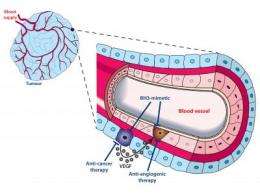
Cancers such as breast cancer, lung cancer and melanoma release the blood vessel growth factor, VEGF, to encourage blood vessels to grow within the tumor, supplying it with nutrients. Tumors can be treated with anti-cancer medications that kill the cancer cells, and anti-angiogenic medications that starve the tumour by attacking its blood supply. The study suggests that a third type of medication, BH3-mimetics, may enhance the tumor-killing effect of anti-cancer and anti-angiogenic medications. Credit: Walter and Eliza Hall Institute

Scientists at the Walter and Eliza Hall Institute have discovered a key molecule needed to kill the blood vessels that supply tumours.

The research team from the institute's Molecular Genetics of Cancer and Cancer and Haematology divisions found that for anti-cancer therapies that target tumour to work the death- inducing molecule Bim is required. The finding could lead to improved anti-cancer treatments that are based on a two- or three-pronged attack on both the tumour and its blood supply. The research will be published online in the today.

The growth of solid tumours, such as lung cancer, breast cancer and melanoma, depends on nutrients and oxygen being provided by the tumour blood supply. encourage the growth of blood vessels to feed a tumour by producing the hormone-like protein, (VEGF). The research by Drs Edwina Naik, Leigh Coultas and Lorraine O'Reilly, and Professors Jerry Adams and Andreas Strasser showed that VEGF produced by tumours blocks production of Bim in the cells that line the tumour blood vessels.

New 'anti-angiogenic' medications that attack the blood vessels within tumours are showing promise in starving many types of cancers by reducing their blood supply.

In this study, in experimental melanoma, lung cancer and models, Bim levels increased in the cells lining the blood vessels when VEGF was depleted by anti-angiogenic drugs, ultimately killing the . VEGF depletion reduced the number of blood vessels in tumours, making the tumours shrink. However, in mice in which the blood vessels do not express Bim, VEGF depletion did not affect the number of tumour-associated blood vessels, and tumours grown in Bim-deficient mice did not respond to anti-angiogenic treatments.

Dr Strasser said this finding suggests that strategies for treating tumours by attacking the tumour could be optimised by incorporating drugs called BH3-mimetics that cause cell death by acting like Bim at a molecular level. "Similarly, therapies that increase the amount of Bim in tumour blood vessels could enhance the effects of anti-angiogenic agents," Dr Strasser said.

"BH3 mimetics may have two beneficial effects in . Our previous research had showed they can directly trigger death in tumour cells, particularly when the tumour is also attacked by chemotherapeutic drugs. We now think BH3-mimetics could also impact tumour cells indirectly by killing endothelial cells within tumours.

"This suggests that a promising new approach to the therapy of solid tumours may be to use a three-medication combination of a drug that specifically targets the tumour cell, an anti- angiogenic agent to impair the tumour blood vessels, plus a BH3 mimetic that will help the anti- tumour drug to directly kill the tumour cells and also will help the anti-angiogenic agent to kill the intra-tumoral endothelial cells, which in turn will starve the tumour, causing even more tumour cell death."

Provided by Walter and Eliza Hall Institute

not rated yet  

Rank not rated yet
Related Stories
Relevant PhysicsForums posts

More news stories

H. pylori, smoking trends, and gastric cancer in US men

Trends in Helicobacter pylori (H. pylori) and smoking explain a significant proportion of the decline of intestinal-type noncardia gastric adenocarcinoma (NCGA) incidence in US men between 1978 and 2008, and are estimated ...

Medical research created 57 minutes ago | popularity not rated yet | comments 0

Common food supplement fights degenerative brain disorders

Widely available in pharmacies and health stores, phosphatidylserine is a natural food supplement produced from beef, oysters, and soy. Proven to improve cognition and slow memory loss, it's a popular treatment for older ...

Medical research created 5 hours ago | popularity 5 / 5 (1) | comments 0 | with audio podcast

Finding a family for a pair of orphan receptors in the brain

Researchers at Emory University have identified a protein that stimulates a pair of "orphan receptors" found in the brain, solving a long-standing biological puzzle and possibly leading to future treatments for neurological ...

Medical research created 6 hours ago | popularity not rated yet | comments 0 | with audio podcast

Insight into the dazzling impact of insulin in cells

Australian scientists have charted the path of insulin action in cells in precise detail like never before. This provides a comprehensive blueprint for understanding what goes wrong in diabetes.

Medical research created 6 hours ago | popularity 4.7 / 5 (3) | comments 0 | with audio podcast

Do men's and women's hearts burn fuel differently?

Researchers at the University of Illinois at Chicago College of Medicine will study gender differences in how the heart uses and stores fat—its main energy source—and how changes in fat metabolism play ...

Medical research created 9 hours ago | popularity not rated yet | comments 0


Reducing caloric intake delays nerve cell loss

Activating an enzyme known to play a role in the anti-aging benefits of calorie restriction delays the loss of brain cells and preserves cognitive function in mice, according to a study published in the May ...

New sleeping pill poised to hit US markets

An experimental sleeping pill from US drug company Merck is effective at helping people fall and stay asleep, according to reviewers at the US Food and Drug Administration, which could soon approve the new drug.

Researchers find genetic risk factor for pulmonary fibrosis

A paper recently published in the New England Journal of Medicine and co-written by physicians and scientists at the University of Colorado School of Medicine finds that an important genetic risk factor for pulmonary fibros ...

Biomarkers discovered for inflammatory bowel disease

Using the Department of Defense Serum Repository (DoDSR), University of Cincinnati (UC) researchers have identified a number of biomarkers for inflammatory bowel disease (IBD), which could help with earlier diagnosis and ...

Changing cancer's environment to halt its spread

By studying the roles two proteins, thrombospondin-1 and prosaposin, play in discouraging cancer metastasis, a trans-Atlantic research team has identified a five-amino acid fragment of prosaposin that significantly reduces ...

Global recommendations on child medicine

Transparent information on the evidence supporting global recommendations on paediatric medicines should be easily accessible in order to help policy makers decides on what drugs to include in their national drug lists, according ...