Single drug, soft environment can increase platelet production
July 8, 2011 By Evan Lerner in Medical research
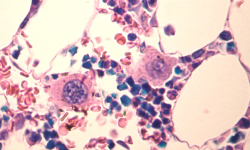
Megakaryocytes in bone marrow
(Medical Xpress) -- Humans produce billions of clot-forming platelets every day, but there are times when there arent enough of them, such as with certain diseases or during invasive surgery. Now, University of Pennsylvania researchers have demonstrated that a single drug can induce bone marrow cells called megakaryocytes to quadruple the number of platelets they produce.
Jae-Won Shin, a graduate student of pharmacology in Penns Perelman School of Medicine, and Dennis E. Discher, professor in the Department of Chemical and Biomolecular Engineering in the School of Engineering and Applied Science, led the research. They collaborated with Joe Swift and Ph.D. student Kyle R. Spinler, also of Chemical and Biomolecular Engineering.
Their research was published in the journal Proceedings of the National Academy of Science.
Megakaryocytes are the large bone marrow cells that produce platelets, the smaller cell fragments that form clots to seal blood vessels when the vessels are damaged. The amount of platelets they produce relates to their size. Unlike most other cells, when megakaryocytes copy their DNA, they dont split into two cells but continue to grow larger.
These cells take the relatively unusual step of becoming bigger and bigger, adding multiple nuclei, which you don't see with other cell types, Discher said. Mature, multinucleated megakaryocytes are better than uni- or bi-nucleated ones; they have more mass and are ready to make more platelets.
When mature, the megakaryocyte will extend a tendril into a neighboring blood vessel; the flow of blood pulls off pieces of the cell, forming platelets. The motor protein myosin-II plays a number of roles in this process; by inhibiting it with a drug known as belebbistatin, the researchers caused megakaryocytes to make up to four times as many platelets as when it is active.
Myosin-II is responsible for many body systems that require contractile tension, such as flexing ones muscles. In many cells, it is responsible for the integrity of the outer membranes, for cell division and for key aspects of adhesion. Because megakaryocytes are best when they are large, multi-nucleated and fragment easily, inhibiting myosin-II helps produce more platelets in three distinct ways.
The first factor is when cells normally divide, there is a contracting force between the dividing cells that cleave them apart, Shin said. But if you inhibit myosin, there is no contracting force and cells grow without dividing. That's how they become multi-nucleated and how the cell mass becomes bigger.
The second factor is cytoskeletal stiffness and tension in the cell. When myosin is active, the cell is stiff and tense like well-toned muscle, but if you inhibit the myosin, the cell becomes flaccid and more easy to push around and fragment, he said.
The third factor is that cells are able to sense the stiffness of their microscopic environment and react to it, which is also regulated by cellular contractivity, Shin said. Adhering to bone inhibits megakaryocyte growth; without myosin-II, they grow as if they were adhering to something soft.
By testing the megakaryocytes growth in different cell culture dishes and gels, the researchers were also able to show that a soft matrix, similar to squishy bone marrow, induced more platelet production than a rigid matrix.
After growing the platelets in Petri dishes saturated with the myosin-II inhibitor blebbistatin, the megakaryocytes were soft enough to spontaneously fragment into platelets. Because platelets need functioning myosin-II to form rigid clots, the researchers subsequently washed away the drug to show that the platelets could still activate.
While the researchers also transplanted blebbistatin-treated human megakaryocytes into genetically modified mice to show that they maintained their increased platelet production within living systems, most of their work was done in vitro to demonstrate that platelets could be successfully synthesized in a lab.
Platelet transfusions are harder and harder to come by. Not only are there contamination issues, but platelets are also very short-lived, Shin said. They only last about a week in a transfusion bag. The ability to make them in large quantities could save lives.
Provided by
University of Pennsylvania
-
Stop the bleeding: New way to restore numbers of key blood-clotting cells
Oct 25, 2010 |
not rated yet |
0
-
Method for manufacturing patient-specific human platelets
Nov 22, 2010 |
not rated yet |
0
-
Bioreactors might solve blood-platelet supply problems
Dec 23, 2008 |
not rated yet |
0
-
Researchers tap into a new and potentially better source of platelets for transfusion
Jul 28, 2008 |
not rated yet |
0
-
Nano-motor with a light switch: Light-triggered myosin allows real-time study of cells
May 10, 2011 |
not rated yet |
0
-
Motion perception revisited: High Phi effect challenges established motion perception assumptions
Apr 23, 2013 |
3 / 5 (2) |
2
-
Anything you can do I can do better: Neuromolecular foundations of the superiority illusion (Update)
Apr 02, 2013 |
4.5 / 5 (11) |
5
-
The visual system as economist: Neural resource allocation in visual adaptation
Mar 30, 2013 |
5 / 5 (2) |
9
-
Separate lives: Neuronal and organismal lifespans decoupled
Mar 27, 2013 |
4.9 / 5 (8) |
0
-
Sizing things up: The evolutionary neurobiology of scale invariance
Feb 28, 2013 |
4.8 / 5 (10) |
14
-
Why is zone 1 in liver more prone to ischemic injury?
May 23, 2013
-
How can there be villous adenoma in colon, if there are no villi there
May 22, 2013
-
How can there be a term called "intestinal metaplasia" of stomach
May 21, 2013
-
Pressure-volume curve: Elastic Recoil Pressure don't make sense
May 18, 2013
-
If you became brain-dead, would you want them to pull the plug?
May 17, 2013
-
MRI bill question
May 15, 2013
- More from Physics Forums - Medical Sciences
More news stories
Study reveals new mechanism for estrogen suppression of liver lipid synthesis
By discovering the new mechanism by which estrogen suppresses lipid synthesis in the liver, UC Irvine endocrinologists have revealed a potential new approach toward treating certain liver diseases.
Medical research
May 23, 2013 |
5 / 5 (1) |
0
|
MRI-based measurement helps predict vascular disease in the brain
Aortic arch pulse wave velocity, a measure of arterial stiffness, is a strong independent predictor of disease of the vessels that supply blood to the brain, according to a new study published in the June issue the journal ...
Medical research
May 23, 2013 |
not rated yet |
0
Antibiotics: A new understanding of sulfonamide nervous system side effects
Since the discovery of Prontosil in 1932, sulfonamide antibiotics have been used to combat a wide spectrum of bacterial infections, from acne to chlamydia and pneumonia. However, their side effects can include serious neurological ...
Medical research
May 23, 2013 |
3 / 5 (1) |
0
|
Scientists discover molecule triggers sensation of itch
Scientists at the National Institutes of Health report they have discovered in mouse studies that a small molecule released in the spinal cord triggers a process that is later experienced in the brain as ...
Medical research
May 23, 2013 |
5 / 5 (3) |
0
|
Discarded immune cells induce the relocation of stem cells
Spanish researchers have discovered that the daily clearance of neutrophils from the body stimulates the release of hematopoietic stem cells from the bone marrow into the bloodstream, according to a report published today ...
Medical research
May 23, 2013 |
5 / 5 (2) |
0
First drug to improve heart failure mortality in over a decade
Coenzyme Q10 decreases all cause mortality by half, according to the results of a multicentre randomised double blind trial presented today at Heart Failure 2013 congress. It is the first drug to improve heart failure mortality ...
Seniors more likely to crash when driving with pet, study finds
(HealthDay)—Animals make great companions for senior citizens, but elderly people who always drive with a pet in the car are far more likely to crash than those who never drive with a pet, researchers have ...
Heart failure accelerates male 'menopause'
Heart failure accelerates the aging process and brings on early andropausal syndrome (AS), according to research presented today at the Heart Failure Congress 2013. AS, also referred to as male 'menopause', was four times ...
Death highest in heart failure patients admitted in January, on Friday, and overnight
Mortality and length of stay are highest in heart failure patients admitted in January, on Friday, and overnight, according to research presented today at the Heart Failure Congress 2013. The analysis of nearly 1 million ...
Feds fight morning-after pill age ruling in NY
(AP)—Department of Justice lawyers have again asked a federal appeals court in New York to delay lifting age restrictions and prescription requirements on an emergency contraceptive popularly known as the morning-after ...
New immune system discovered
(Medical Xpress)—A research team, led by Jeremy Barr, a biology post-doctoral fellow, unveils a new immune system that protects humans and animals from infection.