Eye anatomy at camp? Kids get taste of med careers
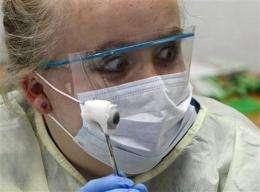
(AP) -- Again and again, 12-year-old Brianna Bowens cautiously pokes the human eyeball. On purpose.
The donated eye is tougher than you'd think. It takes a few slices with a sharp scalpel to pierce the white part - the sclera, she learns - and eventually remove the cornea in front.
Dissecting a human eye isn't the normal fare of summer camp. It's part of an unusual program at a small northern Virginia hospital that aims to hook kids as early as middle school on the possibilities of a medical career.
It's not for the squeamish. But no one's ever fainted over the eyes.
"I've got a strong stomach," says Brianna, of Stafford, Va., who wants to be a pediatric surgeon "or maybe a nurse."
She betrays her excitement when she's done, the twig-like optic nerve, magnifying lens and clear cornea carefully laid out. Whipping out her cellphone, she exclaims, "Wait, I've got to take a picture."
Tom Gaile of the Old Dominion Eye Foundation teaches the crash course at Fauquier Hospital's medical camp, using eyes donated for education, to explain the importance of organ and tissue donation.
"This is something that's going to stay with them the rest of their lives," he says.
Programs to entice budding scientists, from building robots to measuring pollution, increasingly are becoming part of the summer ritual. On the health side, it can be harder to find hospitals that free up space and staff to give youngsters a taste of what beginning medical students learn - how to suture skin, take blood pressure, put on a cast, insert an IV, type blood - much less handle precious donated eyes.
But more medical camps are cropping up, although no one keeps a count. And if 12 sounds young, well, Virginia in particular is targeting middle-school students so they line up enough science courses for the best shot at increasingly competitive college training programs.
"You can't wait `til you're a senior and decide `I want to go into health care,'" says Barbara Brown, vice president of the Virginia Hospital & Healthcare Association, which helps fund the camps.
She counts 760 mostly middle-school students going through one- to five-day medical camps at 26 hospitals this summer.
The idea is to show kids a wide variety of critical health careers, from nurse-anesthetists to pharmacists to physical therapists.
"Nobody ever says, `I want to be an organ recovery technician,'" says Julie Fainter of Fauquier Health, who coordinates the medical camp in this town west of Washington, D.C.
Judging from the questions that pepper Gaile, maybe some will. Does removing the eye affect funeral viewing? No, the lids are closed. People can donate only the cornea or the entire eye, important as the sclera is transplanted in some eye surgeries and the rest is used for research. Does an eye's color change after it's out of the body? Yes, all irises turn brown after a while.
Marquesia Atwater, 14, came from suburban Atlanta after her mother did a Google search for medical camps.
"I decided my whole life I wanted to be a doctor," she says, a decision the camp cemented. As she examined the eye's lens, she says, "I never knew there was so much stuff in an eye."
During July and August, 92 kids will spend two days each in Fauquier's camps designed for either beginners or returning students. Funded mostly through a $15,000 hospital association grant and staff contributions, kids pay $50 to attend.
Eyes aren't the only hands-on experience.
How do you learn to stitch up a cut when you can't practice on people? They use pigs' feet, but nurse Wendy Greenwood makes sure the kids keep things sterile just like as if it was a person.
Gloves on. Swab the wound with iodine. No scratching your nose, Greenwood tells one student - and watch where you lay the curved needle so no one gets stuck.
Will Merriken, 12, of Warrenton, Va., finishes seven stitches, each a little faster as he gets more comfortable with the painstaking knots. "It's much easier once you have practiced and got the motions down."
On to the hospital's lab. If a kid's going to get lightheaded, this is where it happens, Fainter says, maybe because of the faint chemical odor or the warmth necessary for culturing bacteria. She arms them with peppermints to ward off wooziness.
Inside, Will volunteers first to prick his finger and test his blood type. He drips blood onto a slide and medical technologist Suzie Capron explains how different antibodies make one type clump but not another. He's a B-positive.
Down in the emergency room on a quiet Wednesday morning, Dr. Greg Wagner gathers a dozen of the students for what's called a mock code, a resuscitation drill that doctors and nurses perform to fine-tune their own skills.
Paramedics race in a mannequin: A 45-year-old woman in cardiac arrest.
The kids, each assigned an ER job, spring into action under Wagner's direction. One pumps air into the "patient's" lungs. One inserts a tube to open the windpipe. Three trade off CPR. Another sets up the defibrillator, calling "Clear!" before each of three shocks. Others give injections of heart-stimulating drugs.
Ten minutes later, they abruptly fall quiet as Wagner asks how long they should keep trying before declaring death. No one volunteers.
"How often do patients pass away?" 14-year-old Lark Nash of Warrenton finally asks.
Probably once a week, Wagner responds, describing the hardest part of his job. Nurses reveal a body bag lining the bed, and the students zip it over the mannequin.
©2011 The Associated Press. All rights reserved. This material may not be published, broadcast, rewritten or redistributed.


