A change of heart: Researchers reprogram brain cells to become heart cells
July 8, 2011 in Medical research
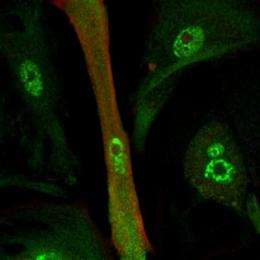
tCardiomyocyte (center), showing protein distribution (green and red colors) indicative of a young cardiomyocyte. Credit: Tae Kyung Kim, PhD, Perelman School of Medicine, University of Pennsylvania
For the past decade, researchers have tried to reprogram the identity of all kinds of cell types. Heart cells are one of the most sought-after cells in regenerative medicine because researchers anticipate that they may help to repair injured hearts by replacing lost tissue. Now, researchers at the Perelman School of Medicine at the University of Pennsylvania are the first to demonstrate the direct conversion of a non-heart cell type into a heart cell by RNA transfer. Working on the idea that the signature of a cell is defined by molecules called messenger RNAs (mRNAs), which contain the chemical blueprint for how to make a protein, the investigators changed two different cell types, an astrocyte (a star-shaped brain cell) and a fibroblast (a skin cell), into a heart cell, using mRNAs.
James Eberwine, PhD, the Elmer Holmes Bobst Professor of Pharmacology, Tae Kyung Kim, PhD, post-doctoral fellow, and colleagues report their findings online this week in the Proceedings of the National Academy of Sciences. This approach offers the possibility for cell-based therapy for cardiovascular diseases.
"What's new about this approach for heart-cell generation is that we directly converted one cell type to another using RNA, without an intermediate step," explains Eberwine. The scientists put an excess of heart cell mRNAs into either astrocytes or fibroblasts using lipid-mediated transfection, and the host cell does the rest. These RNA populations (through translation or by modulation of the expression of other RNAs) direct DNA in the host nucleus to change the cell's RNA populations to that of the destination cell type (heart cell, or tCardiomyocyte), which in turn changes the phenotype of the host cell into the destination cell.
The method the group used, called Transcriptome Induced Phenotype Remodeling, or TIPeR, is distinct from the induced pluripotent stem cell (iPS) approach used by many labs in that host cells do not have to be dedifferentiated to a pluripotent state and then redifferentiated with growth factors to the destination cell type. TIPeR is more similar to prior nuclear transfer work in which the nucleus of one cell is transferred into another cell where upon the transferred nucleus then directs the cell to change its phenotype based upon the RNAs that are made. The tCardiomyocyte work follows directly from earlier work from the Eberwine lab, where neurons were converted into tAstrocytes using the TIPeR process.
The team first extracted mRNA from a heart cell, then put it into host cells. Because there are now so many more heart-cell mRNAs versus astrocyte or fibroblast mRNAs, they take over the indigenous RNA population. The heart-cell mRNAs are translated into heart-cell proteins in the cell cytoplasm. These heart-cell proteins then influence gene expression in the host nucleus so that heart-cell genes are turned on and heart-cell-enriched proteins are made.
To track the change from an astrocyte to heart cell, the team looked at the new cells' RNA profile using single cell microarray analysis; cell shape; and immunological and electrical properties. While TIPeR-generated tCardiomyocytes are of significant use in fundamental science it is easy to envision their potential use to screen for heart cell therapeutics, say the study authors. What's more, creation of tCardiomyoctes from patients would permit personalized screening for efficacy of drug treatments; screening of new drugs; and potentially as a cellular therapeutic.
Provided by
University of Pennsylvania School of Medicine
-
Scientists use RNA to reprogram one cell type into another
Apr 16, 2009 |
not rated yet |
0
-
Why is the heart heart-shaped?
Feb 20, 2007 |
not rated yet |
0
-
Scientists identify role of tiny RNAs in controlling stem cell fate
Mar 05, 2008 |
not rated yet |
0
-
Scientists discover new method for regenerating heart muscle by direct reprogramming
Aug 05, 2010 |
not rated yet |
0
-
Researchers gain new insights on spinal muscular atrophy
May 29, 2008 |
not rated yet |
0
-
Motion perception revisited: High Phi effect challenges established motion perception assumptions
Apr 23, 2013 |
3 / 5 (2) |
2
-
Anything you can do I can do better: Neuromolecular foundations of the superiority illusion (Update)
Apr 02, 2013 |
4.5 / 5 (11) |
5
-
The visual system as economist: Neural resource allocation in visual adaptation
Mar 30, 2013 |
5 / 5 (2) |
9
-
Separate lives: Neuronal and organismal lifespans decoupled
Mar 27, 2013 |
4.9 / 5 (8) |
0
-
Sizing things up: The evolutionary neurobiology of scale invariance
Feb 28, 2013 |
4.8 / 5 (10) |
14
-
Why is zone 1 in liver more prone to ischemic injury?
22 hours ago
-
How can there be villous adenoma in colon, if there are no villi there
May 22, 2013
-
How can there be a term called "intestinal metaplasia" of stomach
May 21, 2013
-
Pressure-volume curve: Elastic Recoil Pressure don't make sense
May 18, 2013
-
If you became brain-dead, would you want them to pull the plug?
May 17, 2013
-
MRI bill question
May 15, 2013
- More from Physics Forums - Medical Sciences
More news stories
Study reveals new mechanism for estrogen suppression of liver lipid synthesis
By discovering the new mechanism by which estrogen suppresses lipid synthesis in the liver, UC Irvine endocrinologists have revealed a potential new approach toward treating certain liver diseases.
Medical research
10 hours ago |
not rated yet |
0
|
MRI-based measurement helps predict vascular disease in the brain
Aortic arch pulse wave velocity, a measure of arterial stiffness, is a strong independent predictor of disease of the vessels that supply blood to the brain, according to a new study published in the June issue the journal ...
Medical research
10 hours ago |
not rated yet |
0
Antibiotics: A new understanding of sulfonamide nervous system side effects
Since the discovery of Prontosil in 1932, sulfonamide antibiotics have been used to combat a wide spectrum of bacterial infections, from acne to chlamydia and pneumonia. However, their side effects can include serious neurological ...
Medical research
12 hours ago |
not rated yet |
0
|
Scientists discover molecule triggers sensation of itch
Scientists at the National Institutes of Health report they have discovered in mouse studies that a small molecule released in the spinal cord triggers a process that is later experienced in the brain as ...
Medical research
12 hours ago |
5 / 5 (2) |
0
|
Discarded immune cells induce the relocation of stem cells
Spanish researchers have discovered that the daily clearance of neutrophils from the body stimulates the release of hematopoietic stem cells from the bone marrow into the bloodstream, according to a report published today ...
Medical research
13 hours ago |
5 / 5 (2) |
0
Controlling mood through the motions of mitochondria
(Medical Xpress)—Regulating the distribution of power in neurons is done by a system that makes the national electric grid look simple by comparison. Each neuron has several thousand mitochondria confined ...
Motion quotient: IQ predicted by ability to filter motion (w/ video)
A brief visual task can predict IQ, according to a new study. This surprisingly simple exercise measures the brain's unconscious ability to filter out visual movement. The study shows that individuals whose ...
Multiple research teams unable to confirm high-profile Alzheimer's study
Teams of highly respected Alzheimer's researchers failed to replicate what appeared to be breakthrough results for the treatment of this brain disease when they were published last year in the journal Science.
Researchers find common childhood asthma unconnected to allergens or inflammation
Little is known about why asthma develops, how it constricts the airway or why response to treatments varies between patients. Now, a team of researchers at Weill Cornell Medical College, Columbia University Medical Center ...
ACP issues recommendations for management of high blood glucose in hospitalized patients
High blood glucose is associated with poor outcomes in hospitalized patients, and use of intensive insulin therapy (IIT) to control hyperglycemia is a common practice in hospitals. But the recent evidence does not show a ...
Diabetes' genetic underpinnings can vary based on ethnic background, studies say
Ethnic background plays a surprisingly large role in how diabetes develops on a cellular level, according to two new studies led by researchers at the Stanford University School of Medicine.
Jul 08, 2011
Rank: not rated yet
Will 'completed' host designated cells ALWAYS BE LITERALLY INDISTINGUISHABLE from original cells of designation? If not, what are the markers?
We are talking 'permanent' cells here.
Jul 09, 2011
Rank: 3 / 5 (2)
Jul 09, 2011
Rank: 5 / 5 (2)
Jul 09, 2011
Rank: 5 / 5 (1)
A good question. The same question:
http://www.ncbi.n...BK28372/
with words;
""In the case of nerve cells it seems likely that cell turnover in the adult would be disadvantageous as a rule, since it would be difficult to reestablish in the adult the precise and complex patterns of nerve connections that are set up under very different circumstances during development. Moreover, any memories recorded in the form of slight modifications of the structure or interconnections of individual nerve cells would presumably be obliterated."
This hypothesis is the object of present day research.
The first step is to offer a working definition for a process that presently is vaguely defined as: 'Learning'.
What are the 'associative properties' of 'memory'?
Is it the "modifications of the structure or interconnections of individual nerve cells"?
There are a whole host of functions leading to "modifications" which are the objects of present day continued research and study.
Jul 09, 2011
Rank: 3 / 5 (2)
Individual brain cells contain no fragments of cognitive memory.
You are confused.
Jul 09, 2011
Rank: 3 / 5 (2)
The heartless are generally brainless, so will there be enough working material?
Jul 09, 2011
Rank: not rated yet
LOL I hadn't considered that. I think you're right too.