Killer Australian virus outbreak claims ninth horse
July 14, 2011 in Diseases, Conditions, Syndromes
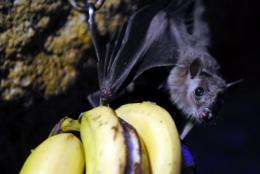
This file photo shows a fruit bat. A horse was put down in Australia on Thursday after contracting the deadly Hendra virus -- the ninth animal to die in an outbreak which has exposed almost 50 people in two states. Passed from fruit bats to horses and highly fatal to humans, a second case of Hendra was confirmed on a New South Wales farm.
A horse was put down in Australia after contracting the deadly Hendra virus -- the ninth animal to die in an outbreak which has exposed almost 50 people in two states.
Passed from fruit bats (flying foxes) to horses and highly fatal to humans, a second case of Hendra was confirmed on a New South Wales farm where one animal has already died and nine people were exposed to the virus.
"Results of laboratory tests yesterday revealed the surviving horse -- which was showing signs of illness for more than 24 hours -- was carrying the Hendra virus," said chief NSW veterinarian Ian Roth, on Thursday.
"It is believed that the horse became infected with Hendra following very close contact with the original infected horse."
At least 48 people have been exposed to Hendra in the past month in an outbreak which has spread from Cairns to within 500 kilometres (300 miles) of Sydney, worrying the city's thoroughbred race trainers.
No humans have yet been infected.
Hendra has killed four of the seven people who have contracted it since it was first identified 1994, but human infections are rare.
Named after the Brisbane suburb in which it was discovered, Hendra is thought to be unique to Australia and is spread from infected bats via half-chewed fruit or water and food contaminated by their urine and droppings.
(c) 2011 AFP
-
Fresh horse death as Australia virus spreads
Jul 07, 2011 |
not rated yet |
0
-
Horse virus hits Australia's tourist north
Jul 12, 2011 |
not rated yet |
0
-
Killer horse virus spreads in Australia
Jul 02, 2011 |
not rated yet |
0
-
Concern mounts over deadly Australian horse virus
Jul 06, 2011 |
not rated yet |
0
-
Anxious wait for Australians exposed to rare virus
Jun 30, 2011 |
not rated yet |
0
-
Motion perception revisited: High Phi effect challenges established motion perception assumptions
Apr 23, 2013 |
3 / 5 (2) |
2
-
Anything you can do I can do better: Neuromolecular foundations of the superiority illusion (Update)
Apr 02, 2013 |
4.5 / 5 (11) |
5
-
The visual system as economist: Neural resource allocation in visual adaptation
Mar 30, 2013 |
5 / 5 (2) |
9
-
Separate lives: Neuronal and organismal lifespans decoupled
Mar 27, 2013 |
4.9 / 5 (8) |
0
-
Sizing things up: The evolutionary neurobiology of scale invariance
Feb 28, 2013 |
4.8 / 5 (10) |
14
-
Classical and Quantum Mechanics via Lie algebras
Apr 15, 2011
- More from Physics Forums - Independent Research
More news stories
Report: NPS hantavirus response followed policy
(AP)—Federal investigators probing the hantavirus outbreak blamed for three deaths at Yosemite National Park recommend that design changes to tent cabins and other lodging run by private concessionaires first be reviewed ...
Diseases, Conditions, Syndromes
4 hours ago |
not rated yet |
0
New test better detects elephantiasis worm infection
A new diagnostic test for a worm infection that can lead to severe enlargement and deformities of the legs and genitals is far more sensitive than the currently used test, according to results of a field ...
Diseases, Conditions, Syndromes
5 hours ago |
not rated yet |
0
|
SARS-like virus claims new life in Saudi
A Saudi man who had contracted the coronavirus has died, raising the death toll in the kingdom from the SARS-like virus to 16, the health ministry announced on Monday on its Internet website.
Diseases, Conditions, Syndromes
6 hours ago |
not rated yet |
0
Telerehabilitation allows accurate assessment of patients with low back pain
A new "telerehabilitation" approach lets physical therapists assess patients with low back pain (LBP) over the Internet, with good accuracy compared with face-to-face examinations, reports a study in the May 15 issue of Sp ...
Diseases, Conditions, Syndromes
6 hours ago |
not rated yet |
0
Bronchodilators appear associated with increased risk of cardiovascular events
A study of older patients with chronic obstructive pulmonary disease (COPD) suggests that new use of the long-acting bronchodilators β-agonists and anticholinergics was associated with similar increased risks of cardiovascular ...
Diseases, Conditions, Syndromes
6 hours ago |
not rated yet |
0
The compound in the Mediterranean diet that makes cancer cells 'mortal'
New research suggests that a compound abundant in the Mediterranean diet takes away cancer cells' "superpower" to escape death. By altering a very specific step in gene regulation, this compound essentially re-educates cancer ...
Do salamanders hold the solution to regeneration?
Salamanders' immune systems are key to their remarkable ability to regrow limbs, and could also underpin their ability to regenerate spinal cords, brain tissue and even parts of their hearts, scientists have ...
Scientists identify molecular trigger for Alzheimer's disease
Researchers have pinpointed a catalytic trigger for the onset of Alzheimer's disease – when the fundamental structure of a protein molecule changes to cause a chain reaction that leads to the death of neurons ...
Practice makes perfect? Not so much
Turns out, that old "practice makes perfect" adage may be overblown. New research led by Michigan State University's Zach Hambrick finds that a copious amount of practice is not enough to explain why people ...
Older prostate cancer patients should think twice before undergoing treatment
Older prostate cancer patients with other underlying health conditions should think twice before committing to surgery or radiation therapy for their cancer, according to a multicenter study led by researchers in the UCLA ...
Researchers develop model for better testing, targeting of malignant peripheral nerve sheath tumors
University of Minnesota Medical School researchers from the Masonic Cancer Center, University of Minnesota, in partnership with the University's Brain Tumor Program, have developed a new mouse model of malignant peripheral ...