Latino teens key for campaigns reaching out to immigrant families, study finds
July 13, 2011 in Health
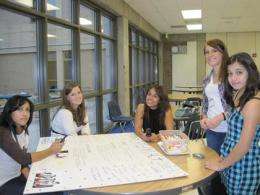
Working together on a project at Centaurus High School in 2009 are, from left to right, student Jasmin Castillo, former Public Achievement coach Jessica Ranglos, student Viridiana Jaquez, former Public Achievement coach Elizabeth Bury and student Yolanda Hernandez. Credit: Public Achievement
Latino adolescents who share knowledge from the classroom, new media and information technology among immigrant families function as "civic information leaders," a new study by the University of Colorado Boulder shows.
Their role helps family members assimilate to American culture and also represents a powerful channel through which to campaign to immigrant parents, according to journalism Associate Professor Mike McDevitt, lead author of the study.
"There is a reason for optimism, as opposed to despair, in thinking about the prospects for reaching a demographic typically portrayed in social science as chronically disengaged from civic and political life," said McDevitt.
"Schools, news media and campaign strategists should view adolescents as the most effective way to mobilize Latino families for active citizenship," he said. "They should not try to reach parents directly, but instead reach out to teens. This can trigger a trickle-up influence."
The study was conducted primarily with Latino participants from Centaurus High School in Lafayette, Colo. Surveys completed by 74 students served as the basis of four focus group discussions involving 53 students and parents. In addition, 12 students completed diaries tracking their media and information technology use over 48 hours.
The student participants were surveyed on their use of media and information technology for schoolwork, entertainment and social interaction. Their consumption of traditional resources -- radio, newspapers, magazines and television -- and newer tools -- the Internet, MP3 players, cellular telephones and texting -- was measured.
They also were surveyed on their political views, activities and willingness to discuss civic issues in school and in family settings. Participants rated their willingness to listen to opponents, initiate discussion and to disagree, among other questions.
"Latino adolescents' use of traditional media and particularly new information technology is perhaps more frequent than many would expect," said McDevitt. "Youth are tapped into general information and issue awareness, which builds confidence in the classroom and serves as a bridge to the home front, where parents are otherwise disconnected and distrusting of mainstream media."
The focus group discussions revealed that Latino youth and immigrant parents experience distinct sets of information sources that rarely overlap. School and media efforts aimed at increasing civic participation should strive to increase the overlap, said McDevitt.
Immigrant parents commonly face language barriers and the undocumented status of many of them causes fear of societal rejection and marginalization, according to the study. Many parents in the focus groups also reported shaky computer skills and a skepticism of English-language news media.
However, McDevitt said there is a downside to the dynamic of Latino teens serving as information leaders when immigrant parents feel their authority is undermined.
"Family communication can be thwarted when Latino youth act as information leaders, changing the usual structure of authority," said McDevitt. "On the other hand, these provocations can promote reciprocal influence in the family because parents want to keep up with their kids and retain a leadership role, particularly about controversial political issues."
The study recommends figuring out ways to preserve family cohesion, cultural identity and parental leadership while taking advantage of Latino youth's propensity for leadership in accessing and using new media.
"For many decades, political scientists have often ignored the family in terms of strategy for promoting political participation, or have viewed the family as a barrier, as a private domain that must be overcome," said McDevitt. "The family is not something to overcome; it's not a deficit; it's a resource for political engagement."
Mary Butler, a graduate of CU-Boulder's communication department, co-authored the study, which is published in the current issue of InterActions: UCLA Journal of Education and Information Studies.
Provided by
University of Colorado at Boulder
-
Latino teens happier, healthier if families embrace biculturalism
Jun 25, 2009 |
not rated yet |
0
-
Children of undocumented parents may be at higher developmental risk
Jul 13, 2009 |
not rated yet |
0
-
Young Latino children show strong classroom skills, despite many growing up in poverty
May 03, 2010 |
not rated yet |
0
-
Are Latino teens sexual risk takers? It's complicated, researcher says
Feb 22, 2010 |
not rated yet |
0
-
Parents fear sex advice will fall on deaf ears
Jan 07, 2011 |
not rated yet |
0
-
Of mice and mental models: Neuroscientific implications of risk-optimized behavior in the mouse
4 hours ago |
not rated yet |
0
-
Limits to growth: Scientists identify key metastasis-enabling enzyme
May 22, 2012 |
5 / 5 (3) |
0
-
Seeing is as seeing does: Spatially-structured retinal input in early development of cortical maps
Apr 26, 2012 |
5 / 5 (4) |
1
-
Dreamless nights: Brain activity during nonrapid eye movement sleep
Apr 09, 2012 |
4.4 / 5 (12) |
0
-
Take your time: Neurobiology sheds light on the superiority of spaced vs. massed learning
Mar 28, 2012 |
4.5 / 5 (21) |
3
-
Classical and Quantum Mechanics via Lie algebras
Apr 15, 2011
- More from Physics Forums - Independent Research
More news stories
Cancer patients share web info with docs for insight, advice
(HealthDay) -- Cancer patients' primary goal in talking with their doctors about information they've found on the Internet is to get more insight and advice on the online information, new research indicates.
Health
7 minutes ago |
not rated yet |
0
P&G to add latches to make detergent packs safer
(AP) -- Procter & Gamble says it will change the design of packaging for its miniature laundry detergent product to deter children from eating the brightly colored packets that look like candy.
Health
39 minutes ago |
not rated yet |
0
In Spain, 70 percent of women use contraceptives during their first sexual encounter
Contraceptive use in Spain during the first sexual encounter is similar to other European countries. However, there are some geographical differences between Spanish regions: women in Murcia use contraceptives ...
Health
1 hour ago |
not rated yet |
0
WHO target to cut early chronic illness deaths
The World Health Organization announced on Friday it was set to approve a new target to reduce premature deaths from chronic illnesses such as heart disease by a quarter by 2025.
Health
2 hours ago |
not rated yet |
0
Better response plans needed for children exposed to domestic violence
(Medical Xpress) -- Each year, millions of children are exposed to domestic violence, a traumatic experience that has been associated with cognitive, behavioral, social and emotional problems in childhood ...
Health
4 hours ago |
not rated yet |
0
More mental health care urged for kids who self-harm
(HealthDay) -- Doctors have long known that some kids suffering severe emotional turmoil find relief in physical pain -- cutting or burning or sticking themselves with pins to achieve a form of release.
Neck strength, cervical spine mobility don't predict pain
(HealthDay) -- Neither isometric neck muscle strength nor passive mobility of the cervical spine, two physical capacity parameters found to be associated with neck pain in other studies, predicts later neck ...
Cancer may require simpler genetic mutations than previously thought
Chromosomal deletions in DNA often involve just one of two gene copies inherited from either parent. But scientists haven't known how a deletion in one gene from one parent, called a "hemizygous" deletion, can contribute ...
Inherited DNA change explains overactive leukemia gene
A small inherited change in DNA is largely responsible for overactivating a gene linked to poor treatment response in people with acute leukemia.
Of mice and mental models: Neuroscientific implications of risk-optimized behavior in the mouse
(Medical Xpress) -- Regardless of an organism’s biological complexity, every encephalized animal continuously makes under-informed behavioral choices that can have serious consequences. Despite its ubiquity, ...
Implantable pain disk may help those with cancer
An estimated 3.5 million cancer patients around the globe are in severe pain from their disease, but many get no relief.