Neuroscientists uncover neural mechanisms of object recognition
July 13, 2011 in Neuroscience

Neuroscientists uncover neural mechanisms of object recognition

Enlarge

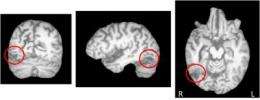
Certain brain injuries can cause people to lose the ability to visually recognize objects -- for example, confusing a harmonica for a cash register. Neuroscientists from Carnegie Mellon University and Princeton University examined the brain of a person with object agnosia, a deficit in the ability to recognize objects that does not include damage to the eyes or a general loss in intelligence, and have uncovered the neural mechanisms of object recognition. The results, published by Cell Press in the July 15th issue of the journal Neuron, describe the functional neuroanatomy of object agnosia and suggest that damage to the part of the brain critical for object recognition can have a widespread impact on remote parts of the cortex. These findings will force researchers to rethink basic assumptions of visual neuroscience. Credit: Carnegie Mellon University and Princeton University

Certain brain injuries can cause people to lose the ability to visually recognize objects — for example, confusing a harmonica for a cash register.

Neuroscientists from Carnegie Mellon University and Princeton University examined the brain of a person with object agnosia, a deficit in the ability to recognize objects that does not include damage to the eyes or a general loss in intelligence, and have uncovered the of . The results, published by Cell Press in the July 15th issue of the journal Neuron, describe the functional neuroanatomy of object agnosia and suggest that damage to the part of the brain critical for object recognition can have a widespread impact on remote parts of the cortex.

"One of the persisting controversies in the field of visual neuroscience concerns the regions of cortex that subserve the human ability to recognize objects as efficiently and accurately as we do, and it's been an elusive topic until now," said Marlene Behrmann, professor of psychology at CMU and a renowned expert in using brain imaging to study the visual perception system.

This video is not supported by your browser at this time.

To gain new insight into the neural basis of object recognition, the research team used neuroimaging and behavioral investigations to study visual and object-selective responses in the cortex of healthy controls and a participant called SM who, following selective brain damage to the right hemisphere of the brain, exhibited object agnosia.

The researchers discovered that the functional organization of the "lower" visual cortex, where the image from the retina is initially processed, was similar in SM and control subjects. However, SM exhibited decreased object-selective responses in the brain tissue in and around the brain lesion, and in more distant cortical areas that are also known to be involved in object recognition. Unexpectedly, the decrease in object-selective responses was also observed in corresponding locations of SM's structurally intact left hemisphere.

"What was perhaps the most dramatic, controversial and counter-intuitive result was that while the lesion was in the right hemisphere, and quite small, we found that the same region in the left hemisphere was also not operating normally," Behrmann said.

She added, "These results will force us in the field to step back a little and rethink the way we understand the relationship between brain and behavior. We now need to take into account that there are multiple parts of the brain that underlie object recognition, and damage to any one of those parts can essentially impair or decrease the ability to normally recognize objects."

Additionally, the researchers found that an area of the brain called the right lateral fusiform gyrus is vital for object recognition. There also appeared to be some functional reorganization in intact regions of SM's damaged right hemisphere, suggesting that neural plasticity is possible even when the brain is damaged in adulthood.

"To our knowledge, this study constitutes the most extensive functional analysis of the neural substrate underlying object agnosia and offers powerful evidence concerning the neural representations mediating object perception in normal vision," said Christina Konen, a postdoctoral fellow at Princeton and lead author of the study.

Provided by Carnegie Mellon University search and more info website

4.6 /5 (5 votes)  

Filter


Move the slider to adjust rank threshold, so that you can hide some of the comments.


Display comments: newest first

hush1
Jul 13, 2011

Rank: not rated yet
Without knowing the exact specifics or nature of the injury, I can assert with confidence the only missing link to this associative memory function is a single chemical substance deficiency. Why the brain is no longer able to balance out this deficiency I do not know. I'm sure you will tell me, eventually.
Rank 4.6 /5 (5 votes)
Related Stories
Relevant PhysicsForums posts

More news stories

Reducing caloric intake delays nerve cell loss

Activating an enzyme known to play a role in the anti-aging benefits of calorie restriction delays the loss of brain cells and preserves cognitive function in mice, according to a study published in the May ...

Neuroscience created 4 hours ago | popularity 5 / 5 (3) | comments 0 | with audio podcast

B vitamins could delay dementia

(Medical Xpress)—Despite spending billions of dollars on research and development, drug companies have been unable to come up with effective treatments for dementia and Alzheimer's Disease (AD). Now, A. ...

Neuroscience created 7 hours ago | popularity 4.8 / 5 (6) | comments 0 | with audio podcast report

Waiting for a sign? Researchers find potential brain 'switch' for new behavior

You're standing near an airport luggage carousel and your bag emerges on the conveyor belt, prompting you to spring into action. How does your brain make the shift from passively waiting to taking action when ...

Neuroscience created 8 hours ago | popularity 5 / 5 (1) | comments 0 | with audio podcast

If you can remember it, you can remember it wrong

(Medical Xpress)—Native peoples in regions where cameras are uncommon sometimes react with caution when their picture is taken. The fear that something must have been stolen from them to create the photo ...

Neuroscience created 9 hours ago | popularity 4 / 5 (4) | comments 0 | with audio podcast report

Study shows where scene context happens in our brain

In a remote fishing community in Venezuela, a lone fisherman sits on a cliff overlooking the southern Caribbean Sea. This man –– the lookout –– is responsible for directing his comrades on the water, ...

Neuroscience created 11 hours ago | popularity 4 / 5 (1) | comments 0 | with audio podcast


New sleeping pill poised to hit US markets

An experimental sleeping pill from US drug company Merck is effective at helping people fall and stay asleep, according to reviewers at the US Food and Drug Administration, which could soon approve the new drug.

Antidepressant reduces stress-induced heart condition

A drug commonly used to treat depression and anxiety may improve a stress-related heart condition in people with stable coronary heart disease, according to researchers at Duke Medicine.

Insight into the dazzling impact of insulin in cells

Australian scientists have charted the path of insulin action in cells in precise detail like never before. This provides a comprehensive blueprint for understanding what goes wrong in diabetes.

Changing cancer's environment to halt its spread

By studying the roles two proteins, thrombospondin-1 and prosaposin, play in discouraging cancer metastasis, a trans-Atlantic research team has identified a five-amino acid fragment of prosaposin that significantly reduces ...

Drugs found to both prevent and treat Alzheimer's disease in mice

Researchers at USC have found that a class of pharmaceuticals can both prevent and treat Alzheimer's Disease in mice.

Biomarkers discovered for inflammatory bowel disease

Using the Department of Defense Serum Repository (DoDSR), University of Cincinnati (UC) researchers have identified a number of biomarkers for inflammatory bowel disease (IBD), which could help with earlier diagnosis and ...