Neutralizing HIV

July 18, 2011 in HIV & AIDS
Neutralizing HIV

Enlarge

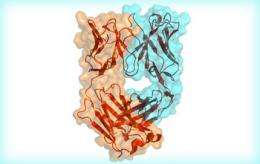
The Fab crystal structure and surface representations from 3BNC60, one of the most potent anti-HIV antibodies isolated in the study.(Credit: Ron Diskin / Caltech)

Each time a virus invades a healthy individual, antibodies created by the body fight to fend off the intruders. For some viruses, like HIV, the antibodies are very specific and are generated too slowly to combat the rapidly changing virus. However, in the past few years, scientists have found that some HIV-positive people develop highly potent antibodies that can neutralize different subtypes of the HIV virus.

Now, a study involving researchers at Caltech points to the possibility of using these in the development of a vaccine. The paper, published in the July 14 issue of , describes a group of novel antibodies that were isolated from HIV-infected individuals using a new cloning approach.

These antibodies are the most potent anti-HIV antibodies targeting the CD4 binding site— a functional site on the surface of needed for cell entry and infection—that have ever been identified, says Ron Diskin, a post-doctoral scholar at Caltech who worked on the paper. David Ho (BS '74), scientific director of the Aaron Diamond AIDS Research Center in New York, also contributed to the study, which was led by researchers at Rockefeller University.

At Caltech, the researchers conducted structural studies and were able to show, based on similarity to a previously known antibody (VRC01), that the new antibodies indeed target the CD4 receptor binding site. CD4 positive cells are the point of HIV infection and where the virus multiplies.

This study is important for several different reasons, according to Diskin. "First, it provides extremely useful reagents that can be used for passive immunization to treat infected individuals," he says. "Second, it demonstrates that a comparable and highly effective anti-HIV immune response was elicited in different individuals, which strongly supports the idea that an effective vaccine will be feasible to develop."

Next, researchers at Caltech will address the structural mechanisms that make those antibodies so potent. In fact, they are currently investigating those structural aspects of the neutralization mechanisms.

"We're very excited to have the opportunity to use structural biology to learn what makes these new antibodies so potent against HIV," says Pamela Bjorkman, Caltech's Delbruck Professor of Biology and a co-author of the study. "We hope that visualizing how these antibodies interact with HIV proteins will allow the design of even more potent anti-HIV reagents and provide critical information for vaccine design."

Provided by California Institute of Technology search and more info website

5 /5 (1 vote)  

Rank 5 /5 (1 vote)
Relevant PhysicsForums posts

More news stories

Mortality rates decrease, chronic disease rates increase among HIV+ ICU patients

The expanded use of antiretrovirals, potent drugs used to treat retroviral infections such as human immunodeficiency virus (HIV), has been linked to significant decreases in hospital mortality rates among severely ill HIV-positive(HIV+) ...

HIV & AIDS created May 23, 2012 | popularity not rated yet | comments 0

Newly discovered breast milk antibodies help neutralize HIV

Antibodies that help to stop the HIV virus have been found in breast milk. Researchers at Duke University Medical Center isolated the antibodies from immune cells called B cells in the breast milk of infected mothers in Malawi, ...

HIV & AIDS created May 22, 2012 | popularity 5 / 5 (3) | comments 1 | with audio podcast

Reactions to HIV drug have autoimmune cause, reports AIDS journal

Potentially severe hypersensitivity reactions to the anti-HIV drug abacavir occur through an autoimmune mechanism, resulting from the creation of drug-induced immunogens that are attacked by the body's immune system, according ...

HIV & AIDS created May 22, 2012 | popularity 5 / 5 (1) | comments 0

Is the U.S. ready for home HIV tests?

At the pharmacy, you can buy anything from tea kettles to Tylenol. But what if you could buy a rapid HIV test over the counter and test yourself in the privacy of your own home?

HIV & AIDS created May 21, 2012 | popularity not rated yet | comments 0 | with audio podcast

Reduced glycerin formulation of tenofovir vaginal gel safe for rectal use

A change in the formulation of tenofovir gel, an anti-HIV gel developed for vaginal use, may make it safer to use in the rectum, suggests a study published online this week in the Journal of Antimicrobial Chemotherapy. In lab ...

HIV & AIDS created May 17, 2012 | popularity 5 / 5 (1) | comments 0


Common therapies for basal cell carcinoma offer similar survival

(HealthDay) -- For patients with superficial basal cell carcinoma (sBCC), treatment with imiquimod or photodynamic therapy (PDT) results in similar long-term tumor-free survival, according to a review published ...

Pancreatectomy OK without downstaging from therapy

(HealthDay) -- Pancreatectomy improves median survival in pancreatic cancer patients even when presurgical neoadjuvant therapy does not lead to radiographic downstaging of tumors, according to a study published ...

One-fifth of healthy middle-aged men have low-grade murmur

(HealthDay) -- More than one-fifth of healthy middle-aged men have a low-grade systolic heart murmur that confers a nearly five-fold higher risk of future aortic valve replacement (AVR), according to a study ...

Cancer may require simpler genetic mutations than previously thought

Chromosomal deletions in DNA often involve just one of two gene copies inherited from either parent. But scientists haven't known how a deletion in one gene from one parent, called a "hemizygous" deletion, can contribute ...

Of mice and mental models: Neuroscientific implications of risk-optimized behavior in the mouse

(Medical Xpress) -- Regardless of an organism’s biological complexity, every encephalized animal continuously makes under-informed behavioral choices that can have serious consequences. Despite its ubiquity, ...

Inherited DNA change explains overactive leukemia gene

A small inherited change in DNA is largely responsible for overactivating a gene linked to poor treatment response in people with acute leukemia.