Dry onion skin has a use
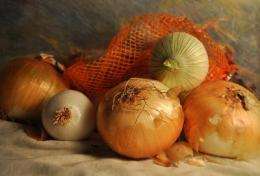
The brown skin and external layers of the onions are rich in fiber and flavonoids. Credit: SINC
More than 500,000 tonnes of onion waste are thrown away in the European Union each year. However, scientists say this could have a use as food ingredients. The brown skin and external layers are rich in fibre and flavonoids, while the discarded bulbs contain sulphurous compounds and fructans. All of these substances are beneficial to health.
Production of onion waste has risen over recent years in line with the growing demand for these bulbs. More than 500,000 tonnes of waste are generated in the European Union each year, above all in Spain, Holland and the United Kingdom, where it has become an environmental problem. The waste includes the dry brown skin, the outer layers, roots and stalks, as well as onions that are not big enough to be of commercial use, or onions that are damaged.
"One solution could be to use onion waste as a natural source of ingredients with high functional value, because this vegetable is rich in compounds that provide benefits for human health", Vanesa Benítez, a researcher at the Department of Agricultural Chemistry at the Autonomous University of Madrid (Spain), tells SINC.
Benítez's research group worked with scientists from Cranfield University (United Kingdom) to carry out laboratory experiments to identify the substances and possible uses of each part of the onion. The results have been published in the journal Plant Foods for Human Nutrition.
According to the study, the brown skin could be used as a functional ingredient high in dietary fibre (principally the non-soluble type) and phenolic compounds, such as quercetin and other flavonoids (plant metabolites with medicinal properties). The two outer fleshy layers of the onion also contain fibre and flavonoids.
"Eating fibre reduces the risk of suffering from cardiovascular disease, gastrointestinal complaints, colon cancer, type-2 diabetes and obesity", the researcher points out.
Phenolic compounds, meanwhile, help to prevent coronary disease and have anti-carcinogenic properties. The high levels of these compounds in the dry skin and the outer layers of the bulbs also give them high antioxidant capacity.
Meanwhile, the researchers suggest using the internal parts and whole onions that are thrown away as a source of fructans and sulphurous compounds. Fructans are prebiotics, in other words they have beneficial health effects as they selectively stimulate the growth and activity of bacteria in the colon.
Sulphurous compounds reduce the accumulation of platelets, improving blood flow and cardiovascular health in general. They also have a positive effect on antioxidant and anti-inflammatory systems in mammals.
"The results show that it would be useful to separate the different parts of onions produced during the industrial process", explains Benítez. "This would enable them to be used as a source of functional compounds to be added to other foodstuffs".
Provided by FECYT - Spanish Foundation for Science and Technology
-
The onion, a natural alternative to artificial preservatives
Apr 14, 2010 |
not rated yet |
0
-
New insights into how natural antioxidants fight fat
Nov 05, 2007 |
not rated yet |
0
-
Naturally-occurring apple compounds reduce risk of pancreatic cancer
Oct 03, 2007 |
not rated yet |
0
-
Ingredient in tequila plant may fight osteoporosis and other diseases
Mar 23, 2010 |
not rated yet |
0
-
Luteolin stars in study of healthful plant compounds
Jul 08, 2010 |
not rated yet |
0
-
Motion perception revisited: High Phi effect challenges established motion perception assumptions
Apr 23, 2013 |
3 / 5 (2) |
2
-
Anything you can do I can do better: Neuromolecular foundations of the superiority illusion (Update)
Apr 02, 2013 |
4.5 / 5 (11) |
5
-
The visual system as economist: Neural resource allocation in visual adaptation
Mar 30, 2013 |
5 / 5 (2) |
9
-
Separate lives: Neuronal and organismal lifespans decoupled
Mar 27, 2013 |
4.9 / 5 (8) |
0
-
Sizing things up: The evolutionary neurobiology of scale invariance
Feb 28, 2013 |
4.8 / 5 (10) |
14
-
How can there be villous adenoma in colon, if there are no villi there
17 hours ago
-
How can there be a term called "intestinal metaplasia" of stomach
May 21, 2013
-
Pressure-volume curve: Elastic Recoil Pressure don't make sense
May 18, 2013
-
If you became brain-dead, would you want them to pull the plug?
May 17, 2013
-
MRI bill question
May 15, 2013
-
Ratio of Hydrogen of Oxygen in Dessicated Animal Protein
May 13, 2013
- More from Physics Forums - Medical Sciences
More news stories
American cancer society celebrates 100 years of progress
(HealthDay)—The American Cancer Society, which is celebrating on Wednesday a century of fighting a disease once viewed as a death sentence, is making a pledge to put itself out of business.
Cancer
7 hours ago |
not rated yet |
0
CT detects twice as many lung cancers as X-ray at initial screening exam
National Lung Screening Trial (NLST) investigators also conclude that the 20 percent reduction in lung cancer mortality with low-dose computed tomography (LDCT) versus chest X-ray (CXR) screening previously reported in the ...
Cancer
7 hours ago |
not rated yet |
0
Research offers promising new approach to treatment of lung cancer
Researchers have developed a new drug delivery system that allows inhalation of chemotherapeutic drugs to help treat lung cancer, and in laboratory and animal tests it appears to reduce the systemic damage ...
Cancer
11 hours ago |
not rated yet |
0
|
Study details genes that control whether tumors adapt or die when faced with p53 activating drugs
When turned on, the gene p53 turns off cancer. However, when existing drugs boost p53, only a few tumors die – the rest resist the challenge. A study published in the journal Cell Reports shows how: tumors that live even i ...
Cancer
11 hours ago |
not rated yet |
0
|
Small increase in cancer risk following CT scans in childhood and adolescence
Study leader, Professor John Mathews from the University of Melbourne said this small increase in cancer risk must be weighed against the undoubted benefits from CT scans in diagnosing and monitoring disease.
Cancer
15 hours ago |
not rated yet |
0
Rate of bicycle-related fatalities significantly lower in states with helmet laws
Existing research shows that bicyclists who wear helmets have an 88 percent lower risk of brain injury, but researchers at Boston Children's Hospital found that simply having bicycle helmet laws in place showed a 20 percent ...
Slowing the aging process—only with antibiotics
Swiss scientists reveal the mechanism responsible for aging hidden deep within mitochondria—and dramatically slow it down in worms by administering antibiotics to the young.
Researchers complete largest genetic sequencing study of human disease
Researchers from Queen Mary, University of London have led the largest sequencing study of human disease to date, investigating the genetic basis of six autoimmune diseases.
Brain can be trained in compassion, study shows
Until now, little was scientifically known about the human potential to cultivate compassion—the emotional state of caring for people who are suffering in a way that motivates altruistic behavior.
Having both migraines, depression may mean smaller brain
(HealthDay)—Migraines and depression can each cause a great deal of suffering, but new research indicates the combination of the two may be linked to something else entirely—a smaller brain.
Novel approach for influenza vaccination shows promise in early animal testing
A new approach for immunizing against influenza elicited a more potent immune response and broader protection than the currently licensed seasonal influenza vaccines when tested in mice and ferrets. The vaccine ...