Researchers discover origin of the Black Death
August 30, 2011 by Chantall Van Raay in Diseases, Conditions, Syndromes
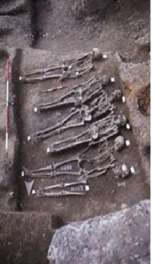
The excavation site at East Smithfield. Hendrik Poinar, an evolutionary geneticist at McMaster, has identified the bacteria responsible for causing the 1348 Black Death. Photo reproduced courtesy of the Museum of London
(Medical Xpress) -- The bacteria responsible for causing the 1348 Black Death, identified as one of the most cataclysmic events in human history, has been identified by a McMaster researcher.
Using a novel method of DNA enrichment coupled with high-throughput DNA sequencing, Hendrik Poinar, an evolutionary geneticist and member of McMaster's Michael G. DeGroote Institute for Infectious Disease Research (IIDR), graduate student Kirsti Bos and collaborator Johannes Krause of the University of Tubingen have discovered that the now-extinct version of the Yersinia pestis bacterium initiated the bug that caused 30-50 million European deaths between 1347 and 1351. Never before have researchers understood the cause of the plague, which continues to claim some 2,000 deaths a year worldwide.
"The Black Death is arguably one of the most dramatic examples ever of emerging or re-emerging disease," said Poinar, noting his study suggests this plague was the second of three pandemics, starting with the Plague of Justinian in 541 AD and culminating with the 20th century's modern pandemic. "By studying the origin of this disease it may yield information concerning the organism's evolutionary history as a human pathogen."
"Black death killed 50 million people in Europe in 1348 and spread from China through the Middle East to Turkey, Messina, Sicily and into the ports of Genoa and into London and then to Paris," he said. "One-third of the population of Europe died and the question in the beginning was, 'What was the bug that started it?'"
Poinar and Bos discovered that individuals buried at East Smithfield, a mass grave site on the outskirts of London in 1349, harboured Yersinia pestis genes after analyzing the DNA of 109 human skeletal remains. His group also studied the DNA of the remains of 10 humans unearthed at St. Nicholas Shambles, a site pre-dating the Black Death medieval plague.
Preliminary data presented in this work suggest that the Black Death pathogen may be a now-extinct variant. Poinar said the bacteria was thought to be particularly virulent in 1348 and acted on genes that facilitated transmission caused by flea bites, encouraging bacterial proliferation in the respiratory system during bouts of pneumonia.
"Our next goal is to sequence the entire DNA, and I am confident that this new technique will lead to answers that will change our understanding of the history of plague and our concept of emerging and re-emerging diseases," he said.
The research, which appears in Proceedings of the National Academy of Sciences, was supported by an IIDR collaborative grant with collaborators Brian Coombes, assistant professor of biochemistry and biomedical sciences and David Earn, professor of mathematics and statistics. Funding was also received from the Canadian Institutes for Health Research and Social Sciences and Humanities Research Council and Canadian Research Chairs.
Provided by
McMaster University
-
Cause of the big plague epidemic of Middle Ages identified
Oct 11, 2010 |
not rated yet |
0
-
New discovery in battle against plague and bacterial pneumonias
Jun 27, 2011 |
not rated yet |
0
-
From mild-mannered to killer plague: New study explains plague's rapid evolution
Aug 29, 2011 |
not rated yet |
0
-
Mimic molecules to protect against plague
Jul 04, 2008 |
not rated yet |
0
-
Ill. scientist dies, possible plague bacteria link
Sep 20, 2009 |
not rated yet |
0
-
Motion perception revisited: High Phi effect challenges established motion perception assumptions
Apr 23, 2013 |
3 / 5 (2) |
2
-
Anything you can do I can do better: Neuromolecular foundations of the superiority illusion (Update)
Apr 02, 2013 |
4.5 / 5 (11) |
5
-
The visual system as economist: Neural resource allocation in visual adaptation
Mar 30, 2013 |
5 / 5 (2) |
9
-
Separate lives: Neuronal and organismal lifespans decoupled
Mar 27, 2013 |
4.9 / 5 (8) |
0
-
Sizing things up: The evolutionary neurobiology of scale invariance
Feb 28, 2013 |
4.8 / 5 (10) |
14
-
Classical and Quantum Mechanics via Lie algebras
Apr 15, 2011
- More from Physics Forums - Independent Research
More news stories
WHO: Scientific red tape mars efforts vs. virus
International efforts to combat a new pneumonia-like virus that has now killed 22 people are being slowed by unclear rules and competition for the potentially profitable rights to disease samples, the head ...
Diseases, Conditions, Syndromes
8 hours ago |
not rated yet |
0
Shortage of key drug hampering U.S. efforts to control TB, report says
(HealthDay)—A shortage of a critical tuberculosis drug has hampered the efforts of health departments across the United States to contain the spread of the highly infectious lung disease, federal officials ...
Diseases, Conditions, Syndromes
9 hours ago |
not rated yet |
0
Heart healthy lifestyle may cut kidney disease patients' risk of kidney failure
Maintaining a heart healthy lifestyle may also help protect chronic kidney disease patients from developing kidney failure and dying prematurely, according to a study appearing in an upcoming issue of the Journal of the Am ...
Diseases, Conditions, Syndromes
9 hours ago |
not rated yet |
0
Flu vaccine also linked to narcolepsy in adults, study reports
Finnish researchers unveiled new data Thursday to link the Pandemrix flu vaccine to a higher risk of the sleeping disorder narcolepsy in adults.
Diseases, Conditions, Syndromes
10 hours ago |
not rated yet |
0
Second child contracts polio in Pakistan's Waziristan
A second child has contracted polio in a restive Pakistani tribal region near the Afghan border after the Taliban banned vaccinations there nearly a year ago, a UN official said Thursday.
Diseases, Conditions, Syndromes
10 hours ago |
not rated yet |
0
Controlling mood through the motions of mitochondria
(Medical Xpress)—Regulating the distribution of power in neurons is done by a system that makes the national electric grid look simple by comparison. Each neuron has several thousand mitochondria confined ...
Motion quotient: IQ predicted by ability to filter motion (w/ video)
A brief visual task can predict IQ, according to a new study. This surprisingly simple exercise measures the brain's unconscious ability to filter out visual movement. The study shows that individuals whose ...
Multiple research teams unable to confirm high-profile Alzheimer's study
Teams of highly respected Alzheimer's researchers failed to replicate what appeared to be breakthrough results for the treatment of this brain disease when they were published last year in the journal Science.
Scientists discover molecule triggers sensation of itch
Scientists at the National Institutes of Health report they have discovered in mouse studies that a small molecule released in the spinal cord triggers a process that is later experienced in the brain as ...
Researchers find common childhood asthma unconnected to allergens or inflammation
Little is known about why asthma develops, how it constricts the airway or why response to treatments varies between patients. Now, a team of researchers at Weill Cornell Medical College, Columbia University Medical Center ...
Diabetes' genetic underpinnings can vary based on ethnic background, studies say
Ethnic background plays a surprisingly large role in how diabetes develops on a cellular level, according to two new studies led by researchers at the Stanford University School of Medicine.