No bones about it: Eating dried plums helps prevent fractures and osteoporosis
August 18, 2011 in Health
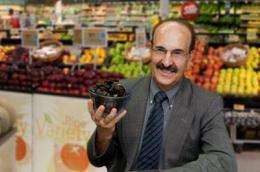
Bahram Arjmandi is Florida State's Margaret A. Sitton Professor and chairman of the Department of Nutrition, Food and Exercise Science. Credit: FSU Photography Services
When it comes to improving bone health in postmenopausal women and people of all ages, actually a Florida State University researcher has found a simple, proactive solution to help prevent fractures and osteoporosis: eating dried plums.
"Over my career, I have tested numerous fruits, including figs, dates, strawberries and raisins, and none of them come anywhere close to having the effect on bone density that dried plums, or prunes, have," said Bahram H. Arjmandi, Florida State's Margaret A. Sitton Professor and chairman of the Department of Nutrition, Food and Exercise Sciences in the College of Human Sciences. "All fruits and vegetables have a positive effect on nutrition, but in terms of bone health, this particular food is exceptional."
Arjmandi and a group of researchers from Florida State and Oklahoma State University tested two groups of postmenopausal women. Over a 12-month period, the first group, consisting of 55 women, was instructed to consume 100 grams of dried plums (about 10 prunes) each day, while the second a comparative control group of 45 women was told to consume 100 grams of dried apples. All of the study's participants also received daily doses of calcium (500 milligrams) and vitamin D (400 international units).
The group that consumed dried plums had significantly higher bone mineral density in the ulna (one of two long bones in the forearm) and spine, in comparison with the group that ate dried apples. This, according to Arjmandi, was due in part to the ability of dried plums to suppress the rate of bone resorption, or the breakdown of bone, which tends to exceed the rate of new bone growth as people age.
The group's research, "Comparative Effects of Dried Plum and Dried Apple on Bone in Post Menopausal Women," was published in the British Journal of Nutrition. Arjmandi conducted the research with his graduate students Shirin Hooshmand, Sheau C. Chai and Raz L. Saadat of the College of Human Sciences; Dr. Kenneth Brummel-Smith, Florida State's Charlotte Edwards Maguire Professor and chairman of the Department of Geriatrics in the College of Medicine; and Oklahoma State University statistics Professor Mark E. Payton.
In the United States, about 8 million women have osteoporosis because of the sudden cessation of ovarian hormone production at the onset of menopause. What's more, about 2 million men also have osteoporosis.
"In the first five to seven postmenopausal years, women are at risk of losing bone at a rate of 3 to 5 percent per year," Arjmandi said. "However, osteoporosis is not exclusive to women and, indeed, around the age of 65, men start losing bone with the same rapidity as women."
Arjmandi encourages people who are interested in maintaining or improving their bone health to take note of the extraordinarily positive effect that dried plums have on bone density.
"Don't wait until you get a fracture or you are diagnosed with osteoporosis and have to have prescribed medicine," Arjmandi said. "Do something meaningful and practical beforehand. People could start eating two to three dried plums per day and increase gradually to perhaps six to 10 per day. Prunes can be eaten in all forms and can be included in a variety of recipes."
Provided by
Florida State University
-
'Apple a day' advice rooted in science
Apr 12, 2011 |
not rated yet |
0
-
Bones restored with dried plum in aging mice
Oct 06, 2010 |
not rated yet |
0
-
HIV-infected postmenopausal women at high risk for bone fractures
Jan 05, 2010 |
not rated yet |
0
-
Yearly zoledronic acid at lower-than-standard doses increases bone density
Jun 06, 2011 |
not rated yet |
0
-
Study examines loop diuretic use and fractures in postmenopausal women
Jan 26, 2009 |
not rated yet |
0
-
Of mice and mental models: Neuroscientific implications of risk-optimized behavior in the mouse
10 hours ago |
not rated yet |
0
-
Limits to growth: Scientists identify key metastasis-enabling enzyme
May 22, 2012 |
5 / 5 (3) |
0
-
Seeing is as seeing does: Spatially-structured retinal input in early development of cortical maps
Apr 26, 2012 |
5 / 5 (4) |
1
-
Dreamless nights: Brain activity during nonrapid eye movement sleep
Apr 09, 2012 |
4.4 / 5 (12) |
0
-
Take your time: Neurobiology sheds light on the superiority of spaced vs. massed learning
Mar 28, 2012 |
4.5 / 5 (21) |
3
-
Classical and Quantum Mechanics via Lie algebras
Apr 15, 2011
- More from Physics Forums - Independent Research
More news stories
Most occupational injury and illness costs are paid by the government and private payers
UC Davis researchers have found that workers' compensation insurance is not used nearly as much as it should be to cover the nation's multi-billion dollar price tag for workplace illnesses and injuries. Instead, almost 80 ...
Health
1 hour ago |
not rated yet |
0
Early physical therapist treatment associated with reduced risk of healthcare utilization and reduced overall healthcare
A new study published in Spine shows that early treatment by a physical therapist for low back pain (LBP), as compared to delayed treatment, was associated with reduced risk of subsequent healthcare utilization and lower ...
Health
4 hours ago |
not rated yet |
0
|
Cancer patients share web info with docs for insight, advice
(HealthDay) -- Cancer patients' primary goal in talking with their doctors about information they've found on the Internet is to get more insight and advice on the online information, new research indicates.
Health
6 hours ago |
not rated yet |
0
P&G to add latches to make detergent packs safer
(AP) -- Procter & Gamble says it will change the design of packaging for its miniature laundry detergent product to deter children from eating the brightly colored packets that look like candy.
Health
7 hours ago |
not rated yet |
0
In Spain, 70 percent of women use contraceptives during their first sexual encounter
Contraceptive use in Spain during the first sexual encounter is similar to other European countries. However, there are some geographical differences between Spanish regions: women in Murcia use contraceptives ...
Health
8 hours ago |
not rated yet |
0
Tongue analysis software uses ancient Chinese medicine to warn of disease
For 5,000 years, the Chinese have used a system of medicine based on the flow and balance of positive and negative energies in the body. In this system, the appearance of the tongue is one of the measures used to classify ...
Of mice and mental models: Neuroscientific implications of risk-optimized behavior in the mouse
(Medical Xpress) -- Regardless of an organism’s biological complexity, every encephalized animal continuously makes under-informed behavioral choices that can have serious consequences. Despite its ubiquity, ...
Skp2 activates cancer-promoting, glucose-processing Akt
HER2 and its epidermal growth factor receptor cousins mobilize a specialized protein to activate a major player in cancer development and sugar metabolism, scientists report in the May 25 issue of Cell.
Cancer may require simpler genetic mutations than previously thought
Chromosomal deletions in DNA often involve just one of two gene copies inherited from either parent. But scientists haven't known how a deletion in one gene from one parent, called a "hemizygous" deletion, can contribute ...
Inherited DNA change explains overactive leukemia gene
A small inherited change in DNA is largely responsible for overactivating a gene linked to poor treatment response in people with acute leukemia.
New device allows pacemaker patients to safely undergo MRIs
For many, it's a medical conundrum: The very pacemaker keeping their heart in rhythm prevents them from undergoing an MRI to diagnose other ailments, because interaction between the two devices could prove deadly.
Aug 19, 2011
Rank: 1 / 5 (1)